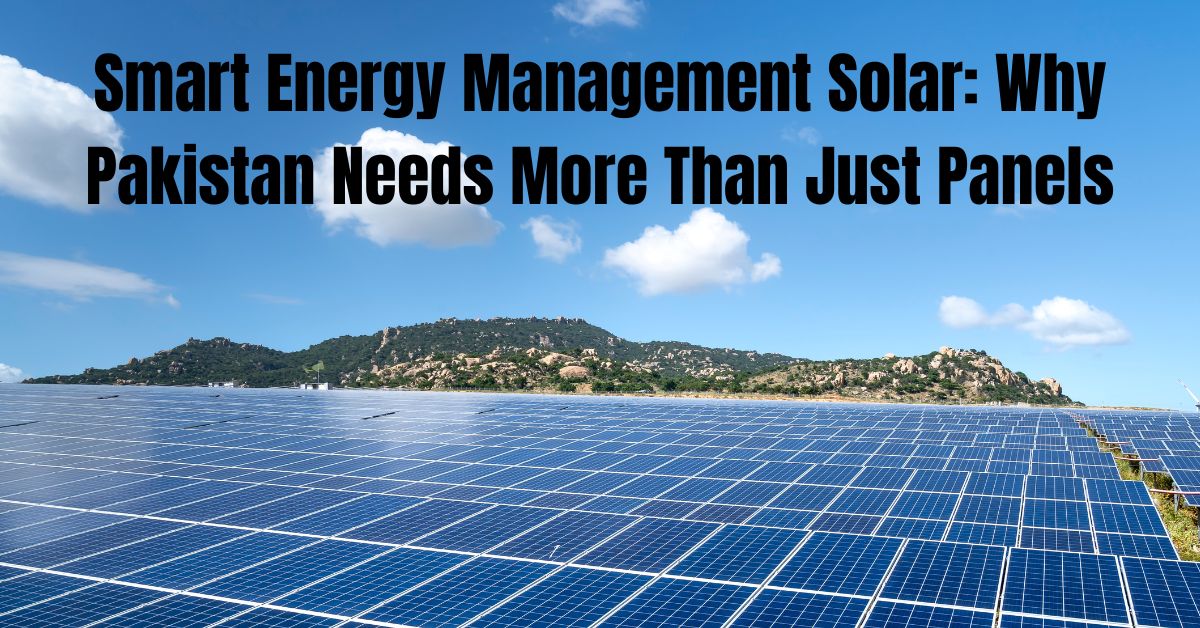
Smart Energy Management for Solar Systems in Pakistan: 2026 Guide
Smart energy management is moving fast from a nice-to-have upgrade to something close to essential for solar owners in Pakistan. The reason isn’t hype it’s regulation. On February 9, 2026, NEPRA replaced the decade-old net metering framework with the new Prosumer Regulations, shifting the country from one-to-one energy credits to a net billing system. That single change makes it far more valuable to control when a home uses its solar power, rather than just exporting whatever isn’t used on the spot and collecting the old rate for it.
This guide breaks down what smart energy management actually does, why it carries more weight in Pakistan this year than last, and which features are genuinely worth paying for.
Read More: Longi HiMo X10 Price in Pakistan 2026 — Complete Buyer’s Guide
What Is Smart Energy Management?
Smart energy management refers to the hardware and software that monitor, control, and optimize how a home or business produces, stores, and consumes electricity. Paired with a solar setup, it typically ties the inverter, battery, and grid connection into a single app or dashboard, then uses that data to decide automatically or with manual input where power should go at any given moment.
At its core, a system like this does three things: shows what’s happening in real time, decides what should happen next through automated optimization, and lets the owner override that decision whenever needed.
Ready to go solar? Get a free, no-obligation quote today.
Compare Other System Sizes → Get Free QuoteWhy This Matters More in Pakistan Right Now
Pakistan’s solar boom has created a problem that smart energy management is specifically built to solve. Distributed solar has grown quickly enough that daytime generation is now pushing close to saturating parts of the grid in some areas, which has shifted peak demand later into the evening precisely the hours solar panels can’t cover on their own. Closing that gap takes either battery storage that carries surplus daytime solar into the evening, or smarter consumption habits that shift usage toward daylight hours instead.
At the same time, the move to net billing means exporting surplus power no longer earns the same rate as importing it. Under the new rules, surplus electricity sent back to the grid is compensated at the National Average Energy Purchase Price, currently around Rs. 11 to Rs. 13 per unit, a noticeable drop from the roughly Rs. 22 to Rs. 27 per unit credited under the old one-to-one system.
That gap alone makes self-consumption using solar power directly, or storing it in a battery for evening use, considerably more valuable than it used to be. Smart energy management is the tool that actually makes self-consumption practical, rather than something managed by hand while watching the weather and guessing.
It’s worth noting who this affects: anyone with a net metering agreement signed before February 9, 2026 keeps their old 1:1 terms until that contract runs out, following a clarification NEPRA issued after public pushback. New applications, though, fall entirely under the new net billing framework, and new contracts are now locked in for 5 years rather than the previous 7.
Core Components of a Smart Energy Management System
Real-time monitoring
Forms the foundation. The system tracks generation, home consumption, and the flow to and from the battery and grid, all visible through an app or dashboard.
Load control
Lets the system manage individual appliances — cutting non-essential loads during a grid outage to stretch battery backup, or scheduling heavy appliances like water heaters and washing machines to run when solar output peaks.
Battery coordination
Decides when to charge, when to draw down, and how much reserve capacity to hold back for backup versus daily savings, for any system that includes storage.
Weather-aware automation
uses local forecasts on some platforms to anticipate a drop in solar output and adjust charging or consumption patterns ahead of time rather than reacting after the fact.
Alerts and diagnostics
Flag underperformance, unusual consumption spikes, or component faults, often before they turn into expensive repairs.
Read More: Solar Batteries in Pakistan 2026 Complete Guide with Prices and Brands
What Smart Energy Management Actually Saves You
Independent estimates put typical savings from smart home energy management somewhere between 10% and 25% on electricity costs, mainly through two mechanisms: shifting consumption to line up with solar generation, and avoiding peak-rate grid draw. In Pakistan, where grid tariffs keep climbing and often carry Fuel Charge Adjustments on top of the base rate, avoiding peak-hour grid usage tends to pay off more than it would in markets with flatter, more predictable pricing.
The other driver is simpler: visibility. Homeowners who can actually see their consumption patterns tend to adjust their behavior around what they notice, independent of any automation running in the background.
Key Features Worth Paying For
Not everything marketed under “smart energy management” delivers equal value. A few genuinely stand out:
Remote access: full control from a phone, not just data viewing, particularly useful for anyone managing a system at a rental property or a second home.
App-based real-time monitoring: essentially non-negotiable at this point, and something nearly every serious inverter brand offers standard rather than as a paid extra.
Load prioritization: the ability to specify which appliances get power first when solar or battery availability is limited, which matters most during load-shedding backup scenarios.
Battery reserve customization: setting aside a fixed percentage of battery capacity for outages instead of letting daily savings drain it fully.
Peak-avoidance scheduling: automatically running high-draw appliances during solar-abundant hours rather than in the evening, when both grid tariffs and household demand tend to peak together.
Ready to go solar? Get a free, no-obligation quote today.
Compare Other System Sizes → Get Free QuoteSmart Energy Management and Pakistan’s Net Billing Shift
Under the old net metering system, a unit exported to the grid earned the same credit as a unit imported a straightforward swap that rewarded generating and exporting as much as possible. Net billing changes that math entirely: exported electricity is now sold at the lower buyback rate, while imported electricity is still purchased at the full retail tariff. Money, rather than raw units, becomes the basis for the calculation.
That shift is exactly what smart energy management is built to handle. A system that can shift a washing machine, water pump, or air conditioning load into daylight hours, or that manages a battery intelligently to cover evening peak demand, effectively converts free daytime solar into savings that would otherwise be lost under the new billing structure. This is a big part of why PV-plus-storage systems, rather than solar panels alone, are becoming the more sensible default for new installations going forward..
Common Mistakes to Avoid
Buying a monitoring-only system and expecting automation.
Many entry-level packages only display data; they don’t act on it. If load shifting and automation matter, confirm the system actually supports it before buying, not after.
Ignoring battery reserve settings.
A system tuned purely for daily savings can drain the battery completely, leaving nothing for an unexpected evening outage. Set a minimum reserve on purpose.
Overlooking compatibility.
Not every smart energy management platform works with every inverter or battery brand; worth confirming against the specific hardware before purchase, especially in Pakistan’s mixed-brand market, where a Huawei inverter and a locally sourced battery don’t always integrate cleanly with third-party monitoring platforms.
Treating it as “set and forget.”
The real value comes from periodically checking and adjusting settings as usage patterns, tariffs, or household needs shift, not from installing it once and walking away.
Homes vs Businesses Same Principle, Different Stakes
For a home, smart management mostly means more comfort with less effort — better backup during load shedding, lower bills, and no need to manually track what’s on and off when the power trips.
For a business, the stakes run higher. A restaurant, clinic, cold storage facility, or manufacturing plant runs continuous loads where energy costs hit the bottom line directly. Commercial setups with smart management often uncover optimization opportunities that dwarf what residential systems find, simply because the inefficiencies are bigger and have been compounding for longer.
Ready to go solar? Get a free, no-obligation quote today.
Compare Other System Sizes → Get Free QuoteThe Mistakes That Keep Coming Up
Buying a large system without smart components is probably the costliest mistake overall — a 10kW “dumb” system consistently underperforms a properly managed 7kW one, since capacity without intelligence is wasted potential rather than extra security.
Skipping monitoring is a close second. Inefficiencies that can’t be seen rarely get found, and many installers don’t push monitoring hard because it adds cost to the quote — it’s worth asking for anyway.
Choosing an inverter purely on price is a mistake that compounds over the years, since the inverter runs daily for a decade, and the quality gap between a cheap unit and a smart, capable one shows up eventually in efficiency losses, missed optimization, and repair costs.
Skipping a conversation with the installer about actual usage patterns is underrated. A smart system configured without knowing when the household cooks, when people are home, or when the heaviest appliances run ends up making decisions based on the wrong assumptions — and that initial conversation is worth far more than most people give it credit for.
What’s Coming Next
The trajectory is fairly clear. Electricity prices in Pakistan have roughly doubled over the past three years with no credible sign of reversing, solar adoption keeps accelerating, and the underlying technology keeps improving. The gap between basic solar and smart solar keeps narrowing as smart components get cheaper.
Within a few years, AI-based systems that learn household patterns automatically, smart appliances that talk directly to inverters, and neighborhood-level energy sharing through smart grids will likely be standard options rather than premium add-ons.
The infrastructure installed today shapes how smoothly those future upgrades slot in. People who install smart-compatible systems now are essentially buying flexibility; people who default to the cheapest option available are buying a future renovation project.
Frequently Asked Questions
Does smart energy management work with any solar inverter in Pakistan?
Not universally. Most major brands, including Huawei, Growatt, and Solis, offer their own monitoring apps, but cross-brand compatibility with third-party energy management platforms varies; always confirm compatibility with the specific inverter model before buying additional smart hardware.
Is smart energy management worth it for a small residential system?
For most 3–5kW residential systems, even basic app-based monitoring pays off through better visibility into consumption habits. Full automation features like load shifting and battery reserve customization add more value as system size and battery capacity grow.
How does net billing change the value of smart energy management?
Net billing pays roughly Rs. 11–13 per unit for exported solar power, well below the Rs. 22–27 per unit credited under the old net metering system, which makes using solar power directly rather than exporting it considerably more financially worthwhile. Smart energy management is what makes that self-consumption practical to pull off.
Can smart energy management help during load shedding?
Yes. Load prioritization and battery reserve settings keep essential appliances running during an outage while automatically cutting non-essential loads, extending how long backup power actually lasts.
Do I need a battery to benefit from smart energy management?
No, though the benefits scale up with one. Even a battery-free system benefits from load shifting, running high-consumption appliances during solar-generation hours instead of in the evening.
Is smart energy management the same as a smart meter?
No. A smart meter measures and reports consumption to the utility. Smart energy management goes further, using that data plus data from the solar system to actively control how and when the home uses power.
What does a smart energy management system typically cost in Pakistan?
Costs vary widely by feature set. Basic app-based monitoring often comes bundled free with a modern inverter, while advanced load control and automation hardware can add anywhere from a modest to a substantial amount to total system cost, depending on how many appliances and loads are being managed.