How to Calculate the Right Solar System Size for Your Home in Pakistan
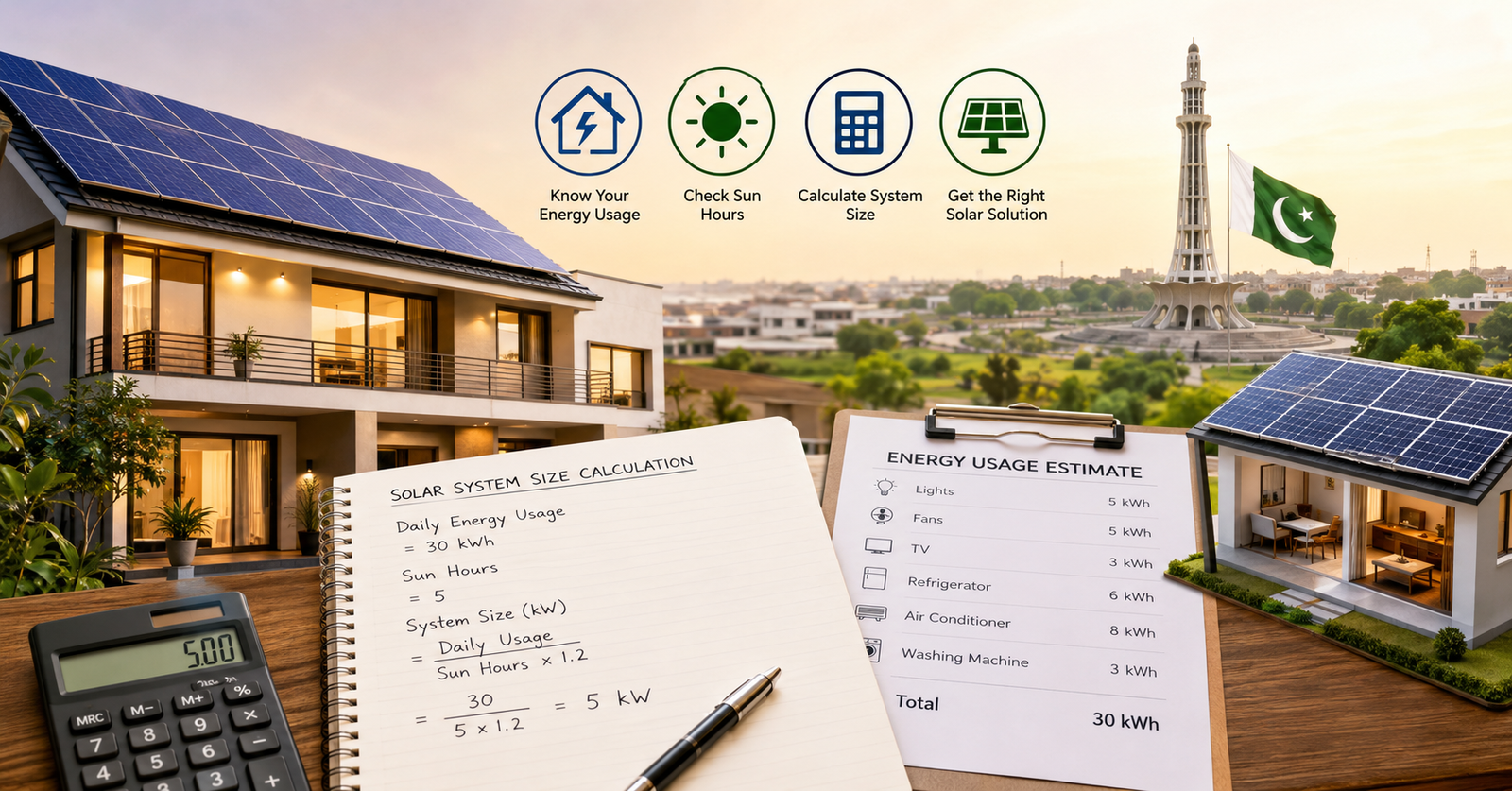
Your electricity bill already contains the answer to “what size solar system do I need.” Most homeowners overpay for solar because they size the system off a neighbor’s rooftop or a salesman’s guess instead of their own consumption data. Getting the solar system size in Pakistan right is a five-minute calculation once you have the correct numbers in front of you and it’s the single decision that determines whether your solar investment pays for itself in three years or eight.
This guide walks through the exact formula, adjusts it for Pakistani sun hours and NEPRA’s net billing rules, and answers the sizing questions people actually search for from AC tonnage to inverter and battery matching.
How Do I Calculate My Solar System Size?
To calculate your solar system size, take your average monthly electricity consumption in units (kWh) from your last six to twelve bills and divide it by 120–130, which is the approximate monthly output of one kilowatt (kW) of installed solar capacity in Pakistan.
System Size (kW) = Average Monthly Units ÷ 120–130
For example, a household averaging 1,000 units a month needs roughly 1,000 ÷ 125 = 8 kW of solar capacity. The 120–130 range accounts for real-world losses — panel temperature derating, inverter conversion losses, wiring resistance, dust accumulation, and seasonal variation in sunlight — so it already builds in a buffer over the panels’ rated nameplate output.
Use an average, not a single bill. A June bill will overstate your needs because of air conditioning load; a January bill will understate them. Add up six to twelve months of “units consumed,” divide by the number of months, and use that figure.
How Do I Calculate the Size of a Solar System in Pakistan Specifically?
Pakistan’s calculation differs from generic international formulas mainly in the divisor used for monthly output per kW, and in how net billing changes the incentive to oversize.
Here’s the step-by-step version:
- Pull 6–12 months of bills from your WAPDA, K-Electric, LESCO, IESCO, or MEPCO account and note the units consumed each month.
- Average them. Total units ÷ number of months = your baseline.
- Divide by 120–130. Cities with strong, consistent sun (Karachi, Multan, Faisalabad) sit closer to 130; cities with winter haze or smog (Lahore, Peshawar) sit closer to 120, or add 5–10% to the result.
- Round to a standard commercial size:3, 5, 6, 8, 10, or 12 kW since panels and inverters are sold in fixed increments, not arbitrary decimals.
- Decide on-grid vs. hybrid, which changes what portion of your consumption the system needs to cover (see below).
Quick Reference: Units to System Size
| Average Monthly Units | Recommended System Size |
|---|---|
| 300 | 3 kW |
| 500 | 4–5 kW |
| 800 | 6–7 kW |
| 1,000 | 7–8 kW |
| 1,500 | 10–12 kW |
| 2,000+ | 15 kW+ |
These are starting points. Roof orientation, shading, and whether you’re offsetting daytime-only or full 24-hour load will move the final number up or down.
Why Does the New Net Billing Policy Change Sizing Strategy?
Under NEPRA’s revised net billing framework, exported solar units are credited at a lower rate than what you pay to import electricity, which makes oversizing a system financially wasteful in a way it wasn’t under the older net metering rules.
Previously, many installers deliberately oversized systems because surplus exports were credited near retail value, effectively making the grid a free battery. That math no longer holds. Every unit you export today earns significantly less than the unit you’d have self-consumed. The practical implication: size for your average consumption, not your summer peak, and lean toward a hybrid system with batteries if you want to capture more of your own daytime generation rather than exporting it cheaply.
On-Grid or Hybrid — Does It Change the Formula?
Yes. An on-grid system only offsets electricity you use while the sun is up, so it should be sized against your daytime load, not total consumption; a hybrid system with batteries can offset your full 24-hour load, so panels are sized for total daily usage and batteries are sized separately for evening consumption.
| Factor | On-Grid | Hybrid |
|---|---|---|
| What it offsets | Daytime usage only | Full day + night usage |
| Sizing basis | Daytime % of total bill | Total daily consumption |
| Battery needed | No | Yes, sized for evening load |
| Export value under net billing | Low | Not applicable (self-consumed) |
| Upfront cost | Lower | Higher |
If roughly 60% of your household’s electricity use happens during daylight common with home offices, retirees, or joint family setups an on-grid system can be sized to that 60% share rather than 100% of the bill, since the remaining 40% will still be drawn from the grid at night regardless of array size.
What Is the 20% Rule for Solar?
The 20% rule refers to adding roughly 20% extra capacity on top of the bare theoretical requirement to compensate for system inefficiencies — panel degradation over 20–25 years, real-world temperature losses, inverter conversion loss, and dust or shading that lab-rated wattage numbers don’t account for.
In practice, this is already baked into the Pakistan-specific 120–130 units/kW divisor above, since that figure reflects real installed performance rather than a panel’s laboratory rating. If you calculate your size using a pure sun-hours method instead (daily kWh ÷ peak sun hours), you should separately multiply the result by 1.15–1.20 to reach the same real-world figure.les on the site)
What Is the 33% Rule for Solar Panels?
The 33% rule is an industry rule of thumb for matching solar panel (DC) capacity to inverter (AC) capacity, allowing the panel array to be oversized by up to roughly 30–35% relative to the inverter’s rated output without triggering clipping losses, because panels rarely produce their full rated wattage simultaneously.
This is why you’ll commonly see a 6.6 kW panel array paired with a 5 kW inverter, or an 8 kW array paired with a 6 kW inverter — the panels are oversized against the inverter, not the other way around. Going beyond that ratio starts to waste generation during peak sun hours because the inverter simply can’t push more power through than its rated ceiling, a problem installers call inverter clipping.
How Should I Size My Inverter for My PV System?
Size your inverter to roughly 75–100% of your total panel array wattage for a grid-tied system, since panels rarely hit their full rated output simultaneously, and matching the inverter one-to-one with panel capacity usually wastes money on unused headroom.
For a hybrid system with batteries, the inverter also needs enough continuous and surge capacity to start your heaviest simultaneous load — most commonly an air conditioner’s compressor start-up surge — so check the inverter’s surge rating against your largest appliance’s starting wattage, not just its running wattage.
How Many Solar Panels Do I Need for a 1.5 Ton AC?
A 1.5-ton inverter AC typically draws about 1,200–1,500 watts of running power, so running it for roughly 8 daylight hours needs about 3–3.5 kW of dedicated solar capacity, translating to roughly 6–8 panels rated at 550–580 watts each, once you factor in real-world derating.
This figure is for the AC alone; it doesn’t include your home’s other loads (fridge, lights, fans, kitchen appliances), which is why a whole-home system is always sized against total consumption, not a single appliance.
Can I Run 2 AC Units on a 5kW Solar System?
A 5kW solar system can typically run two 1-ton to 1.5-ton inverter ACs simultaneously during strong daylight hours, provided the inverter can handle the combined starting surge and the rest of the household load is light, but it will struggle to run two older, non-inverter AC units at the same time due to their higher compressor draw.
Inverter-type ACs modulate their compressor speed and draw far less power than fixed-speed units, which makes a meaningful difference in how many units a given system size can support. If you’re planning around multiple ACs, get the actual running and starting wattage from each unit’s nameplate rather than assuming all “1.5 ton” units draw the same power.
Is a 10kW Solar System Enough to Run a House, and How Many ACs Can It Run?
A 10kW solar system is generally enough to run an average to above-average Pakistani household, including 2–3 inverter-type air conditioners running simultaneously during peak sun hours, alongside typical lighting, fan, refrigerator, and appliance loads.
Whether 10 kW is “enough” depends entirely on your actual monthly consumption — a household averaging 1,200–1,500 units a month is a reasonable match for a 10 kW system using the formula above, while a household averaging 2,000+ units will find 10 kW insufficient for full offset and should plan for 15 kW or more.
What Is the Maximum Load Capacity of a 6kW and a 10kW System?
A 6kW solar system can comfortably support a continuous household load of roughly 4.5–5 kW at any given moment (accounting for the panel-to-inverter oversizing ratio), while a 10kW system supports a continuous load of roughly 7.5–8 kW — in both cases, the practical ceiling is set by the paired inverter’s rating, not the panel wattage alone.
This means the honest way to check “can my system handle this load” is to add up the simultaneous running wattage of everything you might switch on at once — ACs, motor pumps, irons, geysers — and compare that total against your inverter’s continuous rating, with headroom for appliance start-up surges.
What Size Battery Do I Need for a 6.6kW Solar System?
For a 6.6kW hybrid system, a battery bank in the 10–15 kWh usable range typically covers 4–6 hours of evening household load for an average home, though the right number depends on how much of your consumption happens after sunset and how many hours of backup you want.
Battery sizing is calculated separately from panel sizing: list your essential evening loads (lights, fans, fridge, router, a TV, maybe one AC), total the wattage, multiply by the hours you want covered, and convert to kWh. Then size the battery bank to that number rather than to the solar array size, since panels and batteries solve different problems — generation versus storage.
How Many Batteries Do I Need for a 5kW Solar System?
For a 5kW system running on 100Ah–200Ah lithium or lead-acid batteries at 12V or 24V configurations, most households need 2–4 batteries wired in series/parallel to reach a usable 5–10 kWh storage bank, enough for a partial-backup setup covering essential loads through a power outage or overnight period.
The exact count depends on battery chemistry (lithium batteries allow deeper, more usable discharge than lead-acid), voltage configuration, and how many hours of backup you’re targeting this is a case where a proper load list, not a generic battery count, gives an accurate answer.
How Much Solar Do I Need to Run My AC All Day?
Running a single 1.5-ton inverter AC continuously through daylight hours needs roughly 3.5–4.5 kW of dedicated solar capacity to keep up with its running load through the strongest and weakest sun-hour periods of the day, and more if you want it to keep running into the evening on battery backup.
If the AC needs to run overnight as well, you’re no longer solving a solar sizing problem alone — you’re solving a battery sizing problem, since panels don’t generate after sunset. Size the panels for daytime running load and the battery separately for nighttime running load.
What Roof Space Do I Need for My System Size?
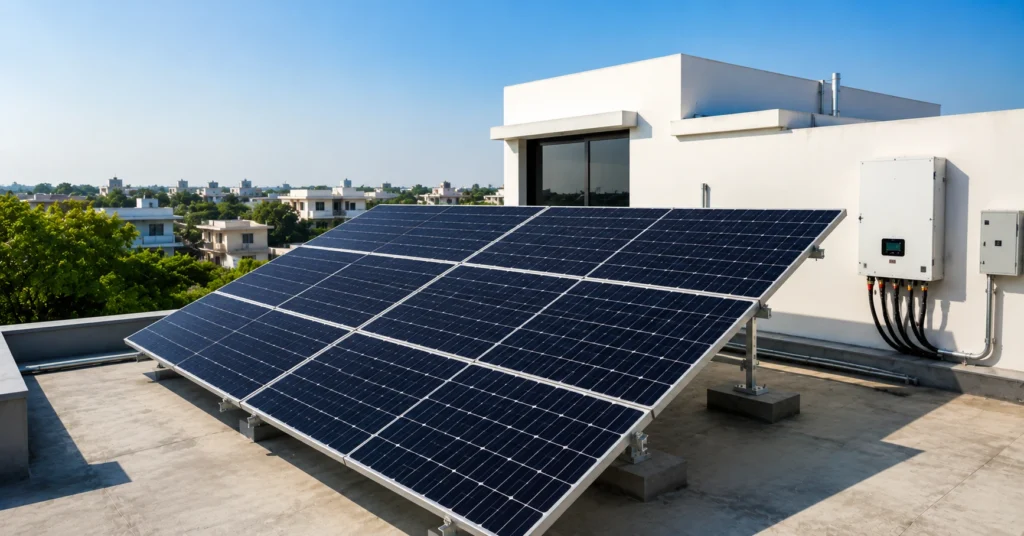
Budget roughly 60–70 square feet of unshaded roof area per kilowatt of solar capacity, which accounts for the panels themselves plus the spacing needed between rows for airflow, maintenance access, and to avoid inter-row shading.
| System Size | Approximate Roof Area |
|---|---|
| 5 kW | ~320 sq ft |
| 8 kW | ~520 sq ft |
| 10 kW | ~650 sq ft |
| 15 kW | ~1,000 sq ft |
If your roof is tight, higher-efficiency panels (22%+ efficiency, N-type TOPCon cells) generate more watts per square foot, which can be the deciding factor between a system fitting your roof or not.
What Is the Best Size Solar System for a Pakistani Home?
There’s no universal “best” size the correct system size is whichever number the consumption-based formula above produces for your actual bills, adjusted for your city’s sun hours, your roof area, and whether you’re going on-grid or hybrid; copying a neighbor’s system size is one of the most common and expensive sizing mistakes homeowners make.
Two households on the same street can have genuinely different correct answers because their appliance mix, occupancy hours, roof shading, and future plans (an EV, a room addition, a second AC) are all different. Run the calculation on your own bills every time.
Common Sizing Mistakes to Avoid
- Using one month’s bill. A summer bill overstates your average; a winter bill understates it. Use 6–12 months.
- Oversizing under net billing. Exported units now earn far less than self-consumed ones — right-sizing matters more than it used to.
- Ignoring future load. A planned EV, a second AC, or a home addition should be factored into today’s system, since adding capacity later costs more per kW than doing it once.
- Mismatching inverter and panel size. A poorly matched inverter causes clipping losses at peak generation hours.
- Copying a neighbor’s system. Consumption, roof orientation, and shading are never identical between two households.
FAQs
How to choose the right size solar system?
Start with 6–12 months of average electricity bills, divide by 120–130 units per kW (adjusted for your city’s sun hours), then round to the nearest standard commercial size and adjust for roof space and on-grid versus hybrid needs.
How to calculate solar for home step by step?
Average your monthly units consumed, divide by 120–130, round to a standard system size, then confirm your roof has enough space (60–70 sq ft per kW) and your inverter is correctly matched to the panel array.
Can 4 solar panels power a house?
Four panels at 550–580W each provide roughly 2.2–2.3 kW of capacity, which is enough for a very light load a few lights, fans, and a small fridge but not a full Pakistani household with AC usage; most homes need 5 kW or more.
Can I run 3 ACs on a 5kW solar system?
Running three ACs simultaneously on a 5kW system is unlikely to work well unless all three are small-capacity inverter units and nothing else heavy is running at the same time — for reliable multi-AC use, size closer to 8–10 kW.
How many kW is a 1 ton AC?
A 1-ton inverter AC typically draws around 800–1,000 watts of running power (roughly 1 kW), though non-inverter 1-ton units can draw closer to 1.2 kW, and starting surge is higher than running wattage in both cases.
Is 10kW enough to run a house near me in Pakistan?
For an average household averaging 1,200–1,500 units a month, a 10kW system is a solid match; check your own average monthly units against the reference table above rather than relying on a general answer, since consumption varies significantly between homes.
What size solar system do I need for my specific bill?
Take the average monthly units from your last 6–12 bills and divide by 120 (Lahore, Peshawar) or 130 (Karachi, Multan, Faisalabad, Islamabad) to get your system size in kW — a licensed installer can then confirm the number against your roof and load profile.
Getting an Accurate Number for Your Home
The formula above gets you within a reasonable range, but a proper sizing decision also accounts for your roof’s actual shading pattern, your inverter-to-panel ratio, and your specific evening versus daytime consumption split details a bill and a calculator alone can’t fully capture. If you want your exact number confirmed against real load data and a site survey rather than a rule of thumb, a licensed solar engineer can run the full assessment for you.