
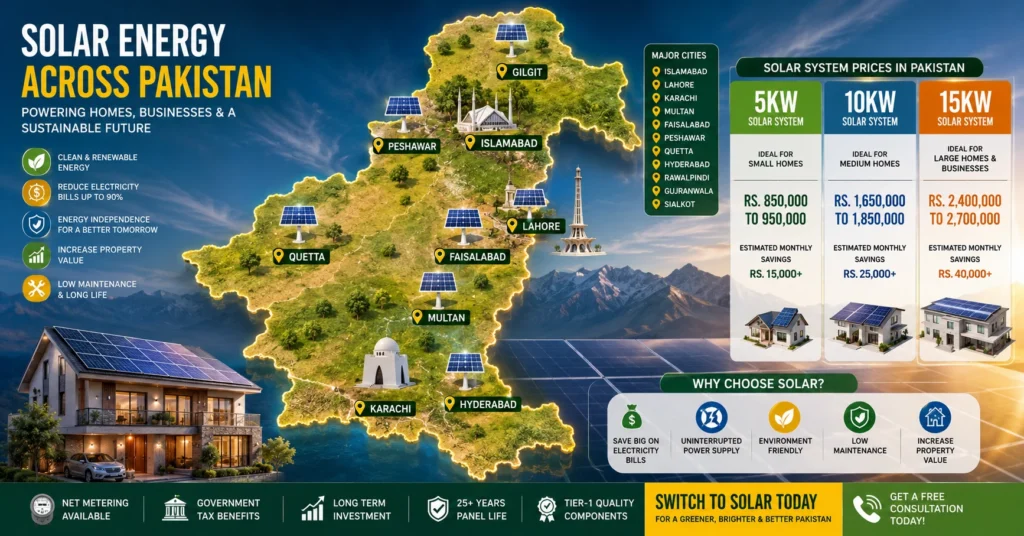
A 10kW solar system quotation must define whether 10kW refers to the panel array, inverter output or both. Panel technology, battery storage, roof work and approval requirements all affect the complete installed cost.
Get an Itemised 10kW Quotation
Specify panel model and quantity, inverter model, optional battery capacity, mounting, cabling, protection, earthing and labour. Record taxes, transport and grid-application costs separately. Compare the final array power using panel count multiplied by module watts instead of accepting the package name as its actual capacity.
Price context: Numerical prices elsewhere in this article are previously published indicative estimates. They have not been independently reverified as live supplier quotations during this content review. Confirm a dated quote for the exact model, quantity, tax, delivery and warranty before buying. Solar Price Pak publishes information and does not sell or install equipment.
If you’ve started requesting quotes, you’ve probably noticed the numbers swing wildly anywhere from Rs. 900,000 to over Rs. 2 million for what’s supposedly “the same” 10kW system. That gap comes down to components, battery inclusion, and installer pricing. Here’s what actually goes into the number.
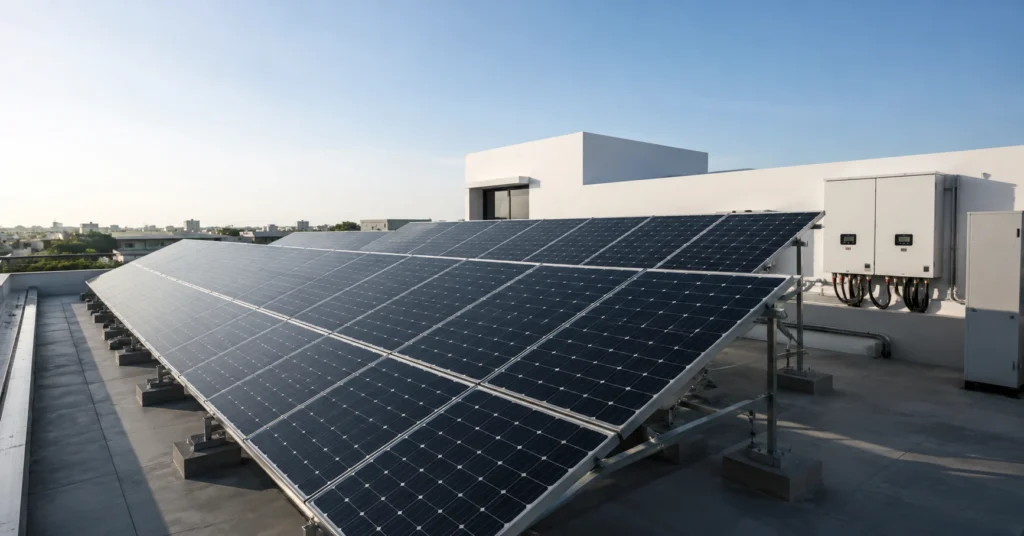
10KW Solar Panel Price in Pakistan
Current price overview
A complete 10kW solar system in Pakistan typically costs between Rs. 900,000 and Rs. 1,600,000 for an on-grid setup without batteries, and Rs. 1,300,000 to Rs. 2,300,000 for a hybrid system with lithium battery backup. The wide spread reflects genuine differences in panel brand, inverter quality, and how much backup storage you add.
Factors affecting the price
Panel efficiency, inverter brand, battery capacity, and site complexity all move the final bill. A basic on-grid system with standard Tier-1 panels sits at the lower end, while a hybrid system built around a premium inverter (Huawei, Growatt) and 10-15kWh of lithium storage lands at the top.
What is included in a 10KW solar system
A properly quoted system should include solar panels, a solar inverter, mounting structure, DC and AC cabling, circuit breakers and protection equipment, earthing, a bi-directional net meter, and full installation and commissioning. If a quote skips any of these line items, ask why before you sign.
What Is a 10KW Solar Panel System?
A 10kW solar system is a rooftop solar setup capable of producing roughly 10,000 watts of electricity under peak sunlight. It’s built for households and small businesses with daytime electricity consumption significantly higher than what a standard 5kW system can offset.
How a 10KW system works
Solar panels capture sunlight and convert it to DC electricity, which the inverter then converts to usable AC power for your home. Any surplus generation either charges a battery bank (in hybrid systems) or gets exported to the grid through net metering, depending on the system type you choose.
Expected electricity generation
A well-installed 10kW system typically generates 35-45 units per day, translating to roughly 1,050-1,350 units a month and 9,000-14,000 units annually, depending on location, panel angle, and shading.
Suitable homes and businesses
This size fits large houses with 6-8 rooms running two to three air conditioners, multiple fans, refrigerators, washing machines, and general lighting. It’s also common in small offices, clinics, and shops with heavy daytime electrical loads. Households with monthly bills above Rs. 60,000-80,000 typically see the fastest financial payoff from a 10kW system.
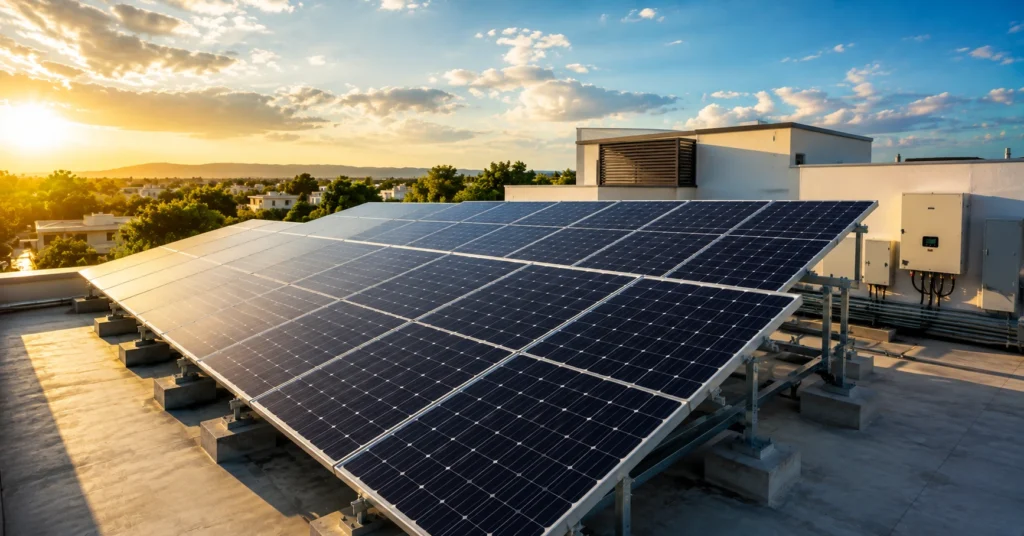
10KW Solar System Components
Solar panels
Tier-1 panels (Jinko, LONGi, Canadian Solar) currently cost around Rs. 24-35 per watt in Pakistan. For a 10kW array, that puts panel cost roughly between Rs. 240,000 and Rs. 350,000, depending on brand and wattage per panel.
Solar inverter
A 10kW-rated inverter typically costs Rs. 150,000 to Rs. 300,000, with hybrid models (capable of managing batteries) priced noticeably higher than pure on-grid units. Brands like Growatt, Huawei, Inverex, and GoodWe dominate the Pakistani market.
Batteries
Lithium battery banks sized for meaningful backup (10-15kWh) typically add Rs. 400,000 to Rs. 700,000 to the total system cost, making batteries the single most expensive optional component in a 10kW setup.
Mounting structure
Galvanized iron or aluminum structures to securely hold the panel array — whether on a flat roof, sloped roof, or ground mount — usually cost Rs. 100,000 to Rs. 180,000 for a 10kW array, depending on the number of panels and roof type.
Wiring and protection equipment
DC and AC cabling, circuit breakers, surge protection, and earthing typically add another Rs. 60,000 to Rs. 100,000, along with the bi-directional net meter, which alone runs Rs. 80,000-150,000 depending on your DISCO.
Factors Affecting 10KW Solar Panel Price
Panel quality and efficiency
Tier-1 panels with strong 25-year performance warranties cost more per watt but generate more electricity over the system’s lifetime and degrade slower than budget alternatives.
Inverter type and brand
Hybrid inverters cost significantly more than on-grid-only models because they manage battery charging, switching, and backup logic — but they’re what makes power available during load-shedding.
Battery capacity
Backup duration scales directly with battery size and cost. Many buyers size batteries for essential loads only (fridge, lights, fans, router, one AC) rather than the entire house, to keep costs manageable.
Installation costs
Roof height, accessibility, distance between the panel array and inverter, and general site complexity all shift labor charges, sometimes by tens of thousands of rupees.
Market and equipment prices
Solar equipment prices in Pakistan move with the US Dollar exchange rate, import duties, and global panel supply. Prices can shift meaningfully within a single year, so quotes from six months ago aren’t always reliable.
10KW Solar System Without Batteries
Estimated cost
An on-grid 10kW system without batteries typically costs Rs. 900,000 to Rs. 1,350,000, making it the more affordable route to a 10kW installation.
Advantages and disadvantages
On-grid systems are cheaper upfront, simpler to install, and require less maintenance since there’s no battery bank to manage. The trade-off is straightforward: the moment WAPDA cuts the line, your solar system shuts down too, since it’s synced to grid power for safety.
Who should choose a battery-free system?
Homes and businesses in areas with reliable grid supply and minimal load-shedding get the best value from a battery-free system, since they can prioritize a faster payback period without paying for backup they rarely need.
10KW Solar System With Batteries
Battery options
Lithium-ion (LiFePO4) batteries dominate the current market thanks to longer lifespans and better performance-to-cost ratios than older lead-acid or AGM options, though AGM batteries remain a cheaper entry point for tighter budgets.
Backup requirements
Most households sizing a battery bank for a 10kW system aim for 3-8 hours of essential backup rather than full-house, all-night coverage, since matching full consumption overnight requires significantly more storage.
Additional cost
Adding batteries typically pushes total system cost up by Rs. 400,000 to Rs. 900,000, depending on capacity, bringing a hybrid 10kW system to a total of roughly Rs. 1,300,000-2,300,000.
Benefits of energy storage
Beyond backup during outages, batteries let you use stored solar power in the evening instead of drawing from the grid at retail rates — which matters more now that Pakistan’s net billing framework pays less for exported units than it used to.
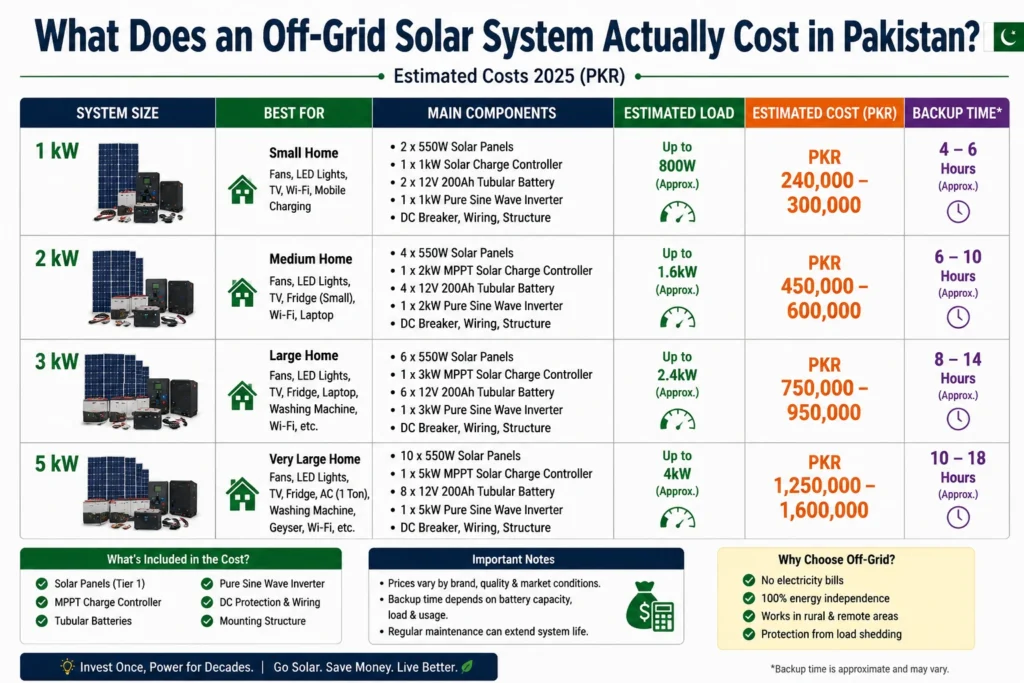
How Much Electricity Can a 10KW Solar System Generate?
Daily electricity production
Under standard Pakistani sunlight conditions, a 10kW system typically produces 35-45 units per day, enough to run multiple inverter ACs, a refrigerator, fans, lighting, and everyday appliances without strain.
Monthly generation
Total monthly output usually lands between 1,050 and 1,350 units, depending on season, cloud cover, and how clean the panels are kept.
Factors that affect solar output
Panel orientation and tilt angle, shading from nearby structures or trees, ambient temperature, dust accumulation, and seasonal sun hours all influence real-world generation — winter output is typically 30-40% lower than summer peak.
Is a 10KW Solar System Worth It in Pakistan?
Electricity bill savings
For households and businesses spending Rs. 60,000-100,000+ a month on electricity, a 10kW system can cut that bill by 70-90%, since most heavy daytime loads — ACs, motors, appliances — get covered directly by solar generation.
Long-term investment
Payback depends on the complete installed cost, generation, on-site use, applicable tariff, maintenance and replacement equipment. Calculate a scenario using actual quotations and your load profile; no fixed recovery period or decades of free electricity can be promised. Use the solar calculator for an illustration with explicit assumptions.
Payback considerations
Confirm the billing arrangement and applicable import and export rates in your electricity company’s current documents and your approved agreement. Do not use a fixed rate from an older price guide to calculate returns. Our prosumer application guide explains the distinction and where to check current requirements.
Installation Cost of a 10KW Solar System
Installation requirements
A 10kW installation needs roughly 550-700 square feet of unshaded roof space (depending on panel wattage), a structurally sound roof, and a three-phase electrical connection, since net metering for larger systems generally requires it.
Labor and mounting costs
Labor for mounting, wiring, and commissioning a 10kW system typically runs Rs. 60,000 to Rs. 120,000, with documentation and net metering approval adding a further Rs. 50,000-100,000 depending on your DISCO’s process.
Maintenance considerations
Solar panels need periodic cleaning to maintain output, particularly in dusty environments, and inverters generally need replacement every 10-12 years. Batteries, where installed, have their own separate replacement cycle depending on chemistry and usage.
How to Choose the Best 10KW Solar Panel System
Compare panel efficiency
Higher-efficiency Tier-1 panels produce more electricity per square foot of roof space, which matters most if your available roof area is limited.
Choose the right inverter
Match the inverter to your actual needs — a hybrid inverter only makes sense if you’re adding batteries or planning to later; otherwise, a quality on-grid inverter saves money without sacrificing performance.
Check warranties
Look for panels with 25-year performance warranties and 10-12 year product warranties, plus at least a 5-year warranty on the inverter, since these components represent the bulk of your investment.
Compare installation quotations
Request itemized quotes from at least two or three installers, and make sure every quote lists the same components — panel brand and wattage, inverter model, battery specs if applicable, and mounting structure — so you’re actually comparing like for like rather than guessing why prices differ.
Frequently Asked Questions
What is the 10KW solar panel price in Pakistan?
A complete 10kW solar system typically costs between Rs. 900,000 and Rs. 1,600,000 for an on-grid setup without batteries, and Rs. 1,300,000 to Rs. 2,300,000 for a hybrid system with lithium battery backup, depending on brand and components.
How much does a complete 10KW solar system cost in Pakistan?
Including panels, inverter, mounting structure, wiring, protection equipment, and installation, a complete 10kW system generally falls between Rs. 900,000 and Rs. 2,300,000, with the wide range driven mainly by whether batteries are included.
How many solar panels are required for a 10KW system?
Using common 550W-580W panels available in Pakistan, a 10kW system typically requires around 17 to 18 panels, though the exact count depends on the wattage of the specific panel model selected.
How much electricity can a 10KW solar system generate per day?
A properly installed 10kW system generally produces 35-45 units per day, adding up to roughly 1,050-1,350 units a month and 9,000-14,000 units annually, depending on season and location.
What is the difference between a 10KW solar system with and without batteries?
A battery-free 10kW system is cheaper and simpler but stops producing power during grid outages, while a system with batteries adds Rs. 400,000-900,000 to the cost but keeps essential appliances running during load-shedding and lets you use stored solar power in the evening.
One Response