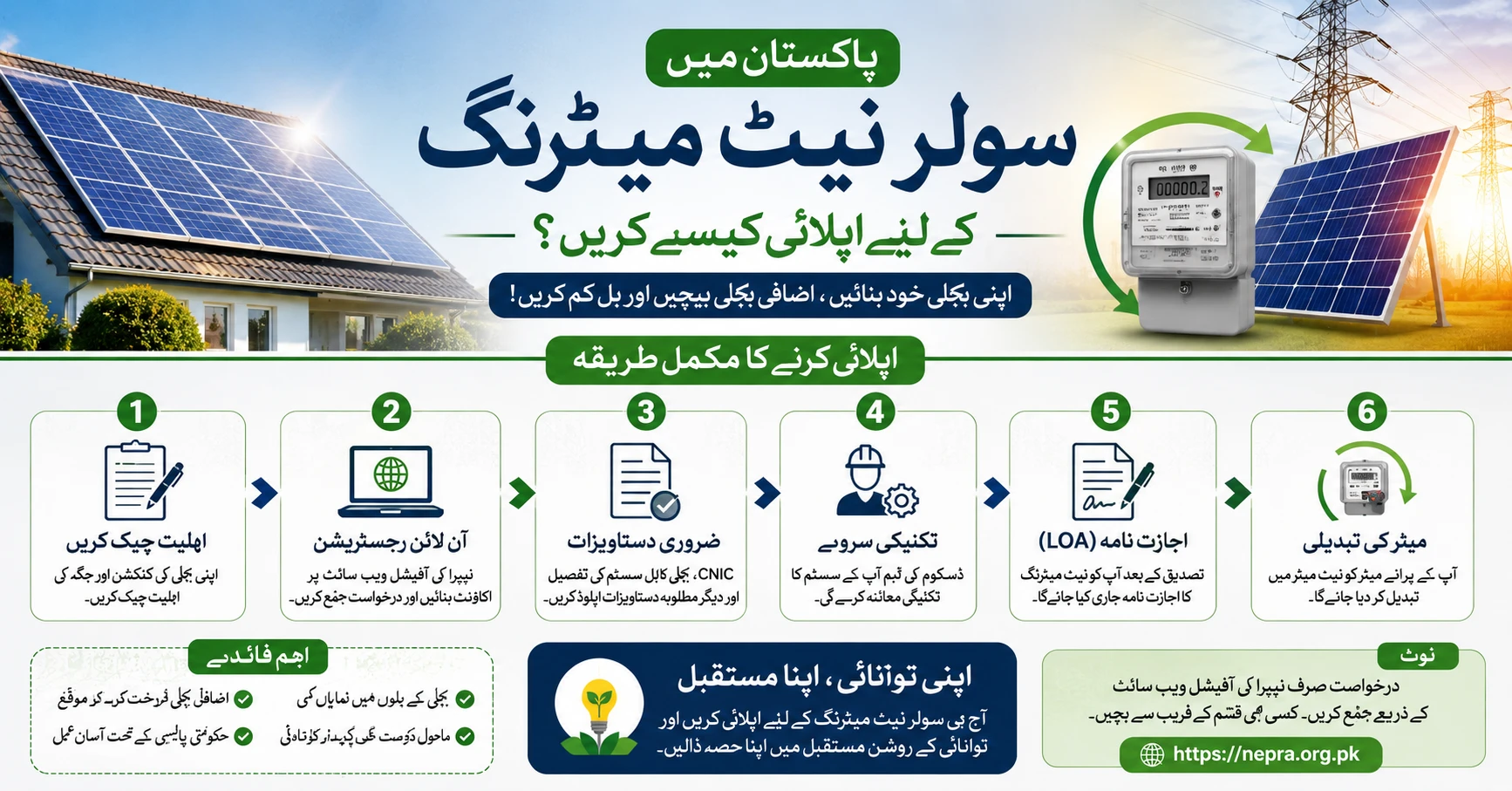
How to Apply for Solar Net Metering in Pakistan (2026 Guide)
Applying for solar net metering in Pakistan means getting your solar system formally connected to the grid so a bi-directional meter can measure the electricity you export and credit it against what you import. The process runs through three parties: your solar installer, your local DISCO (LESCO, K-Electric, IESCO, MEPCO, FESCO, GEPCO, HESCO, or PESCO), and NEPRA, and for most residential systems in 2026, it no longer requires paying a licence fee.
That last part is new. Regulatory changes made earlier in 2026 reshaped who needs a NEPRA licence, what it costs, and how long an agreement lasts details most guides online haven’t caught up with yet. This walkthrough covers the current process end-to-end, including the fee waiver, the online application portal, city-specific notes for Lahore and Karachi, and realistic costs and timelines.
What Is Solar Net Metering, and How Does It Work?
Net metering is a billing arrangement that lets you export surplus solar electricity to the national grid and receive credit for it against the electricity you import later. A bi-directional smart meter tracks both flows separately, so your monthly bill reflects the net difference between what you sent out and what you drew in.
During sunny hours, a correctly sized solar system typically produces more power than a home or business consumes. Instead of that surplus going to waste, it flows backward through the meter into the grid. At night, when panels aren’t producing, you draw power back from the grid as usual — but your bill accounts for the credit you built up during the day.

Am I Eligible to Apply for Net Metering in Pakistan?
You’re generally eligible if your electricity account is in good standing and your proposed solar system fits within your approved connection limits. Specifically:
- Active connection, no arrears: Your DISCO account must be clear of unpaid dues.
- Three-phase connection: Most net-metered systems require three-phase service; very small single-phase setups may qualify in limited cases, but most residential installers will recommend upgrading to three-phase first if you don’t already have it.
- Sanctioned load match: Under the current rules, your solar system size is capped at your sanctioned load (the 1.0x cap replaced the older allowance that let systems run up to 1.5 times the sanctioned load). If your inverter capacity exceeds your sanctioned load, you’ll need a load extension from your DISCO before applying.
- Capacity range: Systems from roughly 1 kW up to 1 MW fall under NEPRA’s net metering and net billing framework.
- Approved equipment: Panels and inverters should be on NEPRA/AEDB-recognised equipment lists, with inverters meeting anti-islanding standards (IEC 62116 / UL 1741).
What Changed for Net Metering Applicants in 2026?
NEPRA’s Prosumers Regulations, 2026 replaced the older 2015 framework and initially brought every prosumer—from 1 kW to 1 MW—under direct NEPRA licensing, with a one-time fee of Rs. 1,000 per kilowatt. That triggered public backlash over “taxing sunlight,” and on the Power Division’s direction, NEPRA withdrew the licence and fee requirement for any system of 25 kW or below, applied retroactively from February 9, 2026. Systems above 25 kW still pay the Rs. 1,000/kW one-time fee.
A few other shifts worth knowing before you apply:
- Net billing terminology: New applicants are processed under a net billing structure rather than the older pure net-metering credit system, though the day-to-day mechanics — export, import, net settlement — remain similar for most households.
- Shorter contract term: New agreements run for five years instead of the previous seven, renewable by mutual consent with the DISCO.
- Lower sanctioned-load multiplier: System size is now capped at your sanctioned load (1.0x) rather than the earlier 1.5x allowance, so oversizing a system purely to maximize export revenue is no longer possible.
- Existing prosumers largely unaffected: If you already have a net metering agreement, it typically continues under its original terms until that contract’s term expires.
If you’re under 25 kW — which covers the vast majority of homes — this is good news: one less fee and one less licensing step to worry about.
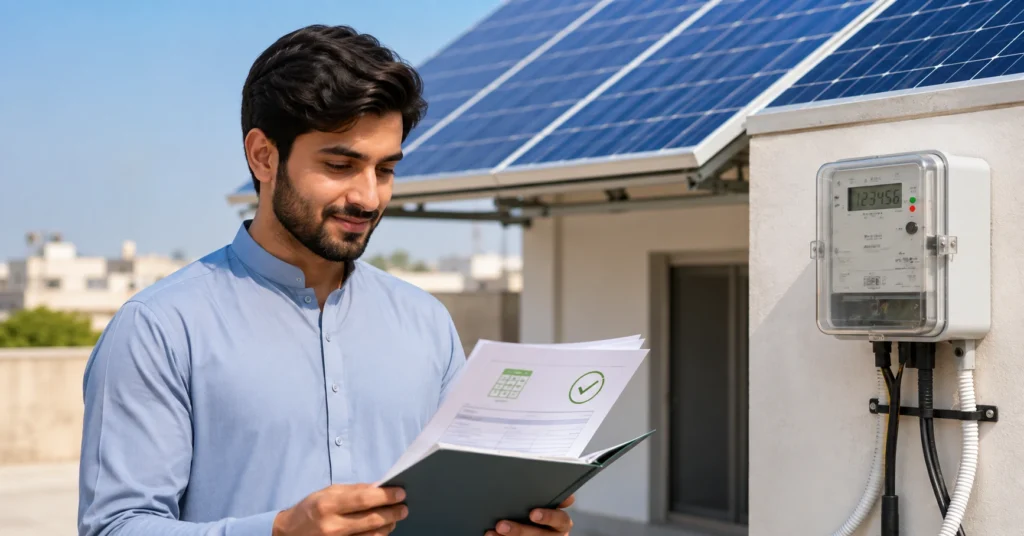
How to Apply for Solar Net Metering: Step-by-Step Process
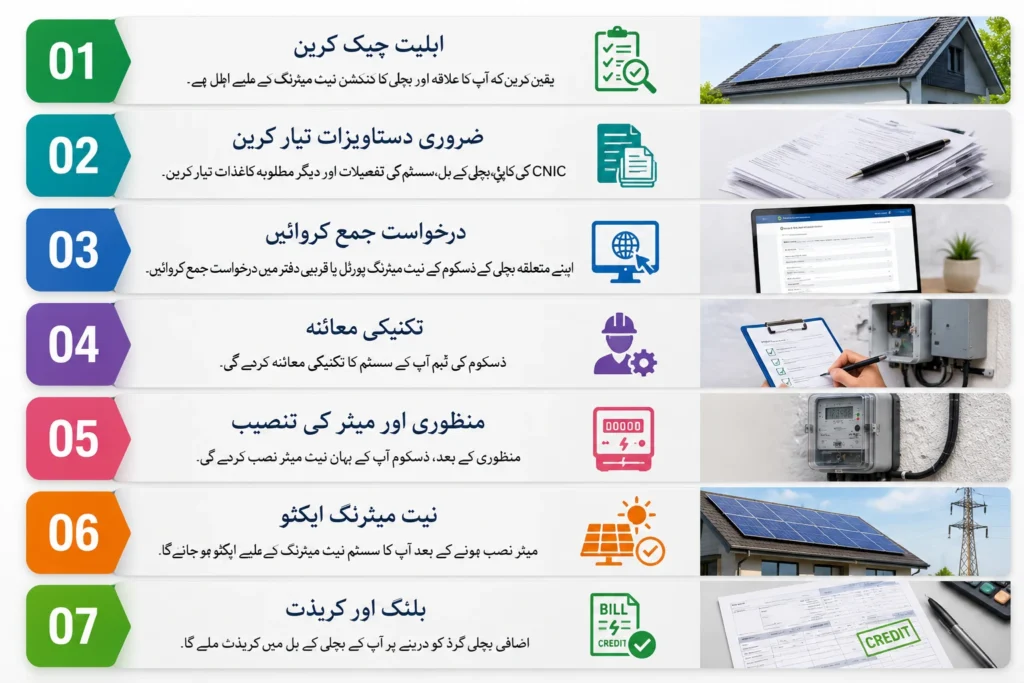
Step 1: Get a Site Assessment from a Certified Installer
Start with an AEDB-registered or PEC-certified solar company. They’ll review your monthly consumption, roof space, and existing sanctioned load to size a system that won’t get flagged during DISCO review. If your target system size exceeds your current sanctioned load, your installer should help you file for a load extension first — this is one of the most common causes of delay.
Step 2: Gather Your Documents
Before submission, have these ready:
- CNIC copy of the account holder
- Last three months’ paid electricity bills
- Proof of property ownership (registry, Fard, or allotment letter)
- Single Line Diagram (SLD) of the solar system, signed by a registered engineer
- Equipment datasheets for panels and inverter
- Signed installation agreement with your solar company
Step 3: Submit the Application to Your DISCO
Your installer files the complete application at your local DISCO’s relevant office—for example, the Sub-Divisional Officer for LESCO or the equivalent office for MEPCO, IESCO, FESCO, GEPCO, HESCO, PESCO, or K-Electric. The DISCO issues a processing fee voucher and logs the application for initial technical review, which, by regulation, should be completed within about 20 working days.
Step 4: Technical Site Inspection
A DISCO engineer visits the property to check the installation against safety requirements: anti-islanding protection on the inverter, dedicated earthing for AC and DC sides, surge protection devices, and correctly rated circuit breakers between the inverter and your main distribution board. For connections up to 250 kW, a separate Electrical Inspector NOC is generally not required — the DISCO’s own inspection covers it.
Step 5: NOC, Interconnection Agreement, and Regulatory Concurrence
Once the inspection passes, the DISCO issues a No Objection Certificate and signs a three-party interconnection agreement with you. For systems above 25 kW, this file is forwarded to NEPRA along with the licence fee for formal concurrence; for systems of 25 kW and below, no NEPRA fee applies under the current waiver.
Step 6: Bi-Directional Meter Installation
After approval, you pay the meter voucher, the DISCO’s lab tests and seals a PEPCO-approved bi-directional smart meter, and technicians swap out your old unidirectional meter for the new one.
Step 7: Commissioning and Billing Activation
With the new meter live, your account is updated in the DISCO’s billing system to show import units, export units, and your net payable or credit balance each cycle.
How to Apply for Net Metering Online (NEPRA DXP Portal)
For cases that still require NEPRA-level processing (systems above 25 kW, or where your DISCO forwards the file for concurrence), NEPRA has moved much of its licensing workflow onto its digital portal, NEPRA DXP. The general online path is:
- Visit NEPRA’s official e-services portal and create or log into your account.
- Select the net metering/generation licence application type.
- Fill in the application directly on the portal or upload a pre-filled, digitally signed PDF form — scanned forms without a digital signature are a common rejection reason.
- Attach supporting documents: technical specifications, the interconnection agreement, and any required affidavits.
- Review everything carefully and submit; you’ll be able to track status through the same portal.
For most residential systems 25 kW and under, though, the practical application still runs primarily through your DISCO, with the online portal mainly relevant for tracking and for larger commercial or industrial systems.
Documents Required for Net Metering Application
| Document | Why It’s Needed |
|---|---|
| CNIC of bill owner | Confirms applicant identity |
| Last 3 months’ paid bills | Verifies account is clear and shows consumption history |
| Proof of property ownership | Confirms right to install on the premises |
| Single Line Diagram (signed) | Shows the technical layout for DISCO review |
| Equipment datasheets | Confirms panels/inverter meet approved standards |
| Installer agreement | Establishes the certified installer of record |
How Long Does Net Metering Approval Take?
Most residential applications take roughly 4 to 8 weeks from submission to a working bi-directional meter, assuming documentation is complete and the first inspection passes. Initial DISCO technical review is bound to about 20 working days by regulation; the remaining time covers inspection scheduling, NOC issuance, and meter procurement and installation. Incomplete paperwork or a failed inspection (missing earthing, wrong breaker rating, non-compliant inverter) is the most common cause of delays beyond this window.
Net Metering Application Cost Breakdown
| Component | Estimated Cost (PKR) |
|---|---|
| DISCO processing/application voucher | 1,000 – 3,000 |
| Engineering SLD and inspection fees | 5,000 – 10,000 |
| Bi-directional smart meter | 18,000 – 45,000 |
| Protection equipment (SPDs, MCCBs, earthing) | 35,000 – 70,000 |
| NEPRA licence fee (only above 25 kW) | Rs. 1,000 per kW |
| Total setup cost (25 kW and below) | Roughly 60,000 – 130,000 |
These figures cover metering, protection equipment, and processing only — not the solar panels and inverter themselves, which are the larger share of overall project cost.
How to Apply for Solar Net Metering in Lahore (LESCO)
In Lahore, applications go through LESCO’s local Sub-Divisional Officer covering your area. The document requirements and inspection standards are the same as the national process, but LESCO’s queue length varies significantly by division, so working with an installer who has an active track record with your specific LESCO sub-division tends to shorten the wait. LESCO also runs a load-extension process through its customer facilitation portals for consumers whose sanctioned load falls short of their planned solar system size.
How to Apply for Solar Net Metering in Karachi (K-Electric)
Karachi is served exclusively by K-Electric rather than a WAPDA-linked DISCO, and its net metering application, inspection, and meter-installation process runs entirely through K-Electric’s own commercial and industrial or residential service channels. The core eligibility and document requirements mirror the national NEPRA framework, but K-Electric handles its own inspection scheduling and metering stock, so timelines can differ from LESCO, IESCO, or MEPCO service areas.
Confirm current forms and voucher amounts directly with K-Electric’s net metering desk, since K-Electric periodically updates its own procedural checklist separately from the DISCOs under the National Transmission and Despatch Company umbrella.
How to Check Your NEPRA Net Metering Licence Status Online
If your system required NEPRA-level concurrence (generally above 25 kW), you can track status through the NEPRA DXP portal login used at submission or by checking NEPRA’s published net metering licence lists by DISCO on its website, which log approved generation licences by applicant name and licence number. For systems 25 kW and below that no longer require a NEPRA licence, status tracking happens through your DISCO’s own application reference number instead.
Common Reasons Net Metering Applications Get Rejected
- Inverter capacity exceeding the sanctioned load (or exceeding the 1.0x cap under current rules)
- Working with a vendor that isn’t AEDB-certified or PEC-registered
- Missing DC/AC surge protection or inadequate earthing resistance
- Feeder-level capacity limits on the local distribution transformer
- Incomplete or unsigned Single Line Diagrams
- Scanned forms submitted without required digital signatures on the NEPRA portal
— FAQ SECTION —
Do I need a NEPRA licence to apply for net metering in 2026?
Not if your system is 25 kW or smaller — NEPRA waived the licence requirement and Rs. 1,000/kW fee for systems at or below this size, effective retroactively from February 9, 2026. Systems above 25 kW still need NEPRA concurrence and must pay the fee.
Can I apply for net metering myself, or do I need an installer?
You need a certified AEDB-registered or PEC-registered solar installer to prepare the technical documentation and submit the application on your behalf — individual consumers don’t file directly with NEPRA or their DISCO without one.
How much does it cost to apply for net metering in Pakistan?
Processing, protection equipment, and the bi-directional meter typically add up to roughly Rs. 60,000–130,000 for systems 25 kW and under, on top of the panels and inverter cost.
Is net metering available in Karachi?
Yes — K-Electric processes net metering applications for Karachi separately from the WAPDA-linked DISCOs, following the same core NEPRA eligibility rules but its own inspection and meter-installation queue.
How long does net metering approval take in Lahore or other cities?
Most applications take about 4 to 8 weeks from submission to a working bi-directional meter, though this varies by DISCO workload and how complete the initial documentation is.
What happens if I use more solar capacity than my sanctioned load?
Your application will likely be rejected or delayed at DISCO review—you’ll need to apply for a sanctioned load extension before submitting the net metering application.
Can I check my net metering application status online?
Yes, for systems requiring NEPRA concurrence, you can track status via the NEPRA DXP portal; for smaller systems processed only through your DISCO, use your DISCO-issued application reference number instead.
— CTA —
Ready to apply? Work with a certified solar installer who handles the full documentation, DISCO submission, and inspection process on your behalf — it’s the single biggest factor in getting approved on the first attempt.

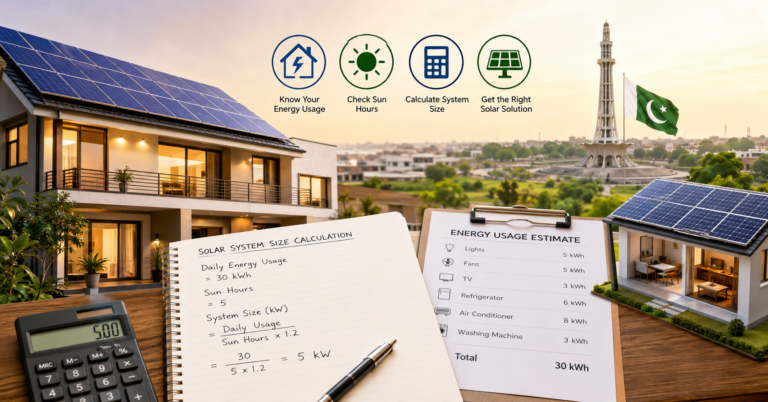

3 Comments