

A 5kW installed solar system can have different panel-array and inverter ratings. Its price depends on the equipment, optional storage, roof conditions and installation scope, so compare written quotations rather than a package headline.
Separate Equipment Cost from Installation Scope
Ask whether mounting, cable runs, protection, earthing, commissioning and any grid application are included. Where battery backup is proposed, confirm its usable energy and intended circuits. A quotation without a battery should not be compared directly with a package that includes storage.
Price context: Numerical prices elsewhere in this article are previously published indicative estimates. They have not been independently reverified as live supplier quotations during this content review. Confirm a dated quote for the exact model, quantity, tax, delivery and warranty before buying. Solar Price Pak publishes information and does not sell or install equipment.
This guide breaks down the real 2026 numbers: what a 5kW system costs, what eats into that budget, and whether it’s still worth installing now that Pakistan’s net metering rules have changed.
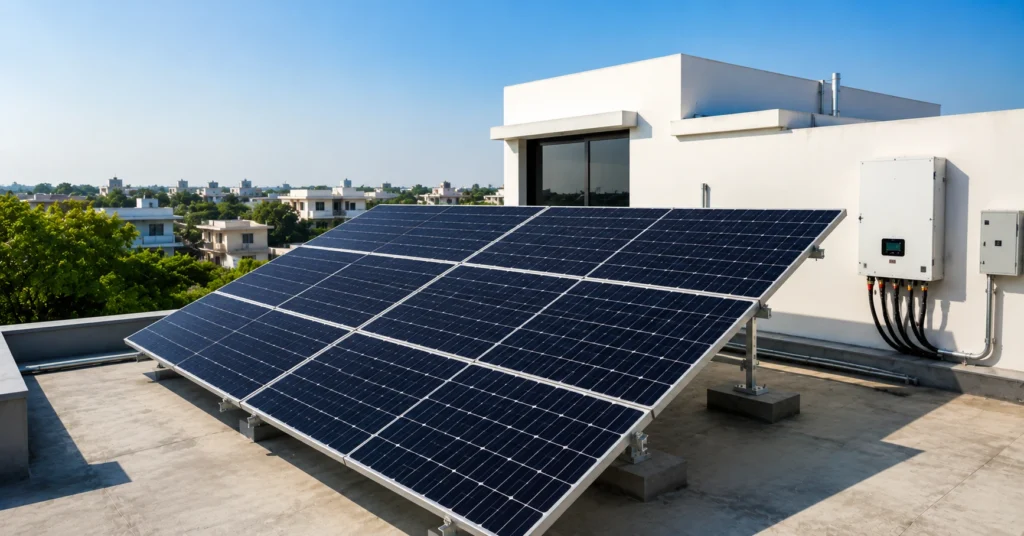
5kW Solar Panel Installation Price in Pakistan
Average installation price
A complete 5kW solar system — panels, inverter, mounting structure, wiring, and labor — typically costs somewhere between Rs. 650,000 and Rs. 1,150,000 in 2026, depending on whether you go on-grid or hybrid. On-grid systems without batteries sit at the lower end, often starting around Rs. 500,000 to 780,000, while hybrid systems with lithium battery backup push the total closer to Rs. 900,000 to 1,150,000. There’s no single “correct” price — it depends entirely on the components you choose.
Factors affecting the total cost
Panel brand, inverter type, battery capacity, and installation complexity all move the final number. A basic on-grid setup with budget panels costs far less than a hybrid system built around Tier-1 panels and a lithium battery. Roof type and wiring distance also matter more than most buyers expect: a flat concrete roof with easy cable runs installs faster and cheaper than a tricky sloped or tiled roof.
Equipment and installation charges
Equipment (panels, inverter, structure, batteries, cabling) usually makes up 75-85% of the total bill. The installation portion alone — labor, commissioning, and site work — generally falls between Rs. 80,000 and Rs. 200,000, depending on project complexity and how much structural or electrical work the roof needs.
What Is a 5kW Solar System?
A 5kW solar system is a rooftop setup capable of producing roughly 5,000 watts of electricity under ideal midday sun. In practical terms, that translates to about 20-25 units per day in summer and 12-18 units per day in winter, or roughly 550-900 units a month depending on location, panel angle, and shading.
How much electricity can a 5kW system generate
Output isn’t constant — it peaks around noon and tapers off in the morning and evening. Over a full month, a well-positioned 5kW system in a city like Lahore or Karachi can realistically generate between 550 and 900 units, which is enough to offset the bulk of a mid-sized household’s consumption.
Ideal usage for a 5kW solar system
This size fits homes consuming roughly 400 to 1,200 units a month — think one or two air conditioners, a refrigerator, lights, fans, a washing machine, and general kitchen appliances. It’s the most commonly installed size in Pakistan for exactly this reason: it matches the average urban household’s load without massively oversizing the system.
On-grid, off-grid, and hybrid systems
- On-grid: Connects to the WAPDA/DISCO grid and exports surplus power; no battery, lowest cost, but no backup during outages.
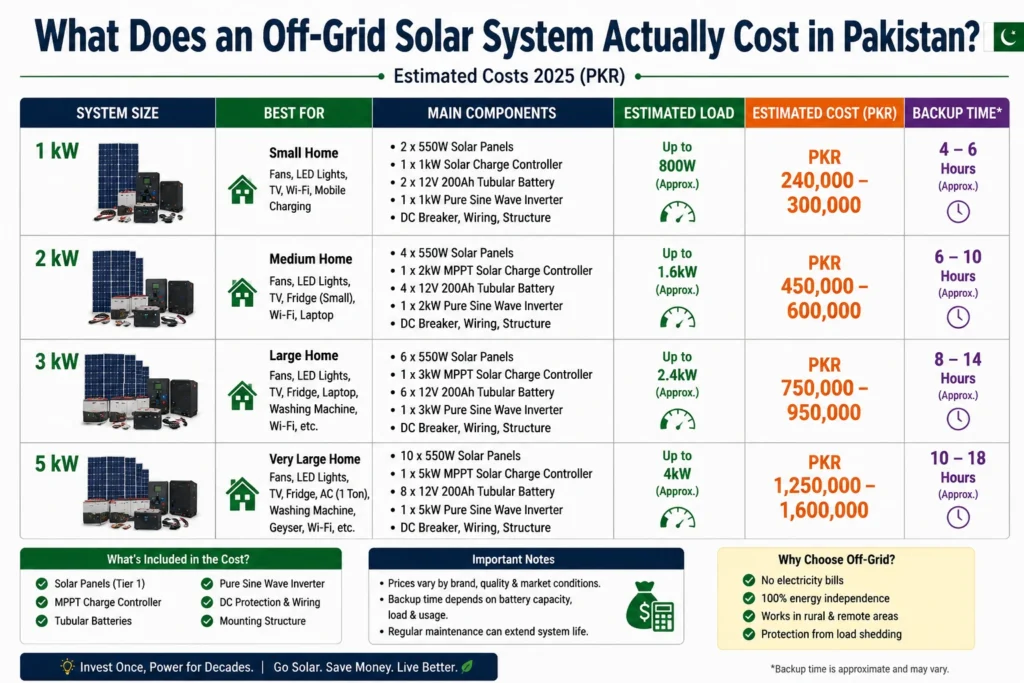
- Off-grid: Fully independent, battery-powered, no grid connection — expensive and rarely used for homes with grid access.
- Hybrid: Combines grid connection with battery backup, so you get net billing benefits and power during load-shedding. It costs more upfront but is now the most popular residential choice in Pakistan.
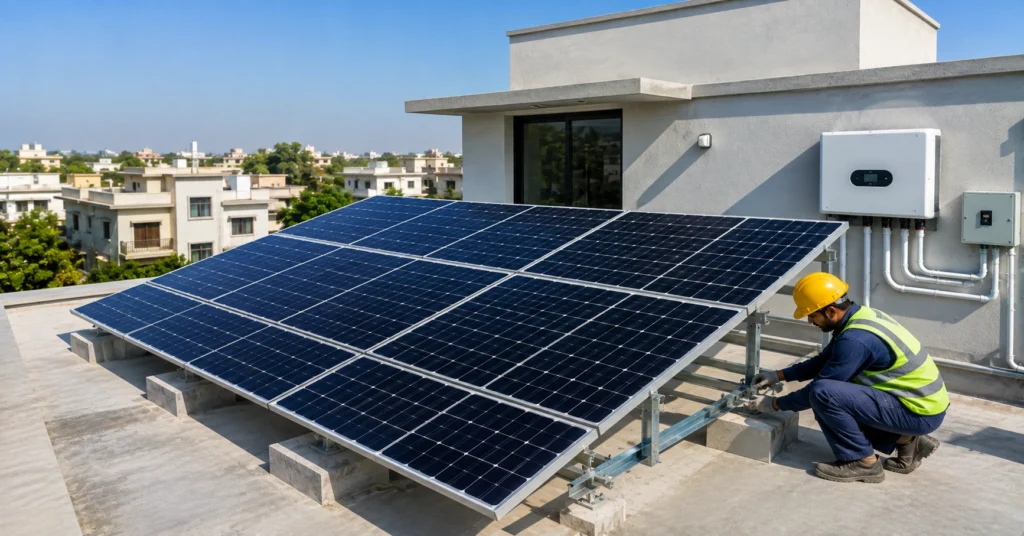
5kW Solar Panel Price in Pakistan
Solar panel cost
Tier-1 solar panels (LONGi, Jinko, JA Solar, Canadian Solar) currently cost around Rs. 35-45 per watt in Pakistan, while budget or unbranded panels go for Rs. 25-35 per watt but come with weaker warranties and lower long-term output. For a 5kW array, that puts panel cost roughly between Rs. 175,000 and Rs. 225,000 for Tier-1 brands.
Inverter cost
A 5kW hybrid inverter from a trusted brand — Solis, GoodWe, Crown, or Inverex — typically runs Rs. 100,000 to Rs. 180,000, while a simpler on-grid-only inverter can cost noticeably less. Inverters generally need replacing every 10-12 years, so it’s worth budgeting Rs. 50,000-70,000 for a future replacement.
Battery cost
Lithium battery packs for a 5kW hybrid setup typically cost Rs. 100,000 to Rs. 150,000 per battery unit, and most homes install one or two depending on backup needs. Skipping the battery is the single biggest way to cut your upfront cost, but it also means no power during outages.
Mounting structure and accessories
Galvanized iron or aluminum mounting structures, DC cables, breakers, earthing kits, and a bi-directional net meter round out the equipment list. Together, these usually add another Rs. 60,000-100,000, with the net metering meter alone costing Rs. 10,000- 25,000. Homeowners commonly use around 8–10 high-output panels. The exact number depends on whether the selected panels are 540W, 550W, 580W, 585W, 590W, 600W, or another rating.
5kW Solar System Installation Cost
Labor charges
Installer labor for mounting panels, running cables, and wiring the inverter typically costs Rs. 30,000 to Rs. 50,000 for a straightforward roof, rising if scaffolding or extra structural work is required.
Wiring and protection equipment
DC/AC protection devices — surge protectors, circuit breakers, and earthing — are non-negotiable for safety and usually add Rs. 20,000-40,000 to the total.
Installation and commissioning
Commissioning covers final testing, connecting the system to the grid, and getting it approved by your DISCO. This step, along with net metering paperwork, can take anywhere from a few weeks to a couple of months depending on your utility company.
Additional installation expenses
Structural assessment for older buildings or unusual roof types, extra cable runs for longer distances, and any required roof reinforcement can add Rs. 30,000-80,000 in “hidden” costs that don’t always show up in the first quote you receive. than a hybrid inverter because it does not need to manage battery storage.
Factors Affecting 5kW Solar Installation Price
Panel brand and efficiency
Tier-1 panels cost more but produce more power per square foot and carry stronger 25-year performance warranties. Cheaper panels lower the sticker price but often degrade faster.
Inverter type and brand
Hybrid inverters cost more than pure on-grid inverters because they handle battery charging and switching logic, but they’re what makes backup power possible.
Battery capacity
More battery storage means longer backup during outages — and a noticeably higher bill. Many households size their battery for essential loads only (lights, fans, fridge, router) rather than the whole house.
Installation location
Roof height, accessibility, distance from the meter room, and even the city you’re in (labor rates differ between Lahore, Karachi, Islamabad, and smaller towns) all shift the final price.
System type
On-grid systems are consistently the cheapest option; hybrid systems with batteries typically cost 40-70% more than an equivalent on-grid setup. can push past PKR 400,000. Panels are the second-biggest line item, and Tier-1 brands cost more upfront but hold their output better over a 25-year lifespan.
5kW On-Grid vs Hybrid Solar System
Price comparison
An on-grid 5kW system generally costs Rs. 500,000-780,000, while a hybrid system with battery backup runs Rs. 900,000-1,150,000 or higher, depending on battery size.
Benefits and drawbacks
On-grid systems are cheaper and simpler but leave you without power the moment WAPDA cuts the line. Hybrid systems cost more upfront but keep essential appliances running during load-shedding, which matters a lot in areas with frequent outages.
Which system is suitable for different users?
Homes with reliable grid supply and low load-shedding often do fine with on-grid, prioritizing a faster payback. Homes in areas with regular outages usually find the extra cost of a hybrid system worth it for the peace of mind alone.
How Much Electricity Can a 5kW Solar System Generate?
Daily production
Expect roughly 20-25 units per day during peak summer sun and 12-18 units per day in winter, when sunlight hours are shorter and the sun sits lower in the sky.
Monthly production
Over a full month, total output usually ranges from 550 to 900 units, depending on season, cloud cover, and panel cleanliness.
Factors affecting electricity generation
Panel angle and orientation, shading from trees or nearby buildings, dust accumulation, and ambient temperature all affect real-world output — actual generation is almost always somewhat lower than the panel’s rated capacity suggests.
Is a 5kW Solar System Worth It in Pakistan in 2026?
Electricity bill savings
For a household spending Rs. 15,000-40,000 a month on electricity, a 5kW system can eliminate or sharply cut that bill, since most of the daytime load — ACs, pumps, appliances — gets covered directly by solar generation rather than imported grid power.
Payback period
Confirm the billing arrangement and applicable import and export rates in your electricity company’s current documents and your approved agreement. Do not use a fixed rate from an older price guide to calculate returns. Our prosumer application guide explains the distinction and where to check current requirements.
Long-term benefits
Payback depends on the complete installed cost, generation, on-site use, applicable tariff, maintenance and replacement equipment. Calculate a scenario using actual quotations and your load profile; no fixed recovery period or decades of free electricity can be promised. Use the solar calculator for an illustration with explicit assumptions.
Frequently Asked Questions
What is the 5kW solar panel installation price in Pakistan in 2026?
A complete 5kW solar system installation, including panels, inverter, mounting structure, and labor, typically costs between Rs. 650,000 and Rs. 1,150,000, depending on whether you choose an on-grid or hybrid setup with battery backup.
How much does a 5kW solar system cost in Pakistan?
On-grid 5kW systems generally start around Rs. 500,000-780,000, while hybrid systems with lithium battery storage run from about Rs. 900,000 up to Rs. 1,150,000 or more, depending on brand and battery capacity.
What is included in a 5kW solar panel installation?
A standard installation includes solar panels, an inverter, a mounting structure, DC/AC cabling and protection equipment, earthing, a net meter, and professional labor for mounting, wiring, and commissioning the system.
How many solar panels are required for a 5kW system?
Using common 550W-580W panels available in Pakistan, a 5kW system typically requires around 9 to 10 panels, though the exact count depends on the wattage of the chosen panel model.
How much electricity can a 5kW solar system generate per day?
A properly installed 5kW system generally produces 20-25 units per day in summer and 12-18 units per day in winter, adding up to roughly 550-900 units across a full month.
What is the price of a 5kW solar inverter in Pakistan?
A 5kW hybrid inverter from established brands like Solis, GoodWe, or Inverex typically costs between Rs. 100,000 and Rs. 180,000, while basic on-grid-only inverters are usually somewhat cheaper.
How much does it cost to install a 5kW solar system?
Labor, wiring, protection equipment, and commissioning for a 5kW system usually cost between Rs. 80,000 and Rs. 200,000 on top of equipment costs, depending on roof type and site complexity.
Is a 5kW solar system enough for a home in Pakistan?
Yes — a 5kW system comfortably covers homes consuming 400 to 1,200 units a month, which fits most medium-sized households running an AC or two, a refrigerator, lights, fans, and standard appliances.
What is the difference between a 5kW on-grid and hybrid solar system?
An on-grid system is cheaper but offers no power during outages, while a hybrid system adds battery storage so essential appliances keep running during load-shedding, at a cost roughly 40-70% higher than an equivalent on-grid setup.
How long does it take to recover the cost of a 5kW solar system?
Payback depends on the complete installed cost, generation, on-site use, applicable tariff, maintenance and replacement equipment. Calculate a scenario using actual quotations and your load profile; no fixed recovery period or decades of free electricity can be promised. Use the solar calculator for an illustration with explicit assumptions.