
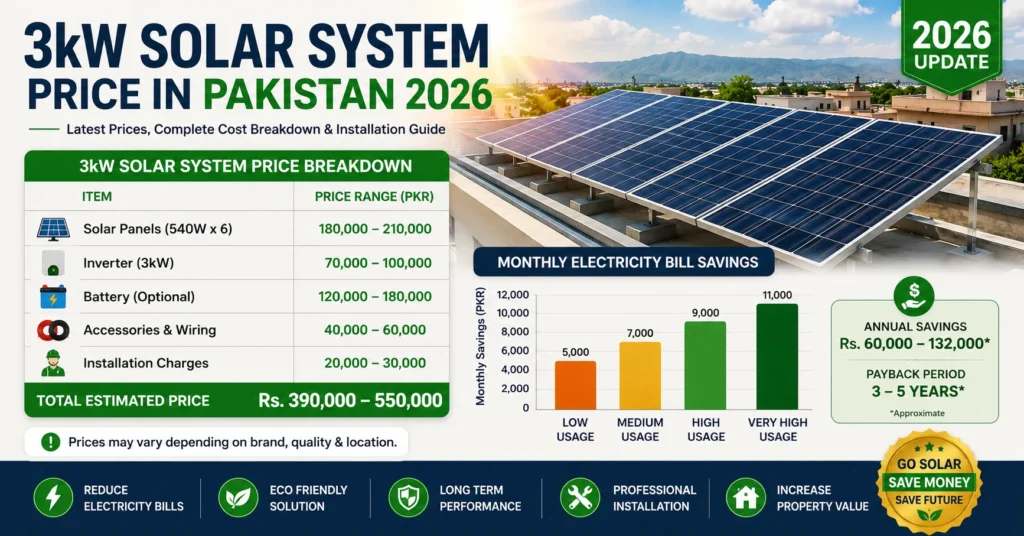
A 3kW solar quotation should state the actual panel-array power, inverter rating and whether storage is included. The appropriate configuration depends on daytime electricity use, backup demand and the installation conditions.
Compare 3kW Packages by Their Contents
Multiply the panel count by module watts to check array capacity. Confirm the inverter’s continuous and backup outputs, and list the intended essential circuits. Compare installed cost and operating assumptions before calculating savings; a panel-only price or estimated export credit cannot establish a system’s payback.
Price context: Numerical prices elsewhere in this article are previously published indicative estimates. They have not been independently reverified as live supplier quotations during this content review. Confirm a dated quote for the exact model, quantity, tax, delivery and warranty before buying. Solar Price Pak publishes information and does not sell or install equipment.
Payback depends on the complete installed cost, generation, on-site use, applicable tariff, maintenance and replacement equipment. Calculate a scenario using actual quotations and your load profile; no fixed recovery period or decades of free electricity can be promised. Use the solar calculator for an illustration with explicit assumptions.
Who Actually Needs a 3kW System?
A 3kW system is built for 2–3 bedroom homes, apartments, or single-floor units with a monthly consumption of 200–400 units, translating to bills of roughly PKR 15,000–25,000. The typical load looks like this: 4–6 ceiling fans, LED lighting throughout, a medium-sized refrigerator, a washing machine, a TV, and one 1-ton inverter AC used sensibly during the day.
If your bill regularly crosses 400–500 units, or you’re running two ACs, an electric water heater, or a home office with always-on equipment, a 3kW system will leave you short — look at a 5kW system instead. And if your roof space is under 200 sq. ft. or your budget is tight, 3kW is genuinely the better fit rather than a downgrade.
| Decision | What It Depends On |
|---|---|
| On-grid or hybrid | Required operating modes, essential backup and budget. |
| Grid export | Current company approval and the applicable agreement. |
| Generation and savings | Site conditions, self-consumption and actual tariff. |
| Payback | Complete installed cost, operating costs and documented savings assumptions. |
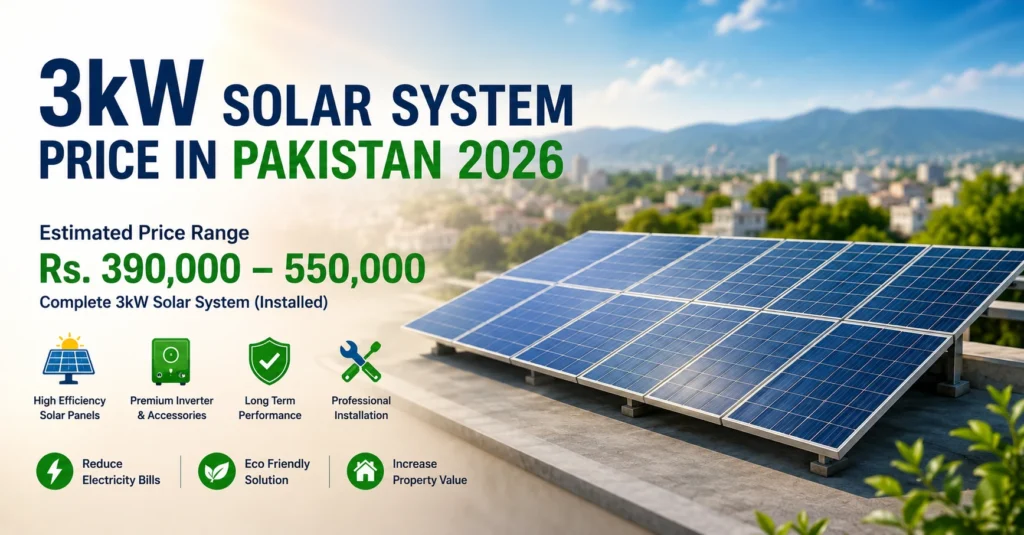
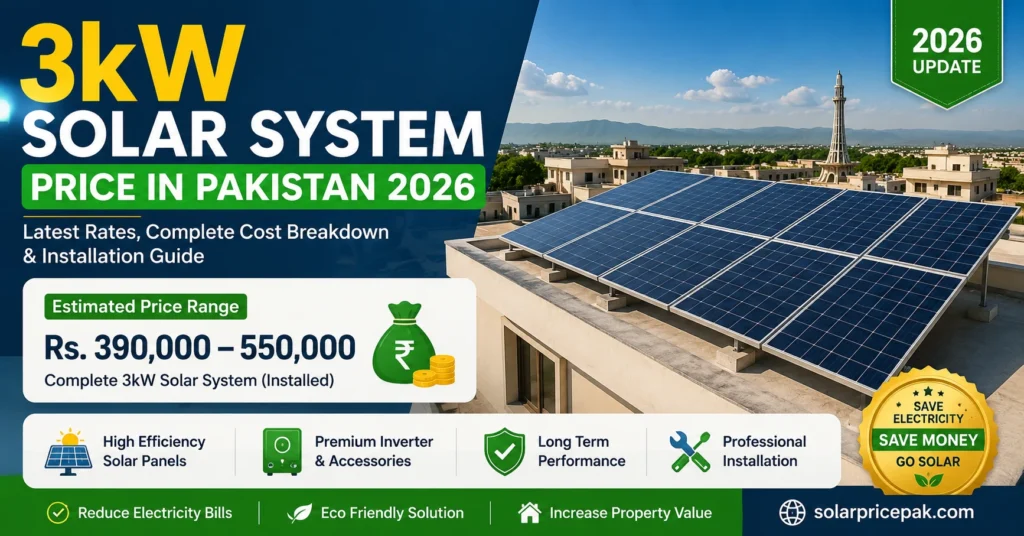
3kW Solar System Price in Pakistan — 2026
Pricing varies more at this size than at 5kW or 10kW, mainly because on-grid, hybrid-without-battery, and hybrid-with-battery configurations sit at very different price points. Here’s a realistic 2026 market range pulled from multiple installers:
| System Type | Price Range (PKR) | Battery Backup | Net Billing Eligible |
|---|---|---|---|
| On-Grid (no battery) | 310,000 – 500,000 | Not included | Yes |
| Hybrid (no battery, ready for one) | 390,000 – 550,000 | Not included | Yes |
| Hybrid (2 tubular batteries) | 390,000 – 600,000 | 3–4 hours | Yes |
| Hybrid (5kWh lithium) | 580,000 – 850,000 | 4–6 hours | Yes |
| Hybrid (10kWh lithium) | 760,000 – 980,000 | 6–8 hours | Yes |
| Off-Grid (full battery bank) | 500,000 – 700,000+ | 8–12 hours | Not applicable |
The spread exists because “3kW system” gets sold at wildly different equipment tiers — a basic on-grid setup with an entry-level Solis inverter and generic panels sits at the low end, while a Tier-1 N-type panel setup with a Huawei or Sungrow hybrid inverter sits at the top. Be wary of any quote well under PKR 300,000 for a complete system — it’s almost always missing earthing, surge protection, or proper cabling, or it’s using an uncertified inverter that won’t qualify for net billing approval.
What a Genuine 3kW Installation Should Include
A proper turnkey 3kW system isn’t just panels bolted to a roof. It should include:
- 5–8 Tier-1 solar panels (550–615W N-type, from brands like Longi, Jinko, Canadian Solar, JA Solar, or Trina)
- A NEPRA-approved 3kW inverter, on-grid or hybrid depending on your needs
- Galvanized steel or aluminum mounting structure, rated for your specific roof
- DC and AC cabling with UV-resistant conduit, all-copper, IEC-rated
- Protection equipment — DC isolator, surge protection devices, MCBs, double earthing
- Net billing/net metering documentation and DISCO filing, handled by the installer
- Professional installation and commissioning, usually 1–3 days
- Workmanship warranty — typically 5 years on installation, 10 years on the inverter, 25 years on panels
If any of these are missing from a quote, it’s not a complete system, regardless of how attractive the headline price looks.
Component-Wise Cost Breakdown
Here’s roughly where the money goes on a standard 3kW hybrid installation:
| Component | Budget Option (PKR) | Premium Option (PKR) |
|---|---|---|
| 5–8 solar panels (550–585W Tier-1) | 95,000 – 130,000 | 130,000 – 165,000 |
| 3kW inverter | 65,000 – 90,000 | 110,000 – 160,000 |
| Mounting structure & rails | 18,000 – 25,000 | 28,000 – 45,000 |
| Wiring, DC/AC cables, DB box | 10,000 – 20,000 | 20,000 – 40,000 |
| Net metering/net billing filing | 30,000 – 40,000 | 40,000 – 60,000 |
| Labor & installation | 12,000 – 25,000 | 20,000 – 45,000 |
| Battery — 2x tubular (200Ah), optional | 70,000 – 85,000 | 95,000 – 120,000 |
| Battery — lithium LFP (5kWh), optional | 160,000 – 220,000 | 220,000+ |
On-Grid vs Hybrid vs Off-Grid: Which One Fits?
On-grid connects straight to the grid and is the cheapest way in — no battery, lower cost, and it earns credit on exported surplus through net billing. The catch: it shuts off automatically during load-shedding, since grid-tied inverters can’t operate without the grid present (a safety feature called anti-islanding).
Hybrid is the most recommended configuration for 2026, and for a specific reason explained below: it keeps you powered through outages and lets you store surplus solar in a battery instead of exporting it for a low credit rate.
Off-grid skips the grid entirely and runs on a large battery bank. For a 3kW residential load, this is rarely worth it in 2026 — battery costs are high, and without a grid connection you get no net billing credit at all. It only makes sense for genuinely remote properties with no WAPDA access.
| Decision | What It Depends On |
|---|---|
| On-grid or hybrid | Required operating modes, essential backup and budget. |
| Grid export | Current company approval and the applicable agreement. |
| Generation and savings | Site conditions, self-consumption and actual tariff. |
| Payback | Complete installed cost, operating costs and documented savings assumptions. |
NEPRA’s 2026 Net Billing Change — Why It Matters for a 3kW System
This is the single most important shift affecting solar economics in Pakistan in the examples below, and it disproportionately affects smaller systems like 3kW, where oversizing used to be a common strategy.
Before February 2026 (net metering):
Every unit exported to the grid was credited at roughly the same rate you’d pay to import — around PKR 22–26 per unit. This made oversizing your system genuinely profitable, since surplus generation was essentially cash-back at retail rates.
Confirm the billing arrangement and applicable import and export rates in your electricity company’s current documents and your approved agreement. Do not use a fixed rate from an older price guide to calculate returns. Our prosumer application guide explains the distinction and where to check current requirements.
| Decision | What It Depends On |
|---|---|
| On-grid or hybrid | Required operating modes, essential backup and budget. |
| Grid export | Current company approval and the applicable agreement. |
| Generation and savings | Site conditions, self-consumption and actual tariff. |
| Payback | Complete installed cost, operating costs and documented savings assumptions. |
The practical takeaway: exporting surplus power is no longer where the value is — using your own solar power directly, or storing it in a battery for nighttime use, is now far more valuable than sending it back to the grid. This is exactly why hybrid systems have become the default 2026 recommendation over plain on-grid setups, even though they cost more upfront.
How Many Panels Do You Need?
Panel count depends on wattage — higher-wattage panels mean fewer panels and a smaller roof footprint.
| Module Power | Count to Reach at Least 3kW DC | Resulting DC Array |
|---|---|---|
| 585W | 6 | 3.51kW |
| 550W | 6 | 3.30kW |
| 500W | 6 | 3.00kW |
| 450W | 7 | 3.15kW |
Most 2026 installations use 5–6 panels at 550–585W, N-type TOPCon technology, which handles Pakistan’s summer heat better than older PERC panels thanks to a lower temperature coefficient, meaning less output loss as panel temperature rises.
How Much Electricity Does a 3kW System Generate?
Output depends heavily on city-level sun hours, and the difference between, say, Sukkur and Islamabad is substantial:
| Generation Input | What Must Be Stated |
|---|---|
| Location and weather | A site-specific solar resource assumption. |
| Array design | Panel capacity, orientation, tilt and shading. |
| System losses | Temperature, inverter, cable, dirt and other losses. |
| Monthly and annual energy | Consistent calculations using the same documented assumptions. |
A well-installed 3kW system on a 5-sun-hour average day comfortably produces 4,000–4,800 units a year — enough to cover the full annual demand of a household in the 200–400 unit monthly range, with a small surplus left over.
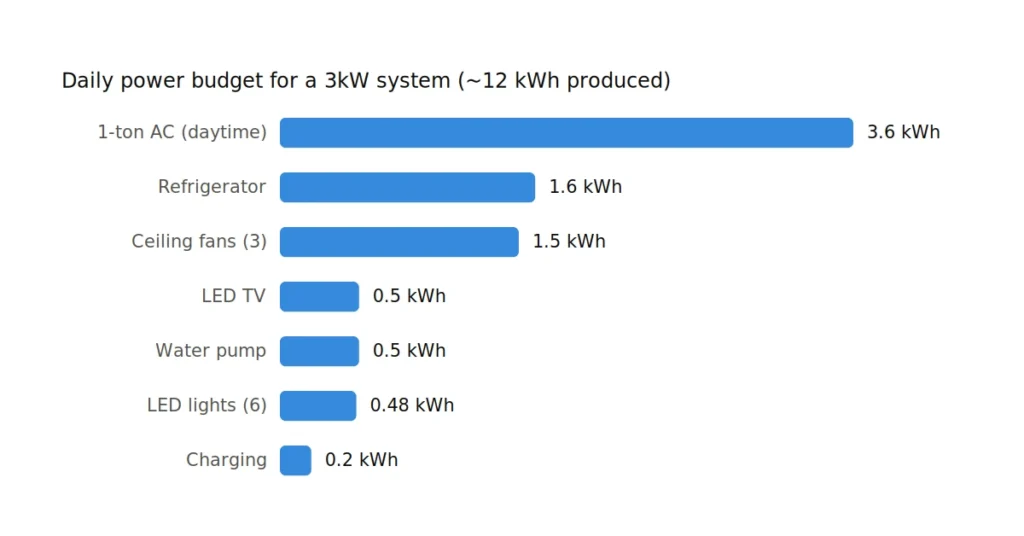
What Can a 3kW System Actually Run?
| Appliance | Wattage | Can It Run? |
|---|---|---|
| 4–6 ceiling fans | 300–360W | Yes |
| 10–15 LED lights | 100–150W | Yes |
| Medium refrigerator | 150–200W | Yes |
| LED TV + router | 200–250W | Yes |
| Laptop/phone charging | 100W | Yes |
| 1-ton inverter AC (daytime) | 800–1,000W | Yes, during peak sun hours |
| 1.5-ton inverter AC | 1,200–1,500W | Risky — likely to overload the system |
| Washing machine | 500W | Yes, but not alongside the AC |
| Small water motor (0.5HP) | 370W | Best run during peak sun hours |
The honest takeaway from installers who’ve done dozens of these systems: a 3kW system rewards households that stagger their heavy loads — running the AC and doing laundry at different times of day, for instance. Households expecting everything to run simultaneously, including a 1.5-ton AC, are usually the ones left disappointed. This isn’t a limitation of a poorly designed system; it’s simply what 3kW of generation capacity means in practice.
ROI and Payback Period — Realistic Numbers
Payback depends on the complete installed cost, generation, on-site use, applicable tariff, maintenance and replacement equipment. Calculate a scenario using actual quotations and your load profile; no fixed recovery period or decades of free electricity can be promised. Use the solar calculator for an illustration with explicit assumptions.
Payback depends on the complete installed cost, generation, on-site use, applicable tariff, maintenance and replacement equipment. Calculate a scenario using actual quotations and your load profile; no fixed recovery period or decades of free electricity can be promised. Use the solar calculator for an illustration with explicit assumptions.
Confirm the billing arrangement and applicable import and export rates in your electricity company’s current documents and your approved agreement. Do not use a fixed rate from an older price guide to calculate returns. Our prosumer application guide explains the distinction and where to check current requirements.
Payback depends on the complete installed cost, generation, on-site use, applicable tariff, maintenance and replacement equipment. Calculate a scenario using actual quotations and your load profile; no fixed recovery period or decades of free electricity can be promised. Use the solar calculator for an illustration with explicit assumptions.
City-Wise Price Differences
Compare dated local quotations including delivery and the same installation scope. This guide does not verify a fixed city premium or discount.
Financing a 3kW System
Very few households pay the full amount upfront, and 2026 has more structured financing options than ever:
Bank solar loans:
KIBOR-linked financing (roughly 15–18% effective, with 1-year KIBOR around 12.5% as of mid-2026) over 5 years works out to an EMI of about PKR 9,500–12,500 a month after a 25% down payment — close to what many households already pay WAPDA. Meezan Bank (Shariah-compliant), JS Bank, and Bank Alfalah are among the lenders active in this space.
Dealer/installment financing:
Several solar retailers now offer direct installment plans without going through a bank, generally at a slightly higher effective rate. As an example, a 3kW hybrid package (without battery) is currently available through Core Energy Solutions on Qistbazaar at PKR 188,800 advance followed by 12 monthly installments of PKR 23,600, with free delivery and installation included — a useful reference point for what no-bank installment pricing looks like for a base hybrid unit.
Agricultural financing:
ZTBL and similar institutions offer subsidized loans for farm and agricultural use, which can apply to 3kW systems used for tube wells or farmhouse loads.
Common Mistakes to Avoid
- Buying on price alone.
A 3kW system advertised well under PKR 300,000 is almost always B-grade or non-Tier-1 panels, which can lose 30–40% of their output within 5 years. - Oversizing under the old logic.
Sizing up “just in case” made sense when net metering paid full retail rates for exports. Under 2026 net billing, oversizing mostly just adds cost without a matching return. - Assuming backup without batteries.
An on-grid system shuts off completely during load-shedding — if reliable backup matters to you, hybrid with a battery is not optional. - Skipping AEDB/NEPRA certification checks.
Net billing applications require a certified installer; going with an unverified one risks a rejected DISCO application. - Ignoring shading.
A water tank, pipe, or neighboring wall casting a shadow on even one panel can drag down the output of an entire string. A proper site survey catches this before installation. - Comparing only upfront battery cost.
Tubular batteries are cheaper upfront (PKR 35,000–45,000 each) but need replacing every 3–4 years. Lithium costs more initially (PKR 70,000–90,000 each) but often works out cheaper over a 10–12 year horizon since it isn’t replaced nearly as often.
Frequently Asked Questions
How much does a 3kW solar system cost in Pakistan in 2026?
A complete on-grid system typically costs PKR 310,000 to 500,000. Hybrid systems with battery backup range from PKR 390,000 for a basic tubular setup up to PKR 980,000 for a 10kWh lithium configuration.
Can a 3kW system run an air conditioner?
Yes — a 1-ton inverter AC can run comfortably during daylight hours alongside normal household load. A 1.5-ton or larger AC is risky on a 3kW system and usually calls for stepping up to 5kW.
Is net metering still available in Pakistan?
Confirm the billing arrangement and applicable import and export rates in your electricity company’s current documents and your approved agreement. Do not use a fixed rate from an older price guide to calculate returns. Our prosumer application guide explains the distinction and where to check current requirements.
How long is the payback period for a 3kW system?
Under 2026 net billing, hybrid systems with strong self-consumption typically pay back in 2–2.5 years, while on-grid systems average 3.5–4.5 years.
How many solar panels does a 3kW system need?
Usually 5 to 8 panels, depending on wattage. Most 2026 installations use 5–6 panels at 550–585W.
Do I need a battery with a 3kW system?
Not necessarily — on-grid systems work fine without one if load-shedding in your area is minimal. If outages run more than a few hours, a hybrid system with battery backup is strongly recommended.
How much roof space does a 3kW system need?
Roughly 195 to 220 sq. ft., or about a 13×15-foot area, which fits comfortably on most residential rooftops, including shared apartment terraces.
Which battery is better — tubular or lithium?
Tubular batteries cost less upfront but need replacing every 3–4 years. Lithium batteries cost more initially but last 10–12 years, often making them cheaper in total cost over a decade or more.
Is a 3kW System Right for You?
| Your Situation | Recommendation |
|---|---|
| Monthly bill PKR 15,000–25,000, small family | 3kW on-grid (low load-shedding areas) |
| Monthly bill PKR 15,000–25,000, want backup | 3kW hybrid with tubular batteries |
| Monthly bill above PKR 30,000, 1.5-ton AC, large family | Consider a 5kW system instead |
| Area with 6+ hours of load-shedding | 3kW hybrid with lithium battery |
| Limited roof space (under 200 sq. ft.) | 3kW is the right fit |
| Tight budget, need to spread payments | Bank or dealer installment plan |
Ready to Go Solar?
Before signing off on a 3kW package, get a proper site survey to confirm your roof space, shading, and actual monthly consumption line up with what a 3kW system delivers — and ask specifically whether the quote includes earthing, surge protection, and net billing documentation, not just panels and an inverter. Reach out for a customized quote based on your home’s real load.