
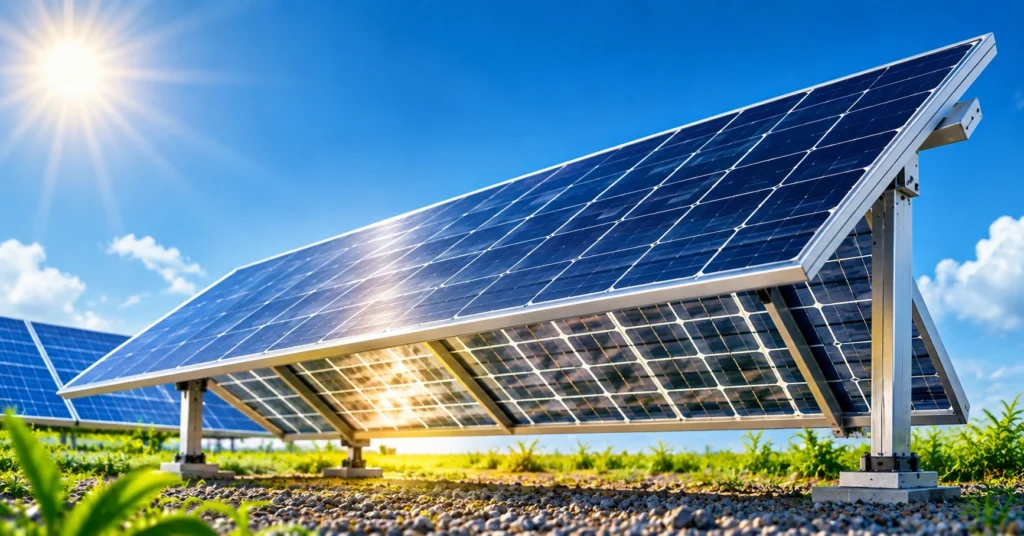
Bifacial solar panels collect light from both faces of the module — the front as usual, plus reflected light reaching the rear. In the right installation they genuinely produce more energy than an equivalent monofacial panel. In the wrong installation, you pay a premium for a rear face that sees nothing but a dark roof. This guide explains when bifacial pays for itself in Pakistan, how to price it fairly, and which installation details decide whether the extra output is real.
First, untangle the labels
Sellers often present “bifacial” as an alternative to “monocrystalline” or “N-type”. It isn’t. Bifacial describes light collection (both sides), monocrystalline describes crystal structure, and N-type describes silicon doping. One panel can be all three at once — many modern bifacial modules are N-type monocrystalline. Comparing “bifacial vs N-type” as competing options is a category error. When a quotation says bifacial, the questions to ask are about the specific module: is rear-side operation documented in its datasheet, what is its bifaciality factor, and what mounting does the manufacturer require? Our panel technology guide maps how these labels overlap.
When bifacial actually earns its premium
Rear-side gain comes from reflected light, so three site conditions decide everything: a reflective surface below (light-coloured roofs, white gravel, concrete), mounting height with clear space behind the modules, and no rear shading from the structure itself, tanks or parapets. Elevated structures — the increasingly common raised “solar sheds” on Pakistani rooftops — are the natural home for bifacial: the height gives the rear face room to breathe, and the shaded area underneath stays usable.
Ground-mounted arrays on light soil or gravel can also benefit. In these setups, documented rear gains of 5–15% are plausible — but insist the gain be estimated for your geometry, not copied from a datasheet scenario. Ask the designer to state the assumed albedo (reflectivity) and mounting height behind their number.
When the premium is wasted
Flush-mounted modules on a dark bitumen or concrete roof see almost no useful rear light — the rear face stares at a surface centimetres away. Paying extra for bifacial there buys you glass-glass construction (which has its own durability merits) but no meaningful energy gain. Similarly, rows packed tightly with no rear access, or structures where purlins and rails shade the back of the modules, strangle the benefit. On a constrained or heavily shaded home roof, a well-chosen monofacial design usually delivers better value per rupee. Be blunt with the seller: “Show me the rear-illumination calculation for my roof.” A promotional percentage applied to every installation is not an engineering estimate.
Considering LONGi’s bifacial options?
Check exact X10 variants, pricing logic and verification steps.
Pricing bifacial fairly
Compare bifacial and monofacial offers with the same discipline: full model codes, delivered cost per watt, identical commercial terms. As a rough, clearly-labelled indication — not a quotation — bifacial modules in Pakistan have recently commanded a modest premium of a few rupees per watt over comparable monofacial models, though the gap varies by brand and supply. The honest comparison is not panel price versus panel price; it is cost per lifetime kWh. A bifacial array that genuinely yields 8% more energy can justify a 5% price premium — but only if the gain is real on your roof. Get a dated written quotation for the exact model, and never let a seller roll an assumed rear gain into the payback calculation without documenting the assumptions. Our price-per-watt method keeps the arithmetic honest.
Installation details that make or break it
Bifacial modules are usually glass-glass: heavier than glass-backsheet, with specific clamp zones and torque requirements in the installation manual. Follow the manual, not the installer’s habits. Cable routing must avoid shading the rear; even a cable clipped across the back of a cell string trims output. The inverter’s current limits need checking against the combined front-plus-rear current the datasheet allows, not the front-side rating alone. And plan cleaning access: a dusty rear face on a dusty site quietly erases the gain you paid for. Include mounting, clearances and access in the installation quotation — pricing panels alone hides the structural cost that bifacial often adds.
Understand the technology first
See how bifacial fits with mono, N-type and TOPCon labels.
Frequently asked questions
Is bifacial worth it on a normal home rooftop?
Usually not, unless the structure is elevated with a reflective surface below. Flush-mounted bifacial on a dark roof gains almost nothing from the rear face.
Do I need a special inverter for bifacial panels?
No special inverter type — but the designer must check current limits against the combined front-plus-rear output, which can exceed the front-side rating used for monofacial strings.
Are glass-glass bifacial panels more durable?
Glass-glass construction resists moisture ingress and PID better than glass-backsheet in many cases, which is a genuine durability plus — separate from the energy-gain question.
How do I verify a real bifacial gain after installation?
Compare metered output against the designer’s documented estimate for your geometry, over several clear months. Monitoring with per-string data (see our sizing guide) is how you catch underperformance early.
4 Responses