Walk into any solar market in Lahore, Karachi or Multan and ask for “the best panel”, and the first question back is usually mono or poly? The honest answer is that crystal type is only one line on a long specification sheet — but it is a useful starting point, because it tells you what kind of product you are being offered and whether the price makes sense.
What the two terms actually mean
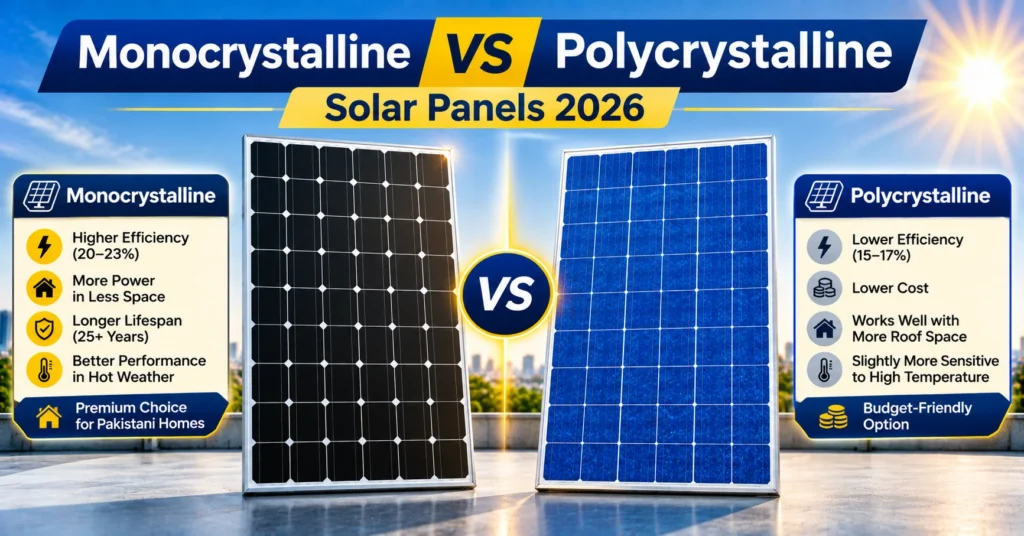
Monocrystalline panels are cut from a single continuous silicon crystal. The cells look uniformly dark, almost black. Polycrystalline panels are cast from multiple silicon fragments melted together; the cells have a speckled blue appearance where the crystal grains meet.
That is all the terms describe: the structure of the silicon. They say nothing about whether a panel is N-type or P-type (that is doping chemistry), whether it uses TOPCon or PERC cell architecture, or whether it collects light from one side or two. A seller who treats “mono” as a synonym for “latest technology” is simplifying beyond what is true — our panel technology guide untangles how these labels overlap.
How they differ in practice
Efficiency and roof space. Mono cells convert a higher share of sunlight into electricity — modern mono modules typically sit in the 21–23% efficiency band, while poly modules were usually 15–18%. On a small roof, that difference decides how many kilowatts you can physically fit.
Price per watt. Poly was historically cheaper to manufacture. As mono production scaled up through the 2020s, the gap narrowed sharply; new poly production has nearly disappeared because the saving no longer justifies the efficiency penalty.
Heat behaviour. Both types lose some output as cell temperature rises. The difference between a decent mono and a decent poly module matters less than the temperature coefficient printed on each datasheet — compare that number, not the crystal label, if your roof bakes from April to September.
Appearance. All-black mono modules suit homeowners who care how the roof looks; speckled blue poly is otherwise a purely cosmetic difference.
Which should you buy in Pakistan?
For new installations, the practical choice is almost always a modern monocrystalline module from a documented manufacturer — not because poly “does not work”, but because the new-panel market has moved on: factories now produce mono, increasingly N-type TOPCon, at prices where poly’s old cost advantage has largely evaporated. See which brands are actually available locally before shortlisting.
Poly still appears in two legitimate contexts: existing systems needing a matching replacement panel, and verified discounted stock. In both cases the decision is about the specific module — its age, condition, test report and inverter compatibility — not about defending poly as a technology. Never pay Tier-1 mono money for unbranded poly stock; compare every offer in rupees per watt to keep quotations honest.
Worried about copy panels?
Learn how to check serial numbers, labels and datasheets before you pay.
Reading the label: what to verify before you pay
Two panels can both be called monocrystalline and still be very different products. Ask the seller to show the module label and the matching datasheet, then check five things: the full alphanumeric model code (brands sell several mono ranges at different prices); the rated power in watts-peak with its tolerance, e.g. 580W at 0/+5W; the dimensions and weight, so you can confirm the roof fit; the warranty split — a product warranty of roughly 10–12 years plus a separate 25–30-year performance warranty; and the flash-test report for your serial numbers, the only factory proof of rated power.
Finally, confirm the seller is an authorised distributor or can name their supply chain. In Pakistan’s market the expensive mistake is rarely mono-versus-poly — it is paying genuine-panel money for a module whose paperwork cannot be verified. A straight seller answers all five questions; a vague one is your cue to walk away.
Frequently asked questions
Are polycrystalline panels still worth buying new?
Only in narrow cases — a matching replacement for an existing poly array, or verified discounted stock where the per-watt saving is real and documented. For a new rooftop system, current mono modules give more energy per square metre at a comparable per-watt price.
Do mono panels work better in cloudy weather?
Both types generate in diffuse light; neither produces its rated power under heavy cloud. Low-light behaviour varies more between specific models than between crystal types — check the datasheet rather than the label.
How do I know a “mono” panel is not counterfeit?
Match the model code on the physical label to the manufacturer’s datasheet, verify the serial number through the brand’s official channel, and insist on a traceable invoice.
Does an old poly system need replacing with mono?
Not automatically. If the array still meets your energy needs and the inverter is healthy, keep it. Consider an upgrade only when you need more output than the roof can host with the existing modules.
Comparing a specific model?
See how to verify a LONGi Hi-MO X10 offer before you buy.
Content reviewed: October 2026. Prices move with the market — always confirm with a dated written quotation.
3 Responses