
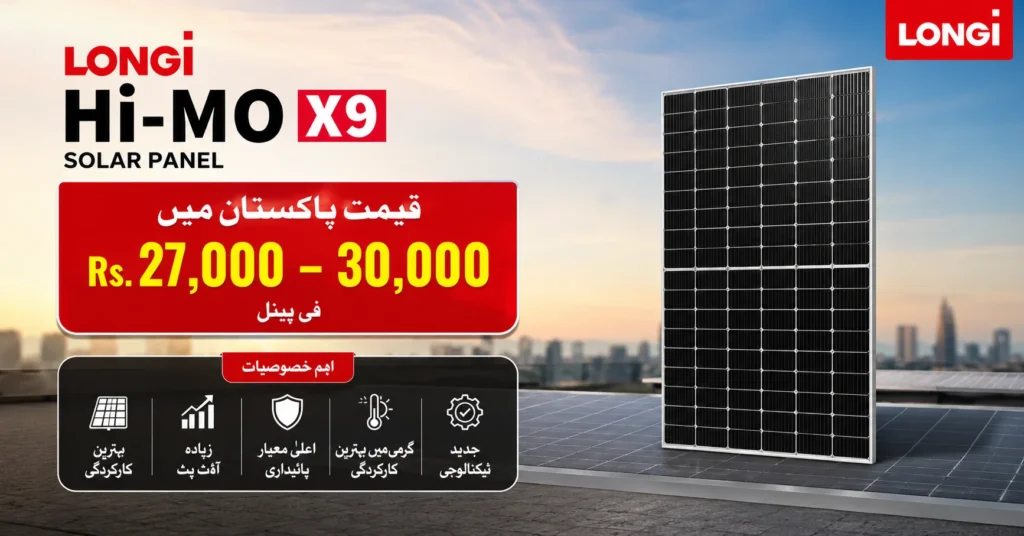
Search “LONGi X9” or “Hi-MO X9” in Pakistan’s solar market and you will find confident listings — for products that may not be the same thing. Supplier naming around this range is inconsistent: some listings mean LONGi’s Hi-MO 9 range, others use “X9” loosely for whatever high-wattage LONGi panel is in stock. Before you compare a single price, you need to establish which product is actually on offer. This guide shows how to pin down the exact module, verify it, and compare it fairly against the alternatives you should actually be considering.
X9 vs Hi-MO 9: resolve the name first
LONGi’s regional documentation identifies Hi-MO 9 products under codes such as LR9-66HYD — a utility-oriented range quite different from the residential Hi-MO X10 family. When a seller writes “X9” on a quotation, ask them to replace the nickname with the full manufacturer module code, the power bin and the datasheet revision, in writing. Then match that code to LONGi’s official documentation yourself. If the seller cannot name the document that governs the delivered product, you are not comparing a panel — you are comparing a rumour.
This matters because specifications shift between revisions and power bins. A review or YouTube video praising “the X9” tells you nothing about the 740W bin quoted to you in Multan. The datasheet revision the seller identifies is the only specification that counts, and it must agree across the quotation, the invoice and the labels on the delivered modules. Our authenticity guide shows how to check labels and serials against manufacturer records.
What a proper X9 quotation contains
Insist on: full module code and power bin, monofacial/bifacial construction, quantity and condition, panel-only price with tax and transport stated separately, and the warranty contact that will handle a claim in Pakistan. Then do the per-watt arithmetic on the delivered panel-only total — our price-per-watt method keeps comparisons honest. As a purely arithmetic illustration (not a market price), a hypothetical 740W module at Rs 29,600 works out to Rs 40/W; use the same division on your real offers and never compare a pallet rate with single-panel retail.
Two warnings specific to this range. First, a manufacturer datasheet establishes specifications — it does not establish today’s retail price or stock in your city. Second, large-format utility modules change the installation: check the datasheet’s dimensions and weight against your roof, handling equipment and mounting design before admiring the wattage.
Comparing with Hi-MO X10 instead?
The residential range, decoded: variants, pricing and checks.
X9 vs X10: which should you actually buy?
For most Pakistani homes, the Hi-MO X10 is the more natural comparison — it is the residential-oriented back-contact range, in sizes like 645W that suit rooftop string design and handling. The Hi-MO 9 / “X9” range leans utility-scale: bigger modules, bigger strings, economies that show up in megawatt projects, not on a 10kW home roof. That does not make X9 bad — it makes the comparison about suitability, not superiority. Compare complete layouts: for a 10kWp target, fourteen 740W modules give 10.36kWp on paper, but roof utilisation, mounting practicality, inverter input windows and handling may favour sixteen smaller modules. Our panel-count guide explains why capacity arithmetic is only the starting point.
Judge the two on delivered cost per watt for equivalent installed scope, the documented temperature and degradation behaviour of the exact bins offered, and which one your installer can actually warrant and service locally.
Bifacial and installation checks
If the offered X9-range module is bifacial, assess it like any bifacial purchase: rear illumination depends on mounting height, surface reflectivity and rear shading — a datasheet gain scenario is not a promise for your roof. Confirm clamp zones, glass-glass handling requirements and cable routing in the installation manual, and have the designer check inverter current limits against front-plus-rear current where the documentation requires it. Keep the invoice, serial records and the identified datasheet revision together; if a warranty question ever arises, that folder is your evidence.
Verify the panels are genuine
Labels, serials and datasheets: the checks that catch fakes.
Frequently asked questions
Is every panel advertised as X9 the same product?
No. Supplier naming is inconsistent. Require the full manufacturer code and matching datasheet before accepting any specification or price comparison attached to the name “X9”.
Can I rely on a regional specification sheet I found online?
Only after matching its revision to the delivered module. Specifications change between revisions and power bins — ask the supplier to identify the applicable document in writing.
Is a bigger X9 module always better for my home?
No. Confirm roof structure, dimensions, handling, mounting and inverter limits. High wattage per panel does not establish suitability for a small residential roof.
X9 or X10 for a typical 10kW home system?
Usually X10: the sizes, string characteristics and installer familiarity suit residential roofs better. Choose X9 only if a like-for-like installed comparison shows clear value for your specific site.
2 Responses