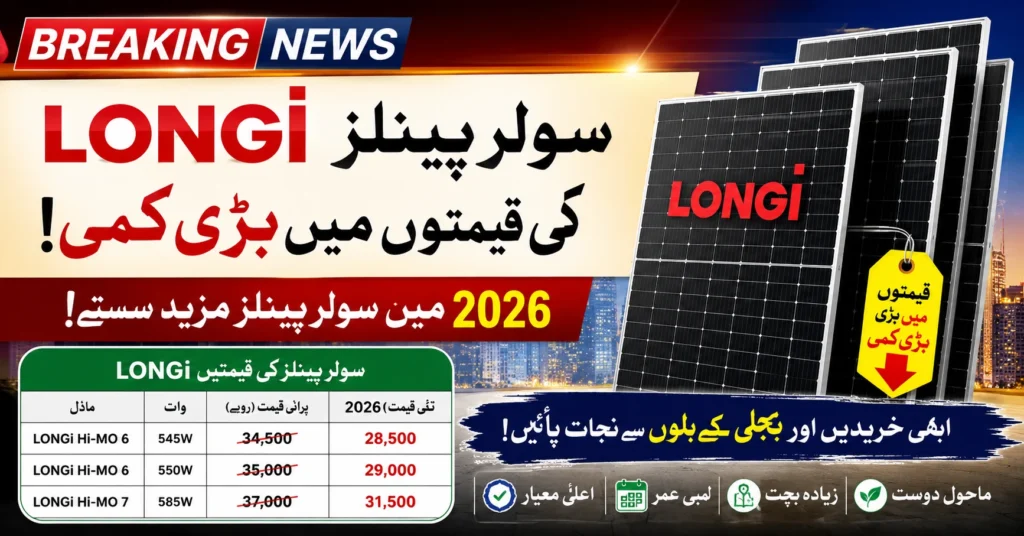
LONGi is the world’s largest manufacturer of monocrystalline silicon wafers, and its Hi-MO panel series dominate Pakistan’s premium segment. But “LONGi solar panel” is not a product — it is a brand covering several Hi-MO generations (Hi-MO 7, Hi-MO X6 and the newer back-contact Hi-MO X10), each with different efficiency, dimensions and pricing. A quotation that says only “LONGi 580W” has told you almost nothing. This guide shows how to pin down exactly what you are being offered and what it should cost.
Know your Hi-MO generation
The three series you will encounter: Hi-MO 7 — the previous mainstream N-type workhorse, still widely stocked and often the value pick; Hi-MO X6 — the earlier back-contact (HPBC) series, high efficiency, now largely superseded; Hi-MO X10 — the current HPBC 2.0 back-contact flagship with the highest efficiency and the highest price. Sellers sometimes quote old X6 or Hi-MO 7 stock at near-X10 prices to uninformed buyers. Always ask which series, then confirm the full model code against LONGi’s official datasheet. The technology guide explains what back-contact and TOPCon actually mean for you.
Also see the LONGi Hi-MO X9 solar guide.
Indicative price guidance
Labelled clearly as budgeting estimates, not quotations: LONGi Hi-MO 7 / mainstream N-type modules have recently traded around Rs 38–44/W in major Pakistani cities, while the premium Hi-MO X10 back-contact series sits noticeably higher — recent market tracking put it around Rs 42–46/W. Convert every offer with our per-watt method and compare identical series and model codes across sellers. Prices move with the dollar and with stock cycles, so always demand a dated written quotation naming the exact series before deciding.
Deep dive: the Hi-MO X10 flagship
Variant identification, quote checklist and when the premium is worth it.
Old stock vs new series: the trap
The most expensive mistake in the LONGi market is paying X10 money for X6 or early Hi-MO 7 panels. Protect yourself: photograph the module label (it states the series), check the manufacturing date where available, and confirm the datasheet revision matches. Older stock is not bad — at the right discounted Rs/W it can be excellent value — but it must be priced as older stock. A seller who cannot or will not name the series is either uninformed or hoping you are.
The buying checklist
- Full model code + series name on the quotation, matching the module label and datasheet.
- New condition confirmed in writing (not “A-grade”, not “original copy” — new).
- Price per watt calculated on delivered cost; compared across two sellers on the identical model.
- Product and performance warranty documents, with the Pakistani claim contact named.
- Serial numbers recorded at delivery and verified through LONGi’s process — see our authenticity guide.
How LONGi compares to rivals
LONGi vs Jinko vs Canadian Solar vs JA — model-level comparison.
When the LONGi premium is — and isn’t — worth it
LONGi modules typically cost a little more per watt than the cheapest Tier-1 alternatives, so the premium needs a reason. It is worth paying when your roof is small (higher efficiency fits more kilowatts into limited space), when you are buying the X10 series for its lower long-term degradation, or when your installer’s strongest distributor relationship — and therefore your most reliable warranty — is with a LONGi channel. It is not worth paying when roof space is plentiful and the quote is for mainstream Hi-MO 7 stock at X10-adjacent pricing; in that case a Jinko or JA module at a lower Rs/W delivers the same annual energy for less. The premium must always buy something specific: efficiency, degradation, or warranty certainty — never just the logo.
Frequently asked questions
Which LONGi series is best for a home roof?
For most homes, Hi-MO 7 N-type stock at a good Rs/W is the sweet spot. Choose X10 only if roof space is tight (its higher efficiency fits more watts per square metre) or you specifically value the lower long-term degradation.
Why do LONGi prices vary so much between sellers?
Different series quoted under the single word “LONGi”, different stock ages, pallet vs single-panel pricing, and different warranty backing. Standardise on the full model code and Rs/W and the mystery usually resolves.
Are LONGi panels good in high heat?
Their N-type modules have competitive temperature coefficients — check the exact figure on your model’s datasheet. Good heat performance is a model property, not a brand property.
How can I be sure my LONGi panels are original?
Match model code and serials to the datasheet and verify through LONGi’s official channels; buy through authorised distributors. Full method: our authenticity verification guide.
One Response