
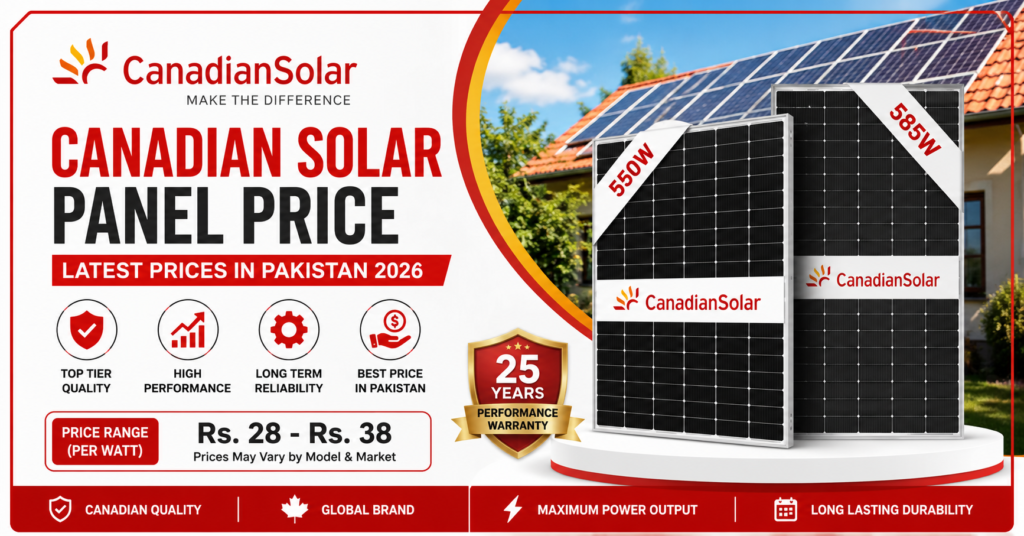
Canadian Solar is one of the world’s most bankable panel manufacturers, with a history stretching back to 2001 and gigawatts deployed on every continent. In Pakistan it sits in the familiar Tier-1 cluster alongside LONGi, Jinko, JA and Trina — which means a Canadian Solar quotation deserves the same rigorous treatment as any other: identify the exact module, verify the price per watt, and confirm the warranty chain. “Canadian Solar 580W” on a shop board is a starting point for questions, not a product description.
Identify the module family first
Canadian Solar’s catalogue spans several module families (its HiKu and BiKu ranges being the best known), each with multiple power bins and both monofacial and bifacial variants. Two panels both labelled “Canadian Solar 575W” can differ in cell technology, dimensions and efficiency. Ask the seller for the full manufacturer code from the module label and the matching datasheet — Canadian Solar’s downloads library lists every family with its documents. Photograph the label yourself at delivery and check it against the datasheet before the installer leaves. Our panel technology guide explains what the family names actually mean.
Indicative price guidance
As a clearly-labelled estimate for budgeting (not a quotation): Canadian Solar modules in Pakistan have recently traded in roughly the same band as other Tier-1 mono panels — around Rs 38–44 per watt delivered in major cities, moving with the dollar and stock levels. Reduce every offer to Rs/W using our per-watt comparison method and compare identical model codes across at least two sellers. Be wary of quotes far below the band — discounted “Canadian Solar” stock is a classic label for panels that cannot pass verification. Only a dated written quotation for the exact model counts.
Master the per-watt comparison
One number cuts through every brand claim. Learn to calculate it properly.
Warranty and distributor: the real purchase
Canadian Solar’s standard offering is a ~12-year product warranty plus a ~25–30-year performance warranty — but warranties are only as real as the party honouring them. Before paying, get written answers to: which Pakistani distributor imported these exact panels, where is their service centre, and what is the claim process? A genuine authorised channel answers without hesitation. A seller who gets vague here is selling you a warranty-shaped hope. Keep every document — invoice, datasheet, serial list — in one file; warranty claims years from now will ask for exactly these. Cross-check the serial numbers through the manufacturer’s verification process as described in our authenticity guide.
Canadian Solar vs the field
Head-to-head against Jinko or LONGi at the same Rs/W, Canadian Solar is a lateral move, not an upgrade or a compromise — the differences that matter are the specific model’s efficiency, temperature coefficient and your installer’s familiarity with it. Where Canadian Solar sometimes wins in Pakistan is availability: its broad distribution means your installer can often source matching panels months later if you expand the array — a genuine practical advantage over a brand your dealer stocks once. See how all five major brands compare in our brand comparison guide, and understand the underlying cell differences in mono vs poly explained.
See the full brand landscape
How Canadian Solar stacks up against LONGi, Jinko, JA and Trina.
Frequently asked questions
Are Canadian Solar panels good for Pakistan’s climate?
Yes — they are deployed in hot climates worldwide. As always, check the temperature coefficient on your exact model’s datasheet rather than relying on the brand name; that number governs hot-afternoon output.
Why is one seller much cheaper than another for “the same” panel?
Usually it is not the same panel: different series, older stock, pallet vs single-panel pricing, or missing warranty backing. Demand the full model code from both and compare Rs/W on identical terms.
How do I verify my Canadian Solar panels are genuine?
Record the full model code and serial numbers, match them against the datasheet, and use the manufacturer’s verification channels. Our step-by-step authenticity guide covers the process.
Monofacial or bifacial — which Canadian Solar should I choose?
Bifacial only pays on elevated structures with reflective ground beneath — a typical flush residential roof gains little. For most homes, monofacial at a lower Rs/W is the better buy.
What documents should I keep after purchase?
The invoice with exact model codes, the datasheet, your serial-number list with label photographs, and the written warranty terms. Store them together — in ten years, when a performance question arises, these four items are the entire difference between a claim and a shrug.
2 Responses