
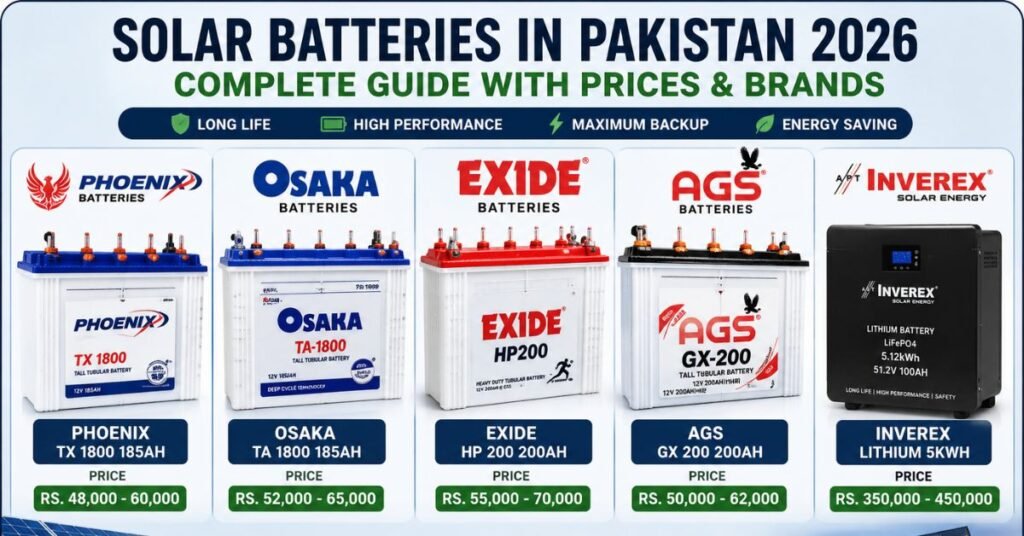
Batteries are where solar budgets go to die — not because batteries are bad, but because buyers compare the wrong numbers. A battery that starts a car brilliantly can fail miserably at running your home through load shedding, and two batteries with the same “100Ah” label can store very different amounts of usable energy. This guide explains how to match a battery to its actual job, compare chemistries honestly, and read the specifications that determine whether your lights stay on.
Start with the job, not the brand
Three common jobs need three different batteries. A vehicle starting battery delivers huge bursts of current for seconds — it is the wrong tool for hours of household backup and will die young in that role. A UPS/inverter battery handles regular charge-discharge cycles for load shedding backup. A deep-cycle solar battery is built for daily cycling with solar charging. Before comparing any two products, write down your job: which appliances, for how many hours, how many days per week. A buyer who needs 4 hours of evening backup for fans and lights needs a fundamentally different product than one running a solar tube well daily. Our battery backup-time calculator guide shows how to convert your appliance list into a storage requirement. For planning daytime solar use and nighttime backup as two separate plans, see our daytime solar and nighttime backup planning guide.
Chemistry choices in plain language
Flooded lead-acid (the traditional tall batteries) are the cheapest per nominal Ah, need ventilation and periodic water top-ups, and tolerate abuse reasonably — but they are heavy, and their usable energy is limited by how deeply you should discharge them. Sealed AGM/GEL batteries cost more, need no watering, handle deeper discharge a little better, and suit indoor installations where ventilation is poor. Lithium (LiFePO4) costs the most upfront but delivers the most usable energy per kilogram, far more charge cycles, and stable voltage — for daily solar cycling, the lifetime economics often favour lithium despite the sticker shock.
For any lithium offer, demand the full specification: exact chemistry, built-in BMS features, permitted voltage platform and the manufacturer’s list of compatible inverters. The word “lithium” alone is not a specification. Compare model-specific options in our Osaka battery guide and AGS battery guide.
How much backup will a battery give you?
Work it out from your appliances before you buy — not after.
Nominal capacity vs usable energy
This is the single most misunderstood number in battery buying. Volts × Amp-hours gives nominal watt-hours: a 12V 100Ah battery nominally holds 1.2kWh. But you cannot use all of it. A flooded lead-acid battery regularly discharged to empty will fail within months; its practical usable energy is roughly half the nominal figure. AGM/GEL stretches a bit further; lithium (LiFePO4) routinely allows 80–90% usable depth. Then the inverter takes its own cut — conversion losses of 5–15% depending on load and quality.
So that “100Ah” battery might deliver anywhere from ~0.5kWh to ~1.0kWh of real backup depending on chemistry and inverter. Always compare usable energy for your discharge pattern, and ask the seller to state the usable figure in writing rather than letting the Ah number do the talking.
Power limits matter as much as storage hours
A battery bank can hold enough energy for the night and still fail at 7pm — because starting a refrigerator compressor or a water pump demands a surge of power, not just stored energy. Check the battery’s continuous and peak discharge ratings (in watts or amps), the BMS current limit on lithium units, and the inverter’s supported output. A 5kW inverter paired with a battery that can only discharge 1kW gives you a 1kW system wearing a 5kW badge. Document your loads’ running watts and starting surges separately, and confirm the whole chain — battery, BMS, cables, inverter — supports the largest surge. Our hybrid inverter guide explains how to match storage to the inverter.
Comparing prices without fooling yourself
Request dated quotations for equivalent usable energy and supported power, with tax, delivery, activation, installation, protection and any old-battery exchange stated separately. Never compare a bare vehicle-battery price with a complete installed solar-storage price — they are different products. As a rough, clearly-labelled indication (not a quotation), a basic 100Ah-class flooded backup battery in Pakistan has recently sold in the low-to-mid teens of thousands of rupees, while lithium options cost multiples of that for equivalent nominal capacity — but deliver far more usable cycles. The cheapest battery is rarely the cheapest backup: divide the price by the warranted throughput (cycles × usable kWh) and the ranking often flips. Check warranty terms for cycling limits and throughput caps — a “2-year warranty” that excludes daily cycling is not a solar battery warranty.
Compare the two big local brands
Osaka vs AGS model-by-model: prices, warranties and checks.
Frequently asked questions
Does a 5kW inverter need a 5kWh battery?
Not by definition. kW is power, kWh is energy. Match the battery’s discharge capability to your simultaneous load and its usable energy to your required runtime — the two numbers are independent.
Can I mix old and new batteries in one bank?
Only in manufacturer-approved arrangements. Mixed age or capacity leads to unequal charging, premature failure of the new units, and usually voids the warranty. Have the installer assess the bank before any expansion.
How long should a solar battery last?
Flooded lead-acid in daily cycling: roughly 2–4 years with disciplined maintenance. AGM/GEL: somewhat longer. Quality lithium: often 8–12+ years. Heat, over-discharge and wrong charge settings shorten all of them. When the bank is due for replacement, see our guide to replacing a solar battery bank.
What must the quotation include?
Complete model, chemistry, voltage, nominal and usable capacity, supported power, inverter compatibility, warranty terms with cycling conditions, and the full installed scope. Anything less is not comparable.
12 Responses