
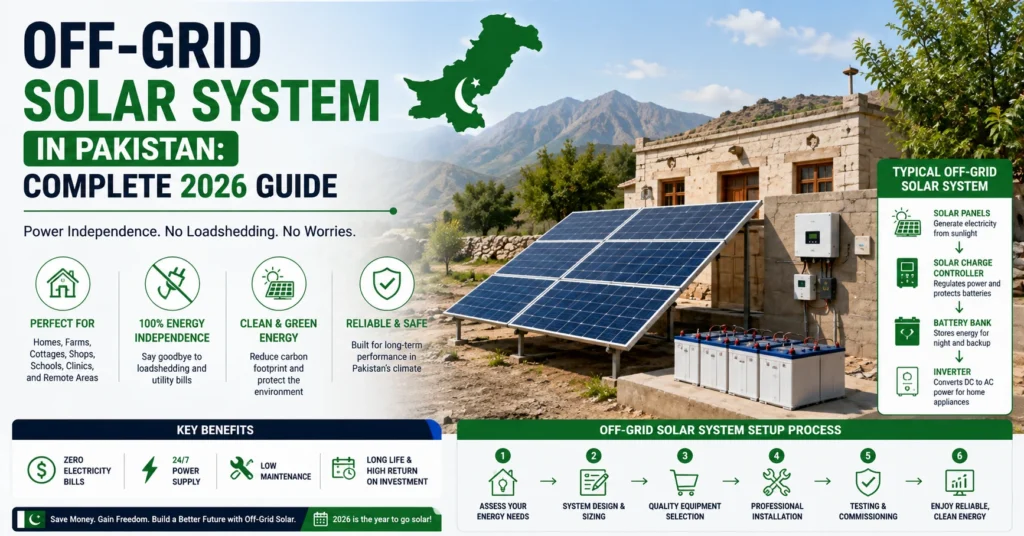
An off-grid solar system supplies specified loads without relying on grid export. Its design must cover the property’s energy demand, short periods of poor solar generation and the power required when several appliances start or operate together.
Size the Battery and the Backup Plan
Record essential loads in watts and operating hours, then calculate their energy requirement. Ask how the system handles cloudy weather, low battery charge and large starting loads. Compare usable battery capacity rather than nominal capacity alone, and confirm whether an alternative charging source is required.
Price context: Numerical prices elsewhere in this article are previously published indicative estimates. They have not been independently reverified as live supplier quotations during this content review. Confirm a dated quote for the exact model, quantity, tax, delivery and warranty before buying. Solar Price Pak publishes information and does not sell or install equipment.
Unlike an on-grid system, an off-grid setup generates electricity from solar panels and stores excess energy in batteries. The stored power can then be used at night, during cloudy weather, or when there is no grid electricity.
In this guide, we’ll explain the Off-Grid Solar System in Pakistan, how it works, its components, off-grid solar system price in Pakistan, battery requirements, 5kW systems, advantages and disadvantages, and the difference between off-grid and on-grid solar.
What Is an Off-Grid Solar System?
An Off-Grid Solar System is a self-sufficient solar power system that operates independently of the national electricity grid. It generates electricity through solar panels and stores unused energy in batteries for later use.
During daylight hours, solar panels convert sunlight into DC electricity. Some of this electricity can immediately power household appliances, while excess energy is sent to the battery bank. At night or during periods of low sunlight, the batteries provide stored electricity through an inverter.
An off-grid system can be particularly useful for:
- Homes in remote areas
- Farmhouses
- Rural properties
- Shops and small businesses
- Construction sites
- Areas with unreliable electricity
- Properties where a grid connection is unavailable or expensive
The major difference is simple: an off-grid system does not need the electricity grid to operate.
How Does an Off-Grid Solar System Work?
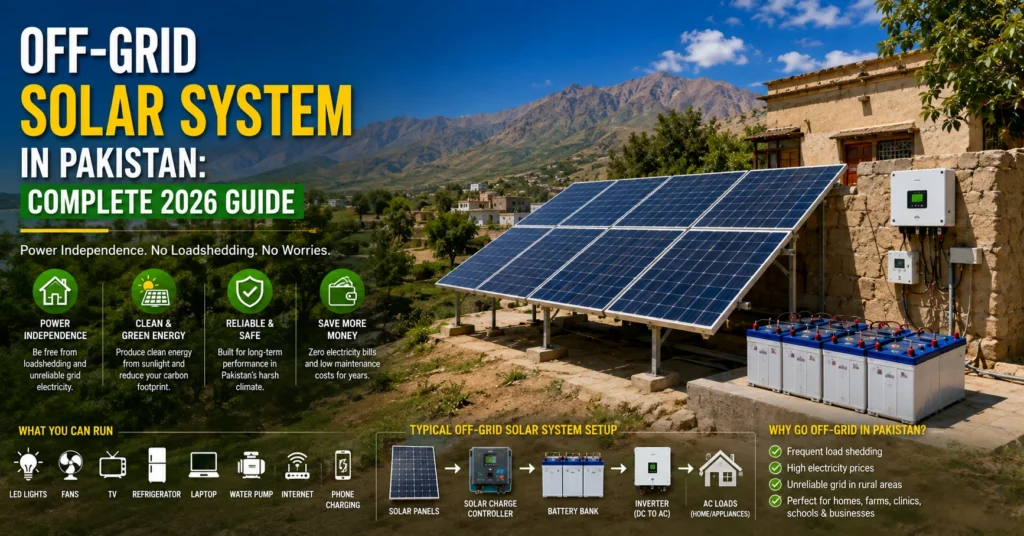
The working process of an off-grid solar system Pakistan setup can be understood in four basic stages.
1. Solar Panels Generate Electricity
Solar panels capture sunlight and convert it into DC electricity. The amount of electricity generated depends on panel capacity, sunlight availability, temperature, shading, and installation orientation.
2. Charge Controller Manages the Energy
A charge controller regulates electricity flowing from the solar panels to the batteries. It helps prevent overcharging and protects the battery bank.
Modern systems commonly use MPPT charge controllers because they can efficiently manage power from the solar array.
3. Batteries Store Excess Electricity
During sunny hours, unused solar energy is stored in batteries. This stored electricity becomes important after sunset or when solar production is low.
This is why an off-grid solar system with battery storage is different from many conventional grid-connected systems.
4. Inverter Supplies Usable Electricity
Solar panels and batteries produce DC electricity, while most household appliances use AC electricity.
The inverter converts DC power into usable AC electricity for appliances such as:
- Other household equipment
- Lights
- Fans
- Refrigerators
- Televisions
- Computers
- Water pumps
Off-Grid Solar System Diagram
A simple off-grid solar system diagram can be represented as:
Sunlight → Solar Panels → Charge Controller → Battery Bank → Inverter → Home Appliances
In some systems, the inverter and charge controller are integrated into one hybrid/off-grid inverter. A backup generator can also be added where longer periods of cloudy weather or heavy loads are expected.
The important point is that the battery bank acts as the main energy reserve because there is no utility grid available as a backup.
Main Components of an Off-Grid Solar System
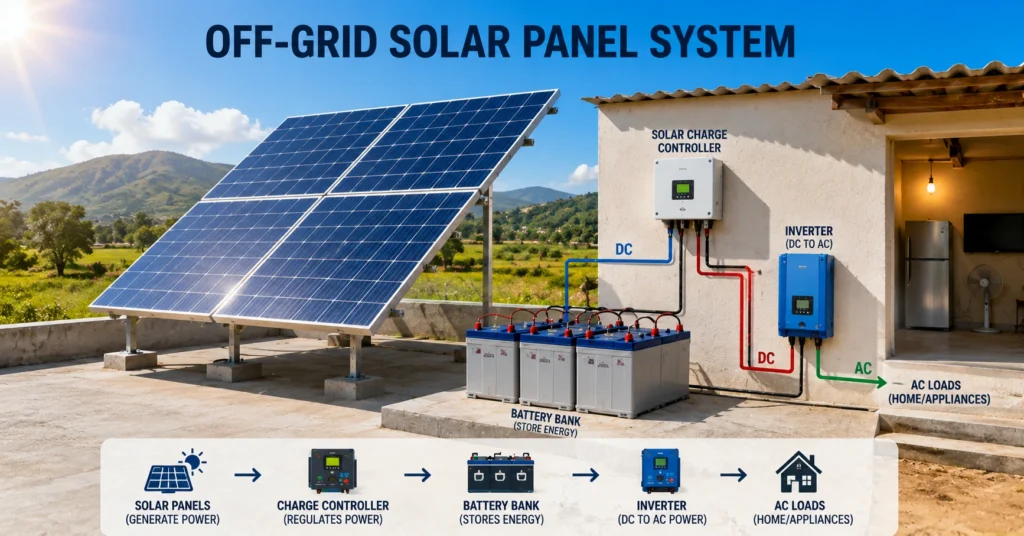
A complete Off-Grid Solar System normally includes several important components.
Solar Panels
Solar panels are responsible for generating electricity from sunlight. High-quality panels can provide better energy production and long-term reliability.
For Pakistan, panel selection should also consider heat, dust, installation conditions, available roof space, and expected energy consumption.
Solar Batteries
Batteries are one of the most important parts of an off-grid system because they store energy for later use.
Common options include:
Lithium batteries:
These generally provide a longer service life, good energy efficiency, and lower maintenance requirements.
Lead-acid batteries:
These can have a lower upfront cost but generally require more maintenance and may have a shorter useful life depending on the type and usage.
The required battery capacity depends on how much electricity you need at night and how many hours or days of backup you want.
Off-Grid Inverter
The inverter converts DC electricity into AC electricity for household appliances. It should be selected according to your expected load and peak power requirements.
A properly sized inverter also needs to handle starting surges from appliances such as refrigerators, pumps, and motors.
Charge Controller
The charge controller controls the charging process between the solar panels and battery bank.
MPPT technology is commonly preferred because it can optimize the available solar energy under changing operating conditions.
Mounting Structure
Solar panels need a strong mounting structure that keeps them secure and positioned for good sunlight exposure.
Wiring and Protection Equipment
Cables, breakers, fuses, disconnects, grounding equipment, and other protection devices are also required for a safe installation.
Off-Grid Solar System Price in Pakistan
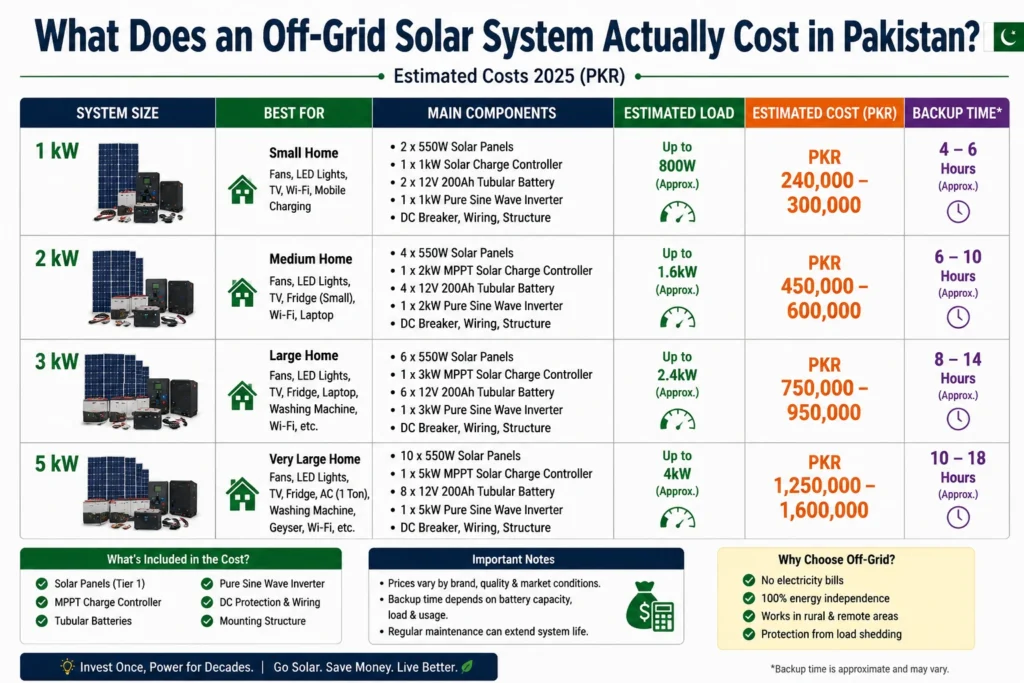
The off-grid solar system price in Pakistan varies considerably depending on system capacity, battery technology, inverter brand, panel quality, installation requirements, and backup duration.
Based on the price ranges provided in the source material, estimated system costs are:
| System Size | Estimated Price in Pakistan |
|---|---|
| 3kW Off-Grid System | PKR 700,000 – 900,000 |
| 5kW Off-Grid System | PKR 900,000 – 1,200,000 |
| 10kW Off-Grid System | PKR 1,800,000 – 2,500,000 |
These should be treated as estimated ranges rather than fixed market prices. Actual quotations can vary depending on the battery capacity and equipment selected.
What Affects Off-Grid Solar System Price?
Several factors can change the final off-grid solar system price, including:
- Solar panel wattage and quantity
- Battery type
- Battery capacity
- Inverter capacity
- Inverter brand
- Mounting structure
- Installation charges
- Wiring and protection equipment
- Required backup time
- Roof or site conditions
The battery bank can make a particularly large difference to the total cost because off-grid systems need sufficient storage to operate when solar production is unavailable.
5kW Off-Grid Solar System
A 5 kW off-grid solar system is a popular option for homes with moderate electricity requirements.
A typical 5kW setup may include:
- Around 5kW or more of solar panel capacity
- 5kW off-grid or suitable hybrid inverter
- Battery bank
- Solar charge controller, if not integrated into the inverter
- Mounting structure
- DC and AC protection
- Wiring and connectors
However, a 5kW system does not automatically mean that every appliance in a house can run simultaneously.
The inverter determines the maximum instantaneous load it can handle, while the battery determines how long appliances can continue operating when solar generation is unavailable.
What Can a 5kW System Run?
Depending on the design and battery capacity, a 5kW system can potentially support appliances such as:
- Fans
- LED lights
- Refrigerator
- Television
- Computers
- Washing machine
- Water pump
- Selected kitchen appliances
High-power appliances such as electric heaters, large air conditioners, electric ovens, and geysers can significantly increase the required system size and battery capacity.
Off-Grid Solar System for Home
An off-grid solar system for a home should be designed according to actual electricity consumption rather than simply selecting a system based on house size.
Before purchasing a system, homeowners should calculate:
- Daily electricity consumption
- Maximum simultaneous load
- Nighttime electricity usage
- Required backup duration
- Available roof space
- Average sunlight conditions
- Battery capacity requirements
For example, a household that consumes relatively little electricity but wants long nighttime backup may need a larger battery bank rather than simply adding more solar panels.
On the other hand, a home with high daytime consumption may require a larger solar array.
How to Calculate the Right Off-Grid Solar System Size
Correct sizing is one of the most important parts of an off-grid installation.
Step 1: Calculate Daily Energy Consumption
List your appliances, their wattage, and the number of hours they operate each day.
For example:
| Appliance | Power | Daily Usage |
|---|---|---|
| LED Lights | 100W | 5 hours |
| Fans | 300W | 8 hours |
| Refrigerator | 200W average | 10 hours |
| TV | 120W | 4 hours |
| Computer | 150W | 5 hours |
The actual energy requirement should be calculated using the specific appliances in your home.
Step 2: Calculate Peak Load
Add the power requirements of appliances that may operate simultaneously.
This helps determine the appropriate inverter size.
Step 3: Determine Battery Backup
Decide how much electricity you need after sunset and how many hours of backup you require.
Step 4: Size the Solar Array
The solar array must produce enough electricity to power daytime loads and recharge the batteries.
Step 5: Account for Poor Weather
An off-grid system should not be designed only around perfect sunny days. Cloudy weather and seasonal changes can reduce solar generation, so adequate battery storage and appropriate system sizing are important.
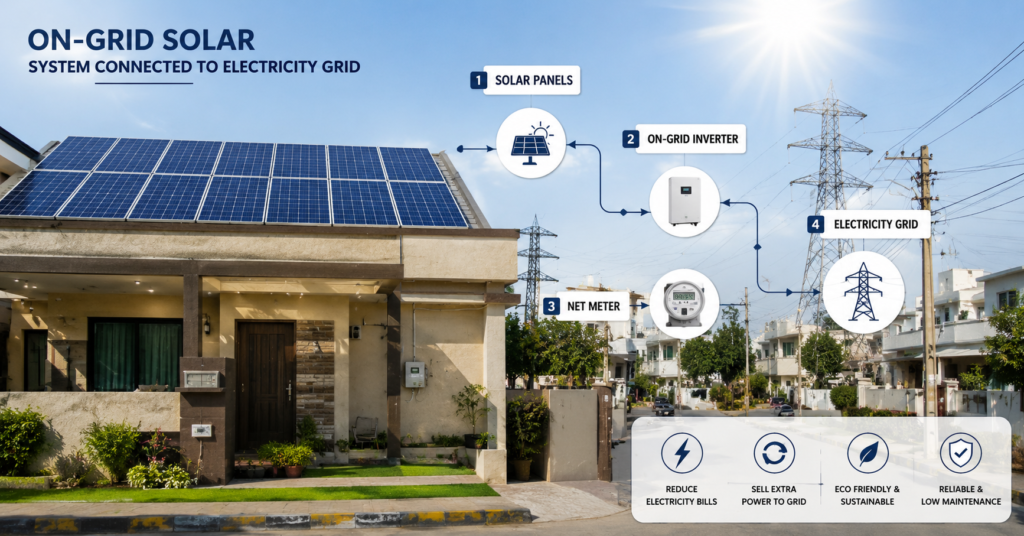
Off-Grid Solar System vs On-Grid
One of the most important decisions for a solar buyer is understanding off-grid solar system vs on-grid technology.
| Feature | Off-Grid Solar | On-Grid Solar |
|---|---|---|
| Grid Connection | No | Yes |
| Battery | Required | Usually optional |
| Works During Grid Outage | Yes | Usually no |
| Net Metering/Export | No | Possible depending on applicable rules |
| Energy Independence | High | Lower |
| Initial Cost | Higher | Usually lower |
| Best For | Remote/unreliable-grid areas | Homes with grid access |
An off-grid system stores excess electricity in batteries, while an on-grid system can use the utility grid to balance electricity supply and demand.
Which Is Better?
There is no single answer for everyone.
An off-grid solar system can be a better choice if:
- Grid electricity is unavailable
- Your area has frequent outages
- You live in a remote location
- You want independent power
- You need electricity during grid failures
An on-grid system may be more suitable where the electricity grid is available and reliable enough for your needs.
Advantages of an Off-Grid Solar System
Energy Independence
One of the biggest advantages is independence from the utility grid. You generate and store your own electricity.
Backup During Load Shedding
Because the system includes batteries, properly sized systems can continue powering connected loads during grid outages.
Suitable for Remote Locations
Off-grid solar is especially useful where extending the electricity grid would be difficult or expensive.
Lower Dependence on Electricity Bills
Once installed, sunlight itself does not have a monthly electricity charge. However, batteries, maintenance, replacements, and other operating costs still need to be considered.
Environmentally Friendly
Solar energy reduces reliance on conventional fossil-fuel-based electricity generation and can support cleaner energy production.
Disadvantages of an Off-Grid Solar System
Despite its benefits, an off-grid system also has some limitations.
Higher Initial Cost
Batteries significantly increase the upfront cost compared with many grid-connected systems.
Battery Replacement
Batteries have a limited service life and may eventually need replacement.
Limited Energy Storage
If the battery becomes depleted and solar production is low, available electricity can become limited.
Requires Proper Sizing
An incorrectly designed system may not provide sufficient power during cloudy weather or periods of high consumption.
Excess Solar Energy May Be Wasted
If the batteries are full and household consumption is low, additional solar energy may not have anywhere useful to go because there is no grid connection for export.
Off-Grid Solar System With Battery: How Much Storage Do You Need?
Battery storage is the heart of an off-grid system.
The required capacity depends on:
- Daily energy consumption
- Nighttime load
- Desired backup hours
- Battery technology
- Depth of discharge
- Inverter efficiency
- Weather conditions
For example, someone who only wants to operate lights and fans at night will have significantly different battery requirements from a household that wants to run air conditioning, refrigerators, pumps, and other high-load appliances.
For this reason, choosing a battery only according to its advertised capacity is not enough. The usable capacity and expected operating conditions should also be considered.
Lithium vs Lead-Acid Batteries for Off-Grid Solar
| Feature | Lithium Battery | Lead-Acid Battery |
|---|---|---|
| Initial Cost | Higher | Lower |
| Lifespan | Generally longer | Generally shorter |
| Maintenance | Low | Can be higher |
| Usable Capacity | Generally higher | Generally lower |
| Weight | Lighter | Heavier |
| Long-Term Performance | Strong | Depends on battery type and maintenance |
Lithium batteries are often attractive for modern off-grid installations because of their efficiency and lifespan. Lead-acid batteries can still make sense where initial budget is a major consideration.
Best Off-Grid Solar System: What Should You Choose?
The best off-grid solar system is not necessarily the system with the most expensive panels or the biggest inverter.
Instead, it should be properly matched to your:
- Electricity consumption
- Peak load
- Battery backup requirement
- Budget
- Available installation space
- Local sunlight conditions
- Future electricity needs
A good system combines compatible solar panels, batteries, inverter, protection equipment, and professional installation.
Off-Grid Solar System Installation Process
Installing an off-grid system involves several stages.
1. Energy Audit
First, determine how much electricity the property consumes.
2. Site Assessment
The installer checks available roof or ground space, shading, orientation, and installation conditions.
3. System Design
The required solar capacity, inverter, battery bank, wiring, and protection equipment are selected.
4. Solar Panel Installation
Panels are securely installed at an appropriate orientation and angle.
5. Battery and Inverter Installation
The battery bank and inverter are installed in a suitable, safe location.
6. Electrical Connections
Panels, batteries, inverter, protection devices, and household circuits are connected according to the system design.
7. Testing and Commissioning
The complete system is tested before being placed into regular operation.
Professional installation is important because incorrect wiring, inadequate protection, or poor battery configuration can reduce performance and create safety risks.
How to Maintain an Off-Grid Solar System
An off-grid system requires regular attention to maintain good performance.
Clean Solar Panels
Dust and dirt can reduce solar generation. Panels should be cleaned when necessary, especially in dusty environments.
Monitor Battery Health
Battery voltage, state of charge, temperature, and other available monitoring information should be checked regularly.
Inspect Wiring
Loose connections, damaged cables, corrosion, or overheating should be addressed promptly.
Check the Inverter
Monitor inverter alerts and error messages and make sure ventilation is not blocked.
Professional Inspection
A periodic professional inspection can help identify problems before they become expensive failures.
Is an Off-Grid Solar System Worth It in Pakistan?
For many Pakistani households and businesses, an off-grid system can be worthwhile when reliable electricity is more important than minimizing the initial investment.
It can be particularly valuable in:
- Rural areas
- Farmhouses
- Remote properties
- Areas with frequent load shedding
- Locations where grid connection is unavailable
- Businesses that cannot tolerate long outages
However, people living in areas with reliable grid electricity should compare the higher battery-related cost of an off-grid system with other solar options before making a decision.
The right choice ultimately depends on electricity consumption, backup requirements, location, and budget.
Frequently Asked Questions
What is an off-grid solar system in Pakistan?
An off-grid solar system in Pakistan is a solar power setup that operates independently from the national electricity grid. It uses solar panels to generate electricity and batteries to store energy for use when sunlight is unavailable.
What is the off-grid solar system price in Pakistan?
The off-grid solar system price in Pakistan depends on system capacity, battery size, inverter, solar panels, installation, and other equipment. The estimated ranges discussed in this guide are around PKR 700,000–900,000 for 3kW, PKR 900,000–1,200,000 for 5kW, and PKR 1,800,000–2,500,000 for 10kW systems.
Can an off-grid solar system run a complete house?
Yes. An off-grid solar system for home use can run a complete house if the solar array, inverter, and battery bank are properly sized according to the home’s electricity consumption and peak loads.
What is a 5kW off-grid solar system?
A 5kW off-grid solar system is a solar setup designed around approximately 5kW of inverter/output capacity. It normally includes solar panels, an inverter, batteries, mounting equipment, wiring, and electrical protection.
Does an off-grid solar system work during load shedding?
Yes. An appropriately sized off-grid solar system with battery storage can provide electricity during load shedding because it does not depend on the utility grid.
What is the difference between off-grid and on-grid solar?
An off-grid solar system operates independently and uses batteries for energy storage. An on-grid system remains connected to the utility grid and generally does not require batteries for normal operation.
Which battery is best for an off-grid solar system?
Lithium batteries are often preferred for their longer lifespan, efficiency, and lower maintenance, while lead-acid batteries can provide a lower-cost option. The best choice depends on budget, energy requirements, and expected usage.
Is an off-grid solar system expensive?
An off-grid system usually costs more initially than a comparable on-grid system because battery storage is required. However, it can provide valuable energy independence and backup power in areas with unreliable electricity.
Conclusion
An Off-Grid Solar System in Pakistan can provide reliable and independent electricity for homes, farms, businesses, and remote properties. Unlike an on-grid setup, it does not depend on the national electricity grid and uses batteries to store solar energy for nighttime and backup use.
The overall off-grid solar system price in Pakistan depends heavily on system capacity, battery technology, inverter selection, installation, and the amount of backup required. A 5kW off-grid solar system can be a practical option for many medium-sized homes, but the correct size should always be determined from actual electricity consumption and peak loads.
For the best results, focus on proper system sizing, quality components, sufficient battery storage, safe installation, and regular maintenance. A well-designed off-grid system can offer energy independence and dependable power even when grid electricity is unavailable.
One Response