
The number of solar panels needed depends on energy consumption, site conditions and the selected panel’s rated power. A preliminary estimate should be checked against roof space, inverter electrical limits and the timing of household electricity use.
Calculate Array Size and Then Panel Count
Estimate the required DC array capacity, divide it by the chosen module wattage and round up to a whole panel. Recalculate the resulting array capacity after rounding. The final layout also needs safe access, shading assessment and a compatible string design; a calculator does not replace those checks.
An undersized array may leave more demand supplied by the grid. Oversizing can add cost without a matching benefit when generation cannot be used or credited economically. Assess daytime and evening consumption separately, then verify the proposed design with your installer.
Pakistan sits in a strong solar belt, with most cities receiving between 5 and 7 hours of sunlight per day. Cities like Multan, Bahawalpur and Sukkur have even more solar radiation than this, while Karachi, Lahore and Islamabad still receive more than enough sun to make residential solar installations profitable all year round.
20kW Solar System Price in Pakistan 2026: Commercial & Large Home Guide
Factors That Determine How Many Solar Panels You Need
Before any calculator can give you an accurate number, it needs to account for the following factors:
Monthly electricity consumption.
This is a starting point. Check your last three to six WAPDA or K-Electric bills and note the total units used. The capacity of your solar panel should be around your average monthly electricity usage, not just your peak summer bills.
Daily energy usage.
Divide your monthly units by 30 to get an accurate daily figure. This tells you how much energy your solar system needs to produce each day to cover your bill meaningfully.
Available roof space.
Each panel needs an open, unshaded area. If your roof is small or partially shaded by water tanks, stairs, or neighboring buildings, this may limit how many panels you can physically install, no matter how many you want.
Hours of sunshine in Pakistan.
A panel in Multan will produce more electricity per day than the same panel in a denser or more cloudy part of the country. Peak sunlight hours directly affect how many panels you need to hit your target output.
Panel efficiency.
Higher wattage panels, such as 580W or 600W models, produce more electricity per square foot than older 330W or 450W panels. Choosing efficient panels means you need fewer of them to achieve the same system size.
Weather conditions.
Dust, humidity, and cloud cover reduce panel output. Installers in Pakistan typically add a small buffer, often 10 to 15 percent, when sizing a system to account for real-world losses from heat and dust accumulation.
1kW Solar System Price in Pakistan 2026: Is It Worth It for Apartments?
Solar Panel Sizes Explained
Panel wattage has increased rapidly over the past two years, changing how many panels you need for the same system size.
550W solar panels.
One of the most common sizes installed on residential rooftops in Pakistan. A 5kW system requires around 9 panels of this size.
580W solar panels.
Slightly more efficient per panel, meaning fewer panels are needed to reach the same target capacity. Many N-Type and TOPCon panels sold by brands such as Jinko, Longi, and JA Solar now fall into this range.
600W solar panels.
Available rapidly in 2026, particularly from the Longi HiMO and Jinko Tiger Neo bifacial ranges. These further reduce the total number of panels, which helps on rooftops with limited space.
Differences between panel capacities.
The higher the wattage per panel, the fewer panels you will need, but the cost per watt for premium N-Type panels is typically slightly higher than standard P-Type panels. For most homes, 550W to 580W panels offer the best balance between cost and roof space efficiency.
Solar System Size Calculator
Here is a practical breakdown of panel counts for a typical system size based on 550W to 580W panels.
3kW Solar System
Number of panels required:
Around 5 to 6 panels.
Suitable households: Small homes or apartments with basic loads such as lights, fans, a refrigerator, and a small television. Good for users with monthly bills in the 200 to 300 unit range.
5kW Solar System
Number of panels required:
Around 9 to 10 panels.
Expected monthly output:
A 5kW system typically produces 600 to 750 units per month, depending on sunlight hours and system losses. This is currently the most popular residential system size in Pakistan.
10kW Solar System
Number of panels required: Around 17 to 19 panels.
Ideal users:
Large homes with multiple air conditioners, water pumps, and heavy equipment running, small businesses, and shops with daytime loads.
15 kW and above
Commercial applications:
Factories, plazas, schools, and offices with high daytime power consumption often require 15kW to 25kW or more, consisting of 26 or more panels.
3kW Solar System Price in Pakistan 2026: Complete Cost Guide
Large homes:
Homes with a canal or more covered space, multiple air conditioning units, and electric water heating typically fall into this bracket.
Electricity Bill vs Required Solar Panels
If you don’t want to calculate anything manually, here is a simple reference table matching monthly electricity units to an approximate solar system size and panel count.
| Monthly Energy Example | 585W Modules | Rounded DC Array |
|---|---|---|
| 200kWh | 3 | 1.755kW |
| 300kWh | 4 | 2.340kW |
| 500kWh | 7 | 4.095kW |
| 700kWh | 10 | 5.850kW |
| 1000kWh | 14 | 8.190kW |
Arithmetic assumptions: 30 days, 5.5 peak-sun-hours per day and a 0.78 system factor. This estimates total generation, not the share used on site. Local weather, seasonal demand, roof layout and inverter electrical limits require a separate assessment.
These numbers assume average sunlight availability across most of Pakistan. Homes in high-irradiance regions like Multan or Bahawalpur may need slightly fewer panels, while homes with shaded rooftops or in cloudier regions may need one or two extra panels to hit the same target.
Roof Space Requirements
Solar panels require clear, unshaded, structurally sound roof space to perform properly.
Space per solar panel.
A standard 550W to 580W panel takes up about 21 to 23 square feet of roof area, including the mounting frame and small gaps for airflow.
Total installation area.
For a quick estimate, multiply the number of panels you have by 22 square feet. A 5kW system with 9 panels requires about 200 square feet, while a 10kW system with 18 panels requires about 400 square feet.
5kW Solar Panel Installation Price in Pakistan 2026: Complete Cost Guide
Installation Tips.
Keep panels away from water tanks, satellite dishes, and the shadows of stairs. South-facing roofs generally catch the most sunlight in Pakistan, and a slightly tilted angle further improves yield, especially during the winter months.
Cost of Installing Solar Panels in Pakistan
Equipment costs.
As of mid-2026, A-grade solar panels in Pakistan cost from around Rs. 27 to Rs. 45 per watt, depending on brand and cell technology, with N-Type bifacial panels at the high end and standard P-Type panels at the low end. Inverters add a separate cost, ranging from around Rs. 120,000 for a budget 5kW on-grid unit to Rs. 300,000 or more for a hybrid inverter with battery support.
Installation costs.
A complete 5kW system, including panels, inverter, mounting structure, wiring, and labor, typically costs between Rs. 700,000 and Rs. 1,000,000 for an on-grid setup, and slightly more for a hybrid system with battery backup. A 10kW system typically costs between Rs. 950,000 and Rs. 1.5 million depending on the quality of the components.
Maintenance costs.
Solar panels require very little maintenance other than periodic cleaning to remove dust, which is especially important given Pakistan’s dusty climate. Inverters typically require servicing or replacement every 8 to 12 years, and this should be factored into your long-term cost planning.
10KW Solar Panel Price in Pakistan 2026: City-Wise Complete Guide
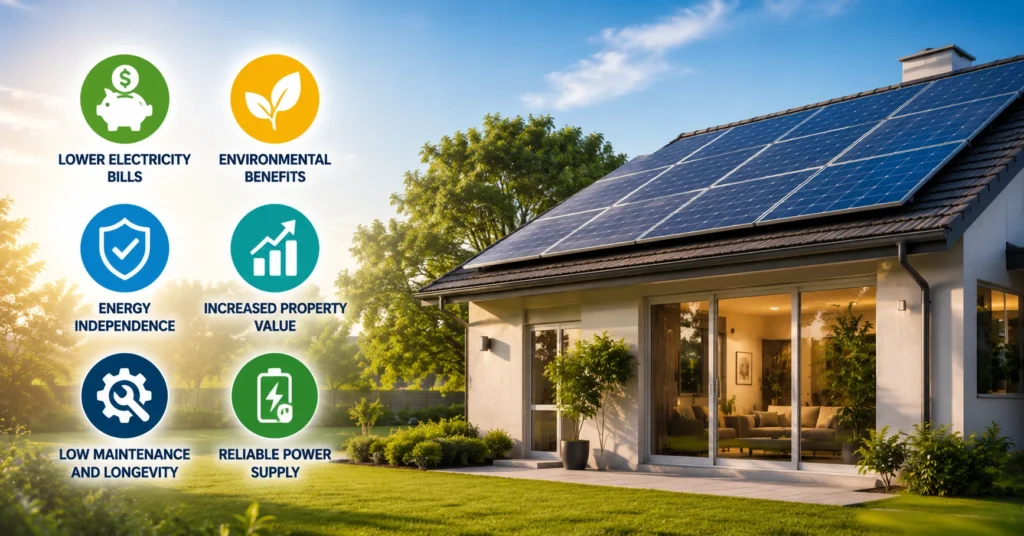
Benefits of Installing the Correct Solar System
Reduce your electricity bills.
A properly sized system covers your actual consumption, rather than you paying more for under-power or unused capacity.
Payback depends on the complete installed cost, generation, on-site use, applicable tariff, maintenance and replacement equipment. Calculate a scenario using actual quotations and your load profile; no fixed recovery period or decades of free electricity can be promised. Use the solar calculator for an illustration with explicit assumptions.
Net metering and net billing considerations.
Pakistan has moved from net metering to a net billing framework under the Nepra Prosumer Regulations 2026. Under the new rules, the compensation for the electricity you export to the grid is much lower than the price you pay to import electricity, so the smartest system in 2026 is one that matches your daytime usage, rather than being designed to sell you as much electricity as possible. Existing net metering agreements are generally recognized until their contract expires.
Long-term savings.
Even with the latest billing structures, self-consumed solar electricity still saves significantly more per unit than you would otherwise pay your DISCO, making a properly sized solar power system a long-term investment.
Jinko Solar Panel 585 Watt Price in Pakistan Today 2026: Complete Buyer’s Guide
Common Mistakes When Choosing Solar Panels
Buying an undersized system.
Choosing the cheapest, smallest system to save money often means your bill barely drops, which defeats the purpose of going solar in the first place.
Ignoring future power needs.
If you’re planning on adding an air conditioner, electric vehicle charger, or expanding your home, size your system with some room for that future load.
Poor roof planning.
Installing panels without checking shading, orientation, or structural load capacity can significantly reduce the real-world output of your system.
Choosing low-quality panels.
B-grade or unbranded panels may look like a bargain, but they degrade quickly, produce less electricity over time, and usually don’t register with your DISCO for net billing.
CM Punjab Free Solar Panel Scheme 2026: How to Get Free Solar Energy for Your Home
Final Recommendation
How to estimate your energy needs.
Take your last six months of electricity bills, calculate your average monthly units, and use the table above as a starting point. From there, decide how much of your daytime load you want to cover with solar power, keeping in mind that self-consumption now is more important than exporting additional units.
When to consult a professional installer.
A calculator will give you a solid estimate, but a certified solar installer should always conduct a proper site survey, check your roof orientation and shading, verify your approved load, and finalize your accurate panel count and inverter size before installation begins.
FAQs (People Also Ask)
How many solar panels do I need for my home in Pakistan?
Most homes need between 5 and 18 panels, depending on monthly electricity consumption. A typical household using 500 units a month usually needs a 5kW system, which comes to around 9 panels of 550W to 580W capacity.
How do I calculate the number of solar panels required?
Divide your desired system size in watts by your chosen panel’s wattage. For example, a 5000W (5kW) system divided by 580W panels comes to roughly 9 panels. Add a small buffer for system losses from heat, dust, and wiring inefficiency.
How many solar panels are needed for a 5kW solar system?
A 5kW solar system typically needs 9 to 10 panels when using 550W to 580W panels. This is the most commonly installed residential system size in Pakistan in 2026.
How many solar panels are required for a 10kW system?
A 10kW system generally needs 17 to 19 panels of 550W to 580W capacity. This size suits larger homes, small commercial spaces, and shops with significant daytime electricity usage.
What factors affect the number of solar panels needed?
Monthly electricity consumption, available roof space, panel wattage, local sunlight hours, panel efficiency, and weather conditions all affect the final panel count for your solar energy system.
How much roof space is required for solar panels?
Each 550W to 580W panel needs roughly 21 to 23 square feet of roof space. A 5kW system with 9 panels needs close to 200 square feet, while a 10kW system needs around 400 square feet.
Which solar panel wattage is best for residential homes?
550W to 580W panels currently offer the best balance of cost, efficiency, and roof space for most Pakistani homes. Larger properties with more space and higher budgets may benefit from 600W or higher N-Type panels.
How much electricity can one solar panel generate daily?
A single 550W panel typically generates between 2 and 2.75 units per day, depending on sunlight hours and weather conditions. A full 1kW of installed solar capacity produces roughly 4 to 5 units per day on average in Pakistan.
How can I reduce my electricity bill with solar panels?
Size your solar system around your actual daytime consumption, run high-load appliances like air conditioners and water pumps during sunlight hours, and keep your panels clean and free of dust to maintain peak output.
Is installing a solar system in Pakistan a worthwhile investment?
Yes. Even after the shift from net metering to net billing in 2026, self-consumed solar electricity still costs far less per unit than grid electricity, and a correctly sized system typically pays for itself within 3.5 to 4.5 years.
One Response