
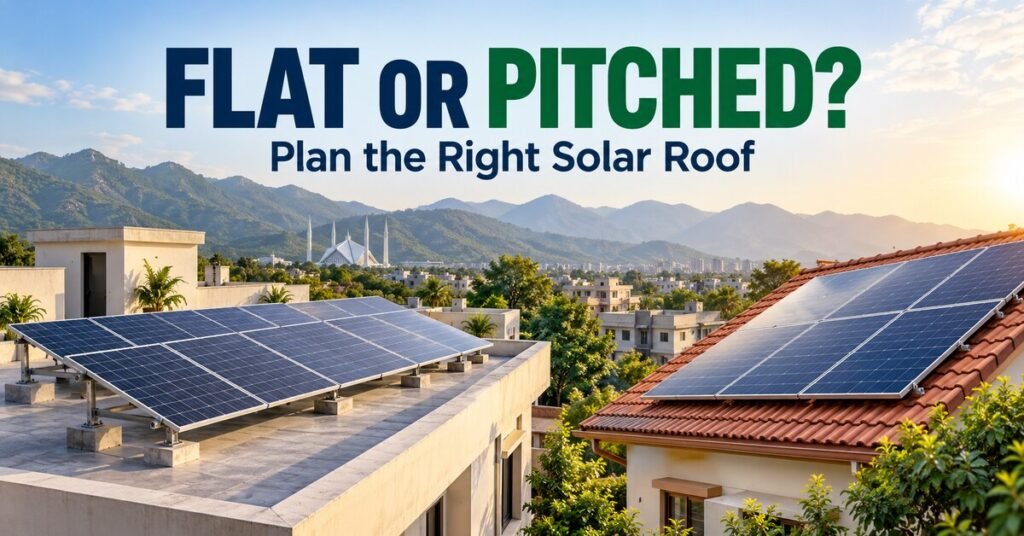
Your roof decides the design — not the other way round
Pakistan has two dominant roof types: the flat reinforced-concrete (RCC) roofs of most urban houses, and the pitched roofs — corrugated sheet, tile or metal — common in northern areas, farmhouses and commercial sheds. Both can carry excellent solar systems. But the structure, mounting, costs and even the maintenance routine differ enough that choosing equipment before assessing your roof is doing things backwards. This guide walks through what actually changes between the two, so you can judge installers’ proposals like someone who has seen both.
Flat RCC roofs: flexibility with responsibilities
The flat concrete roof is Pakistan’s solar workhorse, and for good reason. Installers can orient panels at the ideal tilt and direction regardless of how the house faces, space rows to avoid self-shading, and walk around the array for cleaning. Elevated structures can even keep the space underneath usable.
That flexibility comes with responsibilities:
- Waterproofing first. Every anchor point is a potential leak. Get existing cracks, ponding areas and failed waterproofing repaired before panels go up — not after, when the array has to be dismantled to reach them.
- Structure choice matters. Low-profile L2/L3 frames are cheap and storm-safe; elevated structures cost roughly double or triple per kW but free up usable space. Ballasted (weight-held) systems avoid drilling but need engineering verification for wind uplift.
- Drainage and access. Panels and their frames must not block rainwater paths to the drains, and you need walkways to reach every row for cleaning — dust cuts output noticeably in Pakistani cities.
- Obstructions eat area. Water tanks, stair enclosures (mumties), parapet walls and neighbouring buildings’ shadows shrink the usable area far below the roof’s total square metres. A proper layout drawing shows the usable area, not the gross area.
Pitched roofs: simpler mounting, fixed geometry
On a pitched roof, the roof itself sets the tilt and orientation — the panels follow the slope they are given. Mounting is usually simpler and cheaper: rails fixed to the roof structure with appropriate flashing and sealing. But there are trade-offs:
- Orientation is what it is. A south-facing slope in Pakistan is ideal; east or west costs you roughly 10–20% of annual output versus optimal; a north-facing slope is poor. You cannot tilt your way out of a bad orientation the way you can on a flat roof.
- The covering dictates the detail. Corrugated metal sheet, concrete tile and asbestos-substitute sheets each need different fixings and weather sealing. One mounting detail does not fit all.
- Access is harder. Steep slopes complicate installation and future maintenance — factor safe access into the design, not as an afterthought.
- Structural check still applies. Older timber purlins or rusted sheeting may need reinforcement before carrying an array for 25 years.
Which produces more electricity?
All else equal, a well-designed flat-roof system usually wins — because the designer controls tilt (around 20–30° for most of Pakistan) and orientation, and can space rows to eliminate self-shading. A pitched roof wins only when its slope happens to face near-south at a good angle and the flat-roof alternative would suffer heavy shading from surrounding structures. Shading, honestly assessed across the day and across seasons, decides more real projects than tilt theory does. Ask each installer to show shadow analysis for December (low sun) as well as June.
How many panels fit your roof?
Roof area and panel count answer different questions — learn to convert between them.
Cost differences to expect
As indicative ranges — always get dated written quotations — mounting on a straightforward pitched sheet roof is usually the cheapest per kW, low-profile flat-roof frames sit in the middle, and elevated flat-roof structures cost the most. The gap between cheapest and dearest mounting can be two to three times per kW. That is not installer profiteering; it is steel, concrete and labour. When comparing quotes, separate the mounting line from the equipment lines so a cheap headline price cannot hide an under-engineered frame.
Before you sign: the roof checklist
- Get a structural assessment of the roof’s condition and load capacity — in writing.
- Confirm waterproofing repairs are done or explicitly included in the quote.
- Ask for a scaled layout drawing showing panels, setbacks, walkways and shading.
- Clarify who is responsible if a leak appears at an anchor point in year two.
- For rented property, get written permission covering installation and eventual removal.
Pair this with our system sizing guide and panel brand guide to complete the picture before you commit.
Size the system to the roof you have
Match array size to usable roof area — not the other way round.
Frequently asked questions
Can solar panels damage a concrete roof?
Properly installed, no. Damage comes from poor anchor sealing (leaks), blocked drainage, or structures too heavy for the slab. All three are design failures, not panel problems — which is why the assessment and the quote’s waterproofing line matter For a fuller walkthrough of keeping the roof watertight around mounting points, see our guide to solar roof mounting and waterproofing in Pakistan..
Is an elevated structure worth the extra cost?
It can be, if the shaded space underneath has genuine value to you (seating, storage, drying area) and the structure is properly engineered with bracing and concrete footings. Do not pay elevated prices for what is essentially a tall, unbraced frame.
My pitched roof faces east. Should I still install?
Often yes — east or west orientations still produce roughly 80–90% of the optimal annual yield in Pakistan. Get the design modelled for your specific roof rather than rejecting it on compass direction alone.
How do I know the structure will survive a storm?
Ask for the steel section sizes, galvanisation specification, anchor/bolt details and footing design in the quotation. A serious installer answers with specifics; a vague “heavy-duty frame” promise is not engineering.
2 Responses