CM Punjab Free Solar Panel Scheme 2026: Eligibility, Registration & What You Actually Get
Registering for the CM Punjab Free Solar Panel Scheme doesn’t guarantee a household gets a system. Selection runs through a computerized ballot, and roughly 861,000 households applied for a program originally sized for just 100,000 units.
That distinction matters more than almost anything else in this guide, because most coverage of the scheme reads as though signing up alone secures a free solar setup. It doesn’t. Here’s what the program actually offers, who genuinely qualifies, and what to expect if selected.
CM Punjab Free Solar Panel Scheme 2026
0–200 units walay ghar walon ko muft 550W–1100W solar system. Abhi register karen — seats mahdood hain!
Key Takeaways
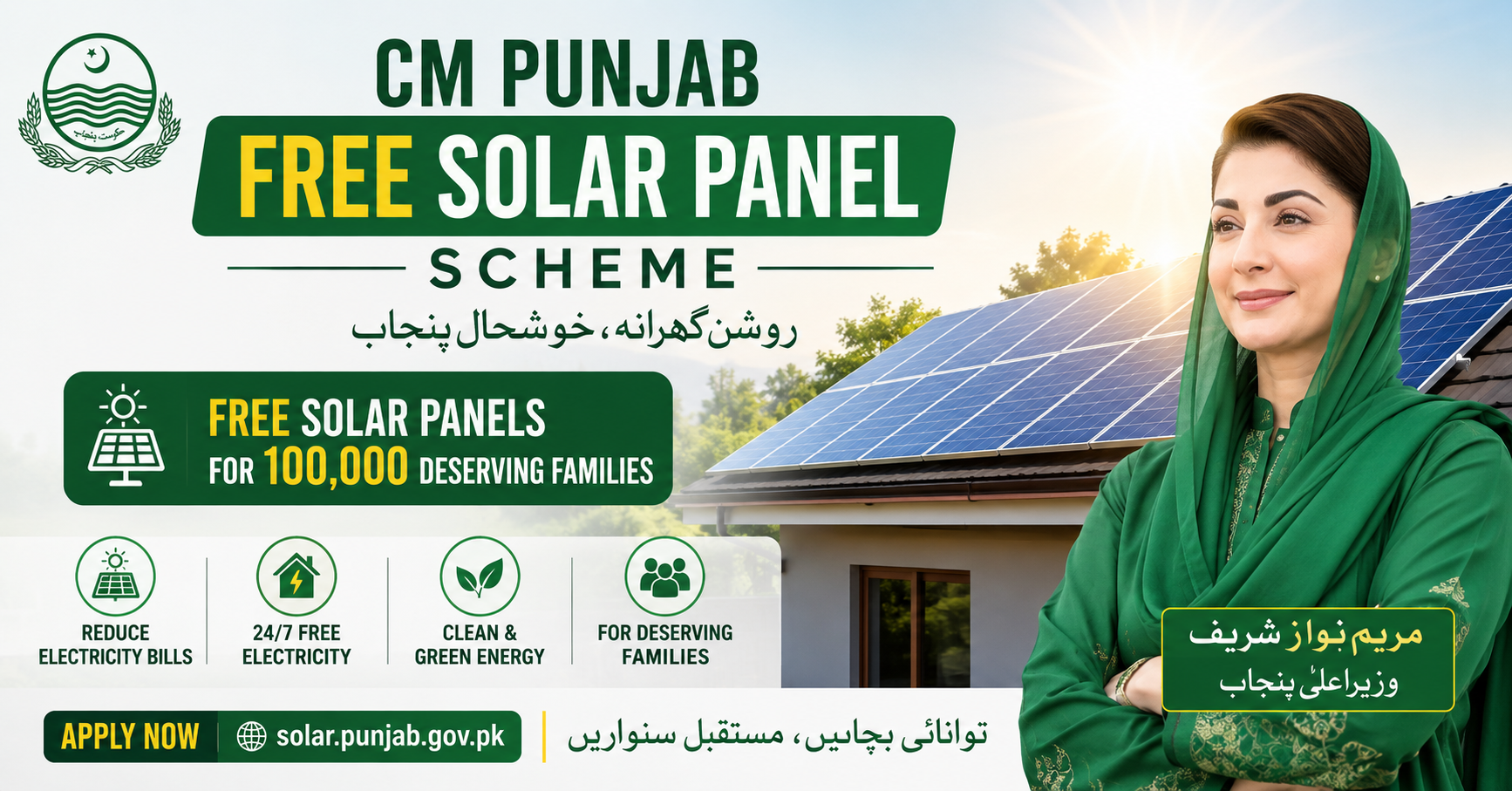
- The Government of Punjab is distributing up to 100,000 free solar systems to households consuming 0–200 units per month.
- Households using 0–100 units receive a 550-watt system; those using 101–200 units receive a 1,100-watt (1.1 kW) system, both at zero cost.
- Registration runs through the web portal at cmsolarscheme.punjab.gov.pk, or by SMS to 8800.
- The program has been extended through December 2026, with more than 94,000 systems already distributed across the province.
- Program estimates put average bill reduction at 60–80% after installation.
What Is the CM Punjab Free Solar Panel Program?
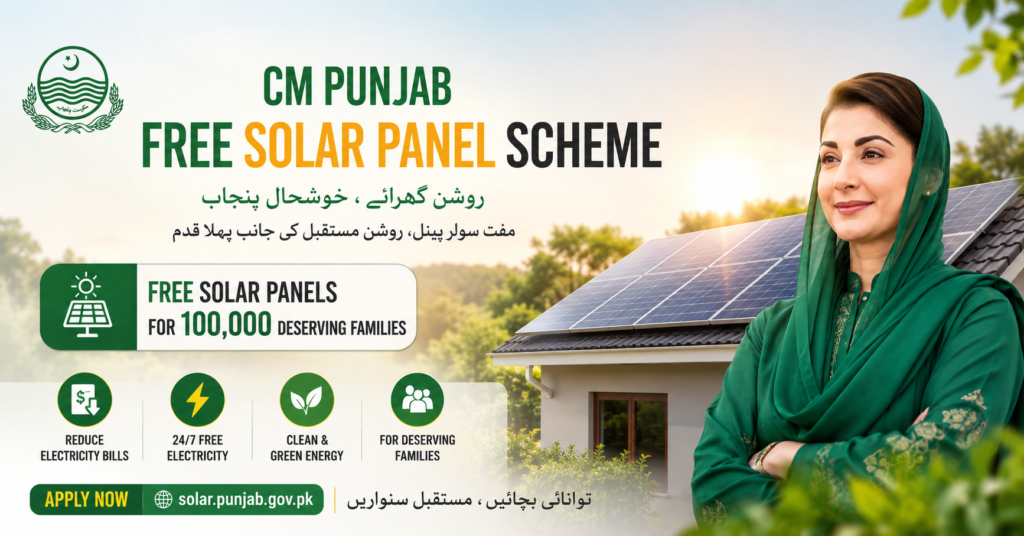
Informally known as the Roshan Gharana Solar Program, this is a welfare initiative from the Government of Punjab under Chief Minister Maryam Nawaz Sharif, aimed at the province’s lowest-consumption electricity users households using 0 to 200 units a month.
Rather than subsidizing a grid connection, the government installs a small standalone setup: a solar panel, a compact inverter, and the wiring needed to run basic fans and lights during daylight hours, cutting into that portion of a household’s WAPDA bill.
Phase 1 balloting took place in early 2025, selecting roughly 94,000 beneficiaries from the 861,000 households who applied. As of mid-2026, the program has distributed more than 94,000 systems at an estimated cost of around Rs. 10 billion, making it one of Punjab’s largest single energy welfare efforts to date.
More Detail: On-Grid vs Off-Grid vs Hybrid Solar System in Pakistan: Which One Should You Install in 2026?
Who Is Eligible for the Free Solar Program?
Eligibility is checked automatically against the applicant’s electricity bill and CNIC record. Based on the official scheme criteria, a household needs to meet all of the following:
Monthly electricity consumption of 0–200 units
A sanctioned load of 2 kW or below
A valid CNIC linked to the electricity account
Punjab residency, with the bill registered in the applicant’s name or an immediate family member’s name
The scheme covers Lifeline consumers (0–50 and 51–100 units) as well as Protected and Unprotected consumers in the 0–100 and 101–200 unit brackets. Claims occasionally circulate online that a later 2026 phase raised the ceiling to 300 units; that figure isn’t confirmed on the official Punjab government portal as of this writing, so it’s worth treating as unverified until an application result explicitly reflects it.
Ready to go solar? Get a free, no-obligation quote today.
See All Solar Panel Brands → Get Free Solar QuoteWho Gets Disqualified
Four categories get excluded automatically, checked against DISCO records rather than self-reported information:
- Households with a documented history of electricity theft
- Connections with defective meters
- Addresses with multiple meters registered to a single residence
- Accounts with more than three late payments in the past 12 months
Anyone unsure where they stand on payment history is better off checking their DISCO billing record before applying rather than after getting rejected at the verification stage, which costs a slot that can’t be recovered. A rejection at the verification stage costs you a slot that other applicants can’t get back either.
More Detail: Best Solar Panel Brands in Pakistan 2026 — Longi vs JA Solar vs Canadian Solar
What Solar System Do You Actually Get?
This is the part most coverage glosses over. The kits are small, standalone, and built for basic lighting loads, not a replacement for a grid connection.
| Monthly Consumption | System Provided | What It Realistically Runs |
|---|---|---|
| 0–100 units | 550-watt solar system | 2–3 ceiling fans and a few LED lights during daylight hours |
| 101–200 units | 1,100-watt (1.1 kW) system | Slightly more fan and light load, still daylight-dependent |
Two things worth understanding clearly before expecting total bill elimination:
These are standalone kits with no net metering. There’s no bidirectional meter, no grid export, and no way to bank daytime solar generation against nighttime consumption. Whatever power isn’t used in real time while the sun is out simply goes unused — a meaningful difference from a paid hybrid or on-grid system, which can store or export surplus.
They won’t run an air conditioner, a full-time refrigerator, a water pump, or any heating appliance. A 550W panel generates roughly 2–3 units a day — enough for basic lighting and fan use, not enough to touch a household’s air conditioning or refrigeration load in any meaningful way. Government estimates of 60–80% bill reduction hold up specifically for households whose usage was already concentrated in fans and lighting, not appliance-heavy homes.
For households consuming more than the eligibility bracket allows — say 500 to 800 units a month with a fridge, an AC unit, and a pump — a professionally sized 5–10 kW net-metered system is what would actually move the needle on the bill, and that falls outside this scheme entirely (see the Bank of Punjab financing option below).
How to Apply for the CM Punjab Solar Panel Program
Registration is free and available through two official channels, with no need to visit a government office.
Option 1: Web Portal (Recommended)
Visit cmsolarscheme.punjab.gov.pk and complete the registration form using a CNIC number and electricity bill reference number. The portal works in both Urdu and English, and applicants get a confirmation or eligibility status message after submission.
Steps:
- Open cmsolarscheme.punjab.gov.pk on a phone or computer
- Click “Register” and enter the 13-digit CNIC
- Enter the electricity bill’s Reference Number
- Submit and note the application tracking number
- Wait for an SMS confirming eligibility status
Option 2: SMS to 8800
For anyone without reliable internet access, registration by SMS works just as well:
Send: Reference-No CNIC to 8800
Example: 1234567890 3520012345678
This method works on any mobile network and was designed specifically to make registration accessible from rural areas and small towns across Punjab.
More Detail: 550 Watt Solar Panel Price in Pakistan 2026 – Real Rates, Best Brands & What Nobody Tells You
What Happens After You Apply?
The Punjab Special Monitoring Unit carries out physical verification of successful applicants across all districts. Once verified, a Letter of Award gets issued, and the government arranges installation through its partnered suppliers.
There’s no payment required at any stage, not for the panels, the installation, or maintenance during the warranty period.
Why This Program Matters: Pakistan’s Energy Crisis in Context
Is this just another government announcement, or does it address a real problem? The numbers suggest the problem is genuinely serious. Pakistan’s electricity prices climbed sharply through FY2023–24 and again in mid-2026, with additional fuel surcharges layered on top. Unannounced blackouts lasting 8 to 16 hours hit many areas daily, and low-recovery feeders, typically the poorer neighborhoods, face the longest scheduled outages.
That creates a difficult cycle in low-income areas: families struggle to afford their bills, fall behind on payments, get hit with even longer outages as a result, and find it harder to earn the income needed to catch back up. Solar breaks that cycle at the source. Net-metered solar systems in Pakistan typically carry a payback period of just 2 to 4 years under normal conditions for paid installations, and for beneficiaries of this free program, the financial benefit starts immediately.
What sets this initiative apart from earlier efforts, like the 2017 Khadim-e-Punjab Ujaala Program that distributed solar lamps to students, is scale and targeting. Rather than basic lighting aid, it delivers actual power generation capacity directly to the households most exposed to the affordability crisis.
Key Benefits of Going Solar Under This Program
- Immediate bill reduction.
Households can expect 60–80% lower electricity expenses starting from day one of installation. For a family paying Rs. 3,000–5,000 monthly, that works out to roughly Rs. 1,800–4,000 in monthly savings. - Freedom from load-shedding during daylight hours.
Areas with high line losses often face 8–12 hours of daily outages, and a solar system keeps basic lights and fans running through part of that window. - Zero upfront or ongoing cost.
Installation, panels, inverter, and maintenance during the warranty period are fully covered no hidden fees, no EMI, no interest. - A small dent in the bigger picture.
Punjab’s push toward household solar aligns with Pakistan’s broader target of sourcing a larger share of electricity from renewables, easing demand on an already overloaded grid one household at a time.
Program Progress and 2026 Update
The program launched with a target of 100,000 systems and an original registration deadline in August 2026. Over 800,000 applications came in during the first phase alone, underscoring just how acute the demand is.
Given that response, Chief Minister Maryam Nawaz extended the program by six months, running it through December 2026. Registration has reopened for new applicants, and distribution continues in phases across all districts. Anyone who applied in the first phase without a confirmation yet should check their status via the web portal or the official helpline, since physical verification is still ongoing in several districts.
FAQs: CM Punjab Free Solar Panel Scheme 2026
Is the CM Punjab Free Solar Panel Program still open in 2026?
Yes. Although the original registration deadline was set for August 2026, the program has been extended through December 2026. Registration has officially reopened for new applicants, and systems are being distributed in phases across all 36 districts of Punjab.
What documents are needed to apply?
Just a 13-digit CNIC and an electricity bill reference number. No additional documents are required for online or SMS registration, though physical verification may require the applicant to be present at the registered address when the government team visits.
Will there be any cost for installation or maintenance?
No. Installation, panels, inverter, and maintenance during the warranty period are fully covered under the program, with no cost at any stage of the process.
What if a household uses more than 200 units per month?
Consumers above 200 units aren’t eligible for the free program. The Bank of Punjab, however, offers a solar financing option with subsidized interest rates aimed at helping middle-income households make the switch; check with any BOP branch for details.
How long does it take to receive the system after applying?
There’s no fixed official timeline. The government verifies and installs in phases: an SMS confirms eligibility first, physical verification follows, and installation gets scheduled after that. Applicants from earlier phases have reported the full process taking several months from application to installation.
The Bottom Line
Pakistan’s electricity affordability crisis is real and well documented, and this program is one of the more direct government responses to it, targeting 100,000 of the province’s lowest-consumption households with free solar systems capable of cutting bills by 60–80% on an ongoing basis.
Households with 0–200 units of monthly consumption, a sanctioned load of 2 kW or below, and no record of theft, late payments, or meter issues are likely to qualify. The registration window won’t stay open indefinitely.
— CTA —
Register now at cmsolarscheme.punjab.gov.pk, or send your Reference Number and CNIC by SMS to 8800.