
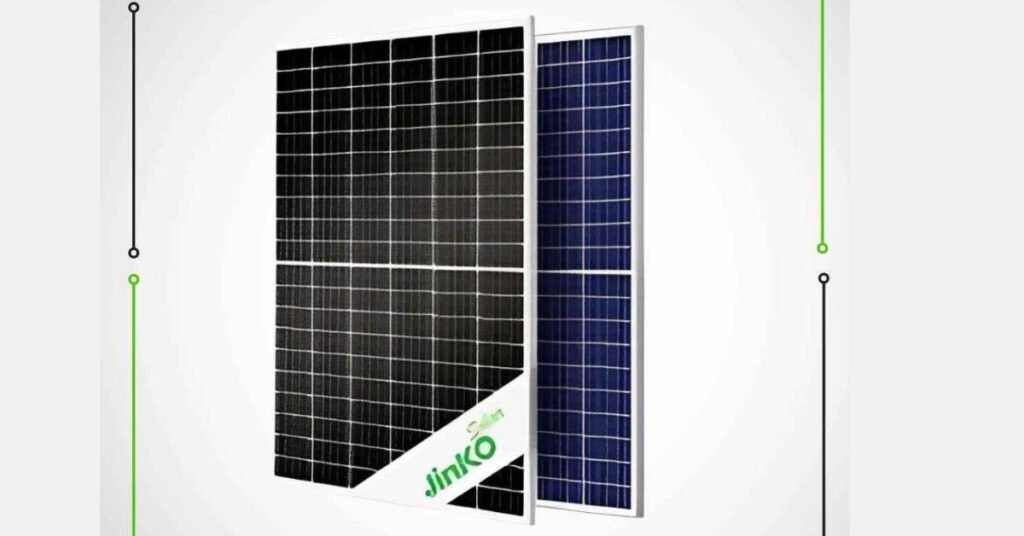
The “Jinko 585W” you see quoted across Pakistan is almost always a Tiger Neo module — JinkoSolar’s N-type TOPCon range — and it has become the default workhorse panel for residential installations. But 585W is just a power bin, not a product identity. Jinko sells several 585W-adjacent variants across generations, and the price, efficiency and warranty terms differ between them. A serious comparison starts with the full module code, not the wattage on the shop banner.
For another mainstream brand to compare, see the Canadian solar panel price guide.
Which 585W exactly? Read the code
Ask the seller for the complete alphanumeric model (for example, a Tiger Neo N-type code including the cell-count and frame details), then match it to Jinko’s official datasheet. Confirm: N-type TOPCon cell technology, the exact dimensions and weight (585W modules are large — roughly 2.3m × 1.1m — so check your roof layout), monofacial vs bifacial construction, and the warranty pair (product + performance). A datasheet from a different power bin or series does not validate your panels. If the seller cannot produce the matching datasheet, you are not being offered a documented product.
Indicative price guidance
Clearly labelled as a budgeting estimate, not a quotation: Jinko 585W N-type modules in Pakistan have recently been advertised around Rs 38–44 per watt in major cities — roughly PKR 22,000–26,000 per panel at 585W — with pallet quantities cheaper and single-panel retail higher. Convert every offer to Rs/W with our per-watt method and compare identical model codes. The market moves with currency and stock, so always replace estimates with a dated written quotation. Suspiciously cheap “Jinko 585W” listings are among the most commonly mislabelled in the market — verify before paying (see below).
Compare prices correctly
Reduce every Jinko quote to Rs/W before comparing. Here’s the method.
Per-watt price guide585W vs 580W vs 590W: does 5W matter?
Barely. Five watts is under 1% of output — invisible on your bill. What matters is the price per watt and the technology generation. A 580W N-type module at Rs 39/W is a better buy than a 590W older-generation module at Rs 42/W, despite the smaller number on the label. Never pay a premium for a rounder wattage; pay for efficiency, temperature coefficient and warranty terms, which is where the technology differences actually live.
Authenticity: Jinko’s popularity is a double-edged sword
Jinko’s market share makes it the most counterfeited label in Pakistan. Protect yourself: photograph the module labels at delivery, record serial numbers, and verify them through Jinko’s official channels — not through a QR sticker the seller printed. Confirm the distributor is authorised and get the warranty claim process in writing. The complete procedure is in our panel authenticity guide; twenty minutes of verification protects a six-figure purchase.
Verify your panels are genuine
Step-by-step: serial numbers, datasheets and the manufacturer’s own checks.
Authenticity checklistWhat to do on delivery day
When your Jinko 585W panels arrive, slow down and verify before the installer mounts them. Count the panels against the invoice, photograph every module label, and record all serial numbers in one list. Compare the label’s model code, wattage and electrical values against the datasheet you were given at quotation stage — they must match exactly. Check the frames for dents, the glass for cracks and the backsheets for blemishes. Only once the count, codes and condition check out should installation proceed; panels already on the roof are dramatically harder to dispute or return. Keep the invoice, the serial-number list and the datasheet together — they are your warranty file for the next 25 years.
Frequently asked questions
Is the Jinko 585W good for homes?
Yes — it is the mainstream residential choice for good reason: N-type efficiency, wide availability and competitive Rs/W. Just make sure you are actually getting the N-type Tiger Neo variant the price implies, not an older series at a new-series price.
How many 585W panels do I need?
Divide your target array watts by 585. A 5kW-class array needs 9 panels (5.27kWp); 10kW needs 17–18. Roof space, shading and inverter limits adjust the final number — see our panel-count guide.
Bifacial or monofacial 585W?
For standard flush-mounted home roofs, monofacial — bifacial gains need elevated mounting and reflective ground. Don’t pay the bifacial premium for a flat roof.
What should a written quotation include?
Full model code, quantity, new condition, per-panel and total price, tax, delivery terms, and warranty documentation. Anything less is not a quotation.
2 Responses