On-Grid vs Off-Grid vs Hybrid Solar System in Pakistan: Which One Should You Install in 2026?
The math on Pakistani solar changed on February 9, 2026 — and most articles comparing on-grid, off-grid, and hybrid systems haven’t caught up. That’s the date NEPRA replaced net metering with net billing under the new Prosumer Regulations, cutting what utilities pay for your surplus solar units by more than half. If you’re choosing a system this year, that single policy shift affects the answer more than anything else in this guide.
Load shedding is still running 4 to 10 hours a day in most cities, and grid tariffs keep climbing. Solar is still the right move for most households. But which system on-grid, off-grid, or hybrid now depends on a slightly different set of numbers than it did even a year ago. Here’s the honest, current breakdown.
Read More: Best Solar Panel Brands in Pakistan 2026 — Longi vs JA Solar vs Canadian Solar
The 2026 Net Billing Change You Need to Know First
Until February 2026, Pakistan ran on net metering: a one-to-one exchange where every unit you exported to the grid offset a unit you imported, at the same rate. Under the new Prosumer Regulations 2026, that’s gone for new applicants. The system is now net billing:
- Export rate (what the DISCO pays you): roughly Rs 8–13 per unit, based on the National Average Energy Purchase Price (NAEPP), not the retail tariff.
- Import rate (what you pay for grid electricity): Rs 42–65 per unit, depending on your DISCO and slab.
- System sizing cap: your solar system can no longer exceed your sanctioned electricity load — the old allowance of installing up to 1.5x your load is gone.
- Contract term: new agreements run 5 years instead of the earlier 7.
If you already had a net metering agreement signed before February 9, 2026, you keep your old 1:1 rate until that contract expires. Everyone applying from here on is under net billing.
Why does this matter for choosing a system? Under net metering, exporting surplus power was nearly as good as using it yourself, so oversizing an on-grid system made financial sense. Under net billing, a unit you export earns roughly a fifth of what a unit you import costs. Oversized on-grid systems now waste most of their financial upside during export hours. This tilts the entire decision toward self-consumption — using your own solar power directly, or storing it in a battery for use at night — rather than relying on grid credits. That’s the single biggest reason hybrid systems have pulled further ahead of on-grid in 2026.
Ready to go solar? Get a free, no-obligation quote today.
Find Your Ideal System Size → Get Free System Quote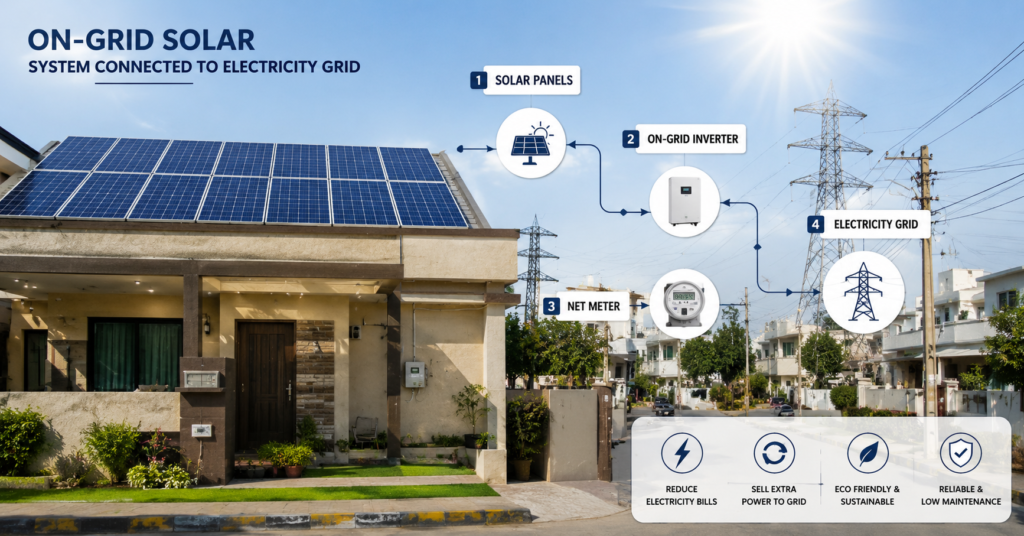
What Is an On-Grid Solar System?
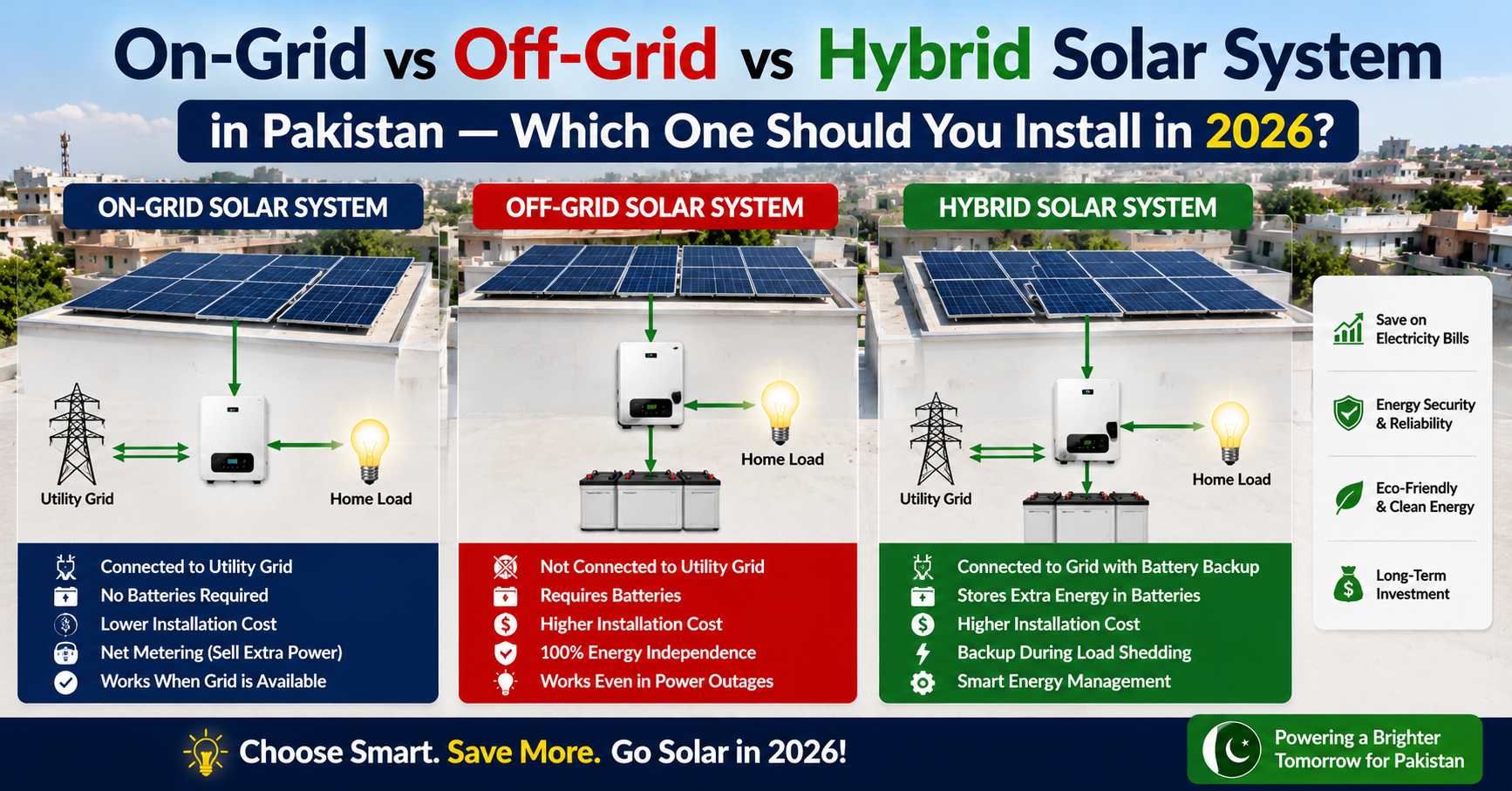
An on-grid solar system connects directly to your DISCO’s grid with no battery. Panels generate power during the day, which runs your home first; anything left over exports to the grid under net billing. When the grid goes down, the system shuts off automatically — a mandatory safety feature that protects utility linemen working on the lines.
On-Grid at a Glance
| Factor | Detail |
|---|---|
| Battery | None |
| Works during load shedding | No |
| Net billing eligible | Yes |
| Best for | Under 4–6 hours of daily load shedding; daytime-heavy commercial loads |
| System cost (5kW) | PKR 550,000 – 780,000 |
| Payback period | 5–7 years (longer than pre-2026 due to lower export rates) |
Pros of On-Grid
Lowest upfront cost. No battery bank means an on-grid system stays the cheapest entry point into solar, especially useful for businesses running high loads during sunlight hours who need very little grid export at all.
Simplest maintenance. Panels and inverters carry 10–25-year lifespans with no battery replacement cycle to plan around.
Still earns export credit — just less of it. Under net billing, surplus units are still purchased by your DISCO, just at the lower NAEPP rate rather than the old retail-equivalent rate.
Ready to go solar? Get a free, no-obligation quote today.
See Updated 2026 Scheme Details →Cons of On-Grid
Zero backup during load shedding, still the dealbreaker for most Pakistani homes. If WAPDA or your DISCO cuts power at 2 pm, your panels stop feeding your house regardless of how much sun is out.
Export economics are weaker in 2026. Because the buyback rate is now a fraction of the retail rate, sizing an on-grid system larger than your actual daytime consumption no longer pays back the way it used to. Right-sizing to your load — not maximizing panel count — is now the smarter strategy.
Grid-dependent performance. Voltage fluctuations common in parts of Pakistan can trigger nuisance shutdowns or shorten inverter life.s in some areas of Pakistan can shorten inverter lifespan or trigger unnecessary shutdowns.
What Is an Off-Grid Solar System?
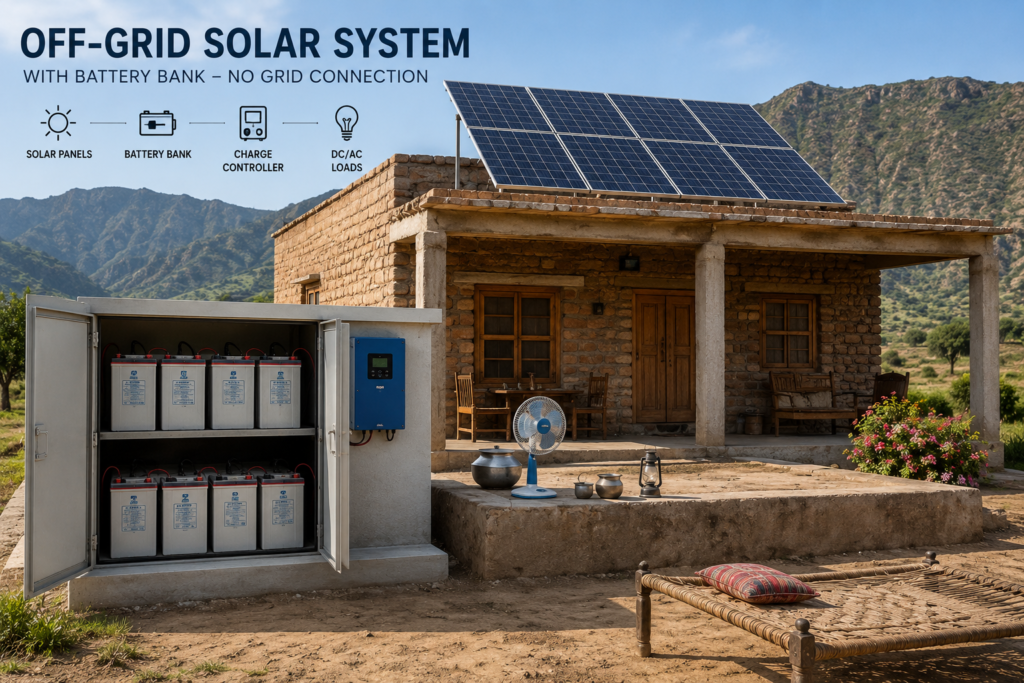
An off-grid system has no grid connection at all. Panels charge a battery bank, and your home runs entirely off that battery day and night. There’s no DISCO bill and no net billing application — you’re completely outside the grid framework.
This setup was built for locations where grid access is unreliable or doesn’t exist: farms, mountain communities, and villages. In Pakistan, it’s the right call where DISCO supply is so poor that disconnecting entirely is both cheaper and more reliable than staying connected.
Off-Grid at a Glance
| Factor | Detail |
|---|---|
| Battery | Yes — large bank required |
| Works during load shedding | Yes, fully independent |
| Net billing eligible | No |
| Best for | Remote areas, farms, 12+ hours of daily outages |
| System cost (5kW) | PKR 950,000 – 1,450,000 |
| Payback period | 6–9 years |
Pros of Off-Grid
Complete independence. No DISCO bill, no outage exposure, no exposure to future NEPRA rate changes either — a real advantage given how much net billing rules have shifted in the last year alone.
The natural fit for remote properties. Tube wells, farmhouses, and rural homes where extending grid infrastructure would cost more than the solar system itself.
Cons of Off-Grid
High upfront cost. A lithium (LiFePO4) battery bank sized for a 5kW off-grid system alone typically runs PKR 400,000–650,000.
Recurring battery replacement, roughly every 5–10 years even with quality lithium cells — a cost on-grid systems never carry.
Oversizing is almost unavoidable. Off-grid systems must be built for your worst-case day (cloudy winter, high load), so most of the year you’re carrying more capacity than you need.
Rarely the right call for cities. In Lahore, Karachi, Islamabad, or Faisalabad, even with 8+ hours of load shedding, a hybrid system solves the same problem for less money.
What Is a Hybrid Solar System?
A hybrid system connects to the grid like an on-grid setup and stores energy like an off-grid setup. Panels power the home during the day and charge the battery with any surplus. When the grid cuts, the hybrid inverter switches to battery power automatically — usually within milliseconds, so the transition is invisible to anyone in the house. Power beyond what the battery can absorb is exported under net billing.
For most homes dealing with daily load shedding, hybrid remains the system that actually solves the problem — and net billing has, if anything, made hybrid more attractive relative to on-grid, since self-consuming your solar power through a battery is now worth far more than exporting it at the reduced NAEPP rate.
Hybrid at a Glance
| Factor | Detail |
|---|---|
| Battery | Yes — sized for backup, not full independence |
| Works during load shedding | Yes |
| Net billing eligible | Yes |
| Best for | Urban/semi-urban homes with 4–12 hours of daily load shedding |
| System cost (5kW with battery) | PKR 800,000 – 1,100,000 |
| Payback period | 4–7 years, faster when generator/UPS savings are counted |
Pros of Hybrid
Uninterrupted power through load shedding. Fans, lights, routers, and refrigerators keep running because the battery bridges the gap the moment the grid drops.
Net billing still applies, so any true surplus beyond battery capacity still earns credit, even at the lower rate — better financial return than a pure off-grid setup that gets nothing.
Self-consumption beats export under 2026 rules. Because you’re storing surplus power instead of selling it back at Rs 8–13/unit, a hybrid system captures far more of the value of every unit your panels produce than an on-grid system does.
Scalable and future-proof. You choose 2, 4, or 8 hours of backup based on budget, and most hybrid inverter platforms let you add battery capacity later without replacing the inverter.
Real cost offsets beyond the electricity bill. For households already spending PKR 3,000–8,000 a month on generator fuel or UPS battery replacement, a hybrid system often pays back the battery premium from those savings alone within 2–3 years, before counting any grid bill reduction.
Cons of Hybrid
Higher upfront cost than on-grid, driven entirely by the battery bank.
Battery monitoring and eventual replacement. Lithium cells last longer than lead-acid but still carry a finite cycle life and a real replacement cost down the road.
Side-by-Side Comparison (2026 Net Billing Rules)
| Feature | On-Grid | Off-Grid | Hybrid |
|---|---|---|---|
| Grid Connection | Yes | No | Yes |
| Battery Backup | No | Yes | Yes |
| Works in Load Shedding | No | Yes | Yes |
| Net Billing Eligible | Yes | No | Yes |
| Upfront Cost (5kW) | PKR 550–780k | PKR 950k–1.45M | PKR 800k–1.1M |
| Best For | Low load-shedding, daytime-heavy loads | Remote/off-grid locations | Most urban homes with load shedding |
| Maintenance | Low | High | Medium |
| Payback Period | 5–7 years | 6–9 years | 4–7 years |
| Recommended in Pakistan (2026) | Limited use cases | Rural/farms only | Most homes ✅ |
Which System Should You Choose in 2026?
Choose on-grid if:
- Your area has under 4–6 hours of daily load shedding
- You run a business with heavy daytime consumption and can use most of what you generate directly, without relying on export credit
- Minimizing upfront cost is the priority and you can size the system close to your actual sanctioned load
Choose off-grid if:
- You’re in a rural area with no reliable grid access at all
- You run a farm, tube well, or genuinely remote property
- Your local supply is irregular and under roughly 8 hours a day
- You want permanent independence from your DISCO, regardless of future policy changes
Choose hybrid if:
- You’re in a city or town with 4–12 hours of daily load shedding — this describes most Pakistani households in 2026
- You want backup power for essential loads without going fully off-grid
- You’re already paying for a generator or UPS and want those recurring costs gone
- You want to keep some net billing benefit while capturing most of your solar value through self-consumption rather than export
Battery Options for Hybrid and Off-Grid Systems
| Type | Lifespan | Depth of Discharge | Price per kWh | Recommended? |
|---|---|---|---|---|
| Lithium Iron Phosphate (LiFePO4) | 10–15 years, 3,000–6,000 cycles | 80–95% | PKR 60,000–90,000 | Yes, for any serious installation |
| Lead Acid / Tubular Gel | 3–5 years, 500–1,200 cycles | ~50% | PKR 20,000–35,000 | Only on a tight budget — higher long-term replacement cost |
A 10kWh lithium battery bank on a hybrid system typically covers 6–8 hours of essential load (fans, lights, router, phone charging) for a standard urban home in Lahore or Karachi. Adding air conditioning cuts that backup window significantly.
Net Billing Registration: What Changed in Practice
Applications still go through your local DISCO — LESCO, HESCO, MEPCO, SEPCO, or IESCO — but the process now sits under the Prosumer Regulations rather than the old 2015 net metering framework. A few practical changes worth knowing before you buy:
- Sizing cap: your system can’t exceed your sanctioned load anymore, so oversizing to chase export credit isn’t an option the way it once was.
- Bi-directional smart meter: still required, and the cost (roughly PKR 18,000–28,000) is typically borne by the consumer.
- Approved inverter list: only NEPRA-approved inverter models qualify for net billing — confirm your chosen model is on the current list before purchasing.
- Existing agreements are protected. If your net metering contract was signed before February 9, 2026, you keep your original rate and terms until that contract’s natural expiry.
Inverter Brands Available in Pakistan by System Type
- On-Grid Inverters: Huawei SUN2000, Solis, Growatt, GoodWe, Fronius
- Hybrid Inverters: Solis S6, Deye, Growatt SPH, Sungrow, Sofar, Voltronic Axpert
- Off-Grid Inverters: Voltronic Axpert, Luminous, Microtek, Su-Kam
Deye and Solis hybrid inverters remain the dominant choices in the Pakistani market through 2026 thanks to reliable local support and compatibility with both lithium and lead-acid batteries.
FAQ Section
Which solar system is best for a home in Pakistan with load shedding?
For most urban and semi-urban homes, a hybrid solar system is the best choice. It provides battery backup during load shedding while remaining connected to the grid for net metering. It solves Pakistan’s specific electricity challenge better than either pure on-grid or off-grid systems.
What is the price of a 5kW hybrid solar system in Pakistan in 2026?
A complete 5kW hybrid system, including panels, a hybrid inverter, and a 10kWh lithium battery bank, typically costs between PKR 700,000 and PKR 1,000,000 depending on brand choices and installation quality.
Can on-grid solar work during load shedding in Pakistan?
No. An on-grid solar system automatically shuts down when WAPDA cuts power. This is a mandatory safety feature. Without a battery backup, on-grid systems cannot supply power during outages, regardless of how much sunlight is available.
Is off-grid solar worth it in Pakistan?
Off-grid solar makes sense for remote areas, farms, and locations where WAPDA supply is genuinely unavailable or fewer than 6 hours per day. For urban homes, a hybrid system delivers the same load-shedding protection at a lower cost while adding net metering income.
How many hours of backup does a hybrid system give?
It depends on battery size and your load. A 10kWh lithium battery running essential loads fans, lights, phone charging, a router covers approximately 6–8 hours. Adding heavy loads like air conditioning reduces backup time significantly.