Today’s Solar Panel Price in Pakistan 2026 Updated Rates & Complete Buying Guide
Solar panel prices in Pakistan have fallen to their lowest point in years, making this one of the smartest times to go solar. As of May 21, 2026, A-Grade Tier-1 panels are selling for Rs. 40 to Rs. 43 per watt, though your total system cost will depend on system size, inverter type, and installation complexity. This guide breaks down today’s verified per-watt rates across all major brands, complete system-wise pricing, and the key factors to weigh before you buy.
Ready to go solar? Get a free, no-obligation quote today.
See All Solar Panel Brands → Get Free Solar QuoteSolar Panel Price Per Watt in Pakistan Today (May 21, 2026)
Today’s wholesale rates for A-Grade, Tier-1, documented solar panels are listed below. Prices are sourced from Hall Road (Lahore), Saddar (Karachi), College Road (Rawalpindi), and G-8 (Islamabad) wholesale markets.
| Brand & Model | Cell Type | Grade | Price (Rs./Watt) |
|---|---|---|---|
| Longi Hi-Mo X10 HPBC 2.0 | N-Type Bifacial | A-Grade, Tier-1 | 41 – 41.50 |
| Jinko N-Type Bifacial Double Glass | N-Type Bifacial | A-Grade, Tier-1 | 42 – 43 |
| Canadian Solar N-Type TopCon / HJT | N-Type Bifacial | A-Grade, Tier-1 | 42 – 43 |
| JA Solar N-Type Bifacial | N-Type Bifacial | A-Grade, Tier-1 | 40 |
| Trina N-Type Monocrystalline | N-Type Mono | A-Grade, Tier-1 | 40 |
| AstroNergy N-Type TopCon Bifacial 20BB | N-Type Bifacial | A-Grade, Tier-1 | 40 |
| B-Grade Panels (various brands) | Mixed | B-Grade | 22 – 28 |
Note: Final prices may vary by city, dealer margin, documentation status, and batch stock. Always confirm with a verified dealer before placing an order. Dollar rate reference: Rs. 278/USD.
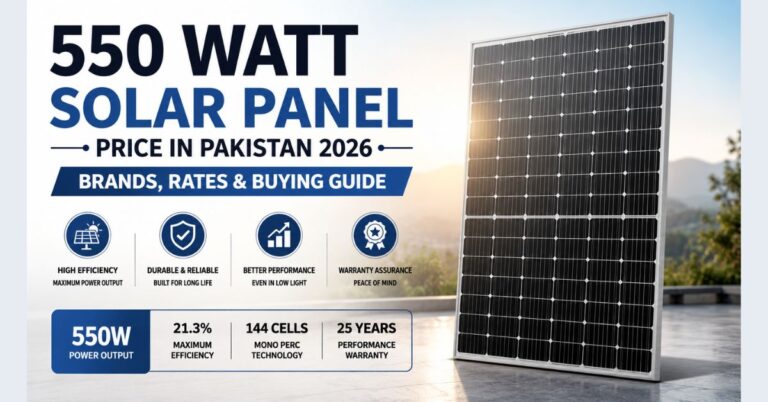
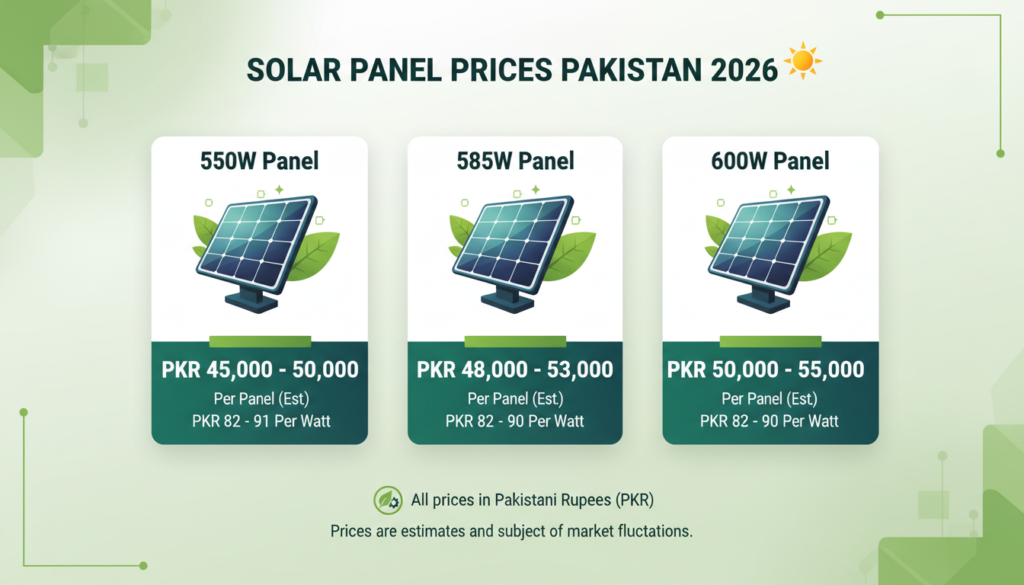
A popular 585W panel from a Tier-1 brand costs approximately Rs. 23,400 to Rs. 25,155, depending on brand and specifications.
Brand-by-Brand Solar Panel Price Breakdown
How much do Longi solar panels cost in Pakistan in 2026?
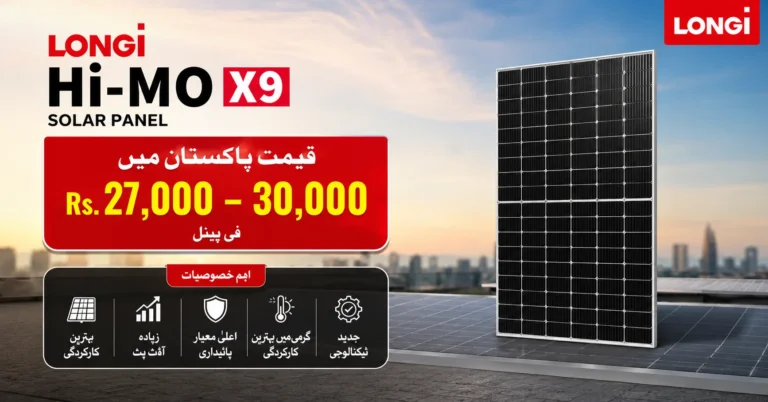
Longi’s Hi-Mo X10 HPBC 2.0 Anti-Glare panel is priced at Rs. 41 to 41.50 per watt, positioning it as a premium option that’s still within reach for most buyers. As Pakistan’s best-selling and most trusted solar brand, Longi backs its panels with a 25-year product warranty, and its N-Type models hold degradation rates below 0.25% per year — among the lowest in the industry.
Buyers on a tighter budget can opt for the older Hi-Mo 6 and Hi-Mo 7 series, which run Rs. 38 to 40 per watt. These are still genuine Tier-1 panels, just a generation behind Longi’s latest technology.
How much do Jinko solar panels cost in Pakistan in 2026?
Jinko’s N-Type Bifacial Double Glass panels are priced at Rs. 42 to 43 per watt. Jinko is a globally recognized Tier-1 manufacturer with a proven performance record in Pakistan’s high-heat, high-dust conditions, which makes it a common choice for commercial installations where long-term bankability and resale value carry weight.
For buyers prioritizing cost over the newest technology, Jinko’s earlier PERC and P-Type panels start at Rs. 28.50 per watt, though these use older cell technology than the N-Type Bifacial line.
How much do JA Solar panels cost in Pakistan in 2026?
JA Solar’s N-Type Bifacial A-Grade panels are priced at Rs. 40 per watt, offering one of the strongest quality-to-price ratios on the market right now. JA Solar has scaled quickly in Pakistan and now ranks among the top three brands by sales volume.
Budget buyers can also find older JA PERC Mono panels for Rs. 26 to 35 per watt, with exact pricing depending on wattage and whether the stock is fully documented.
How much do Canadian Solar panels cost in Pakistan in 2026?
Canadian Solar’s N-Type TopCon and HJT Bifacial panels are priced at Rs. 42 to 43 per watt, sitting at the premium end of the market. The higher cost reflects their high efficiency ratings and stronger international warranty backing. Canadian Solar tends to attract buyers who value long-term reliability over shaving a few rupees off the upfront bill.
How much do Trina solar panels cost in Pakistan in 2026?
Trina Solar’s N-Type Monocrystalline panels are priced at Rs. 40 per watt, putting them on par with JA Solar at a similar quality tier. Trina’s Vertex series has become a go-to choice for large residential and commercial rooftop installations.
Complete Solar System Price in Pakistan 2026
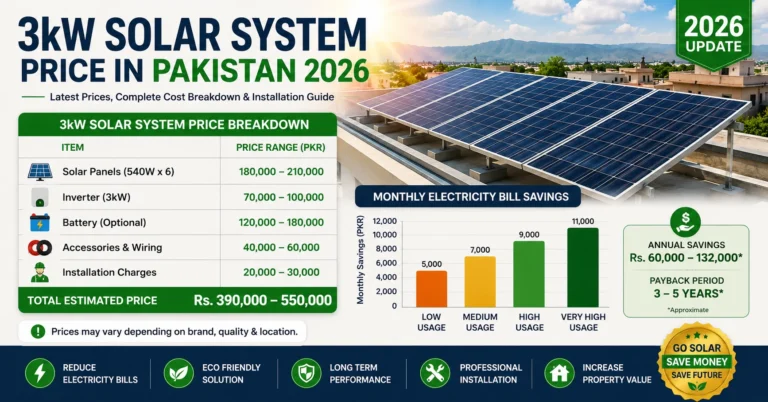
Panel price is only part of the equation. A complete solar system also includes an inverter, mounting structure, cabling, breakers, and installation labor. Here’s what full systems cost in 2026:
| System Size | Best For | Hybrid (With Battery) | On-Grid Only |
|---|---|---|---|
| 3 kW | 1–2 bedroom house, light usage | Rs. 424,000 | Rs. 280,000 – 320,000 |
| 5 kW | 3-bedroom house, 2–3 ACs | Rs. 620,000 – 750,000 | Rs. 450,000 – 550,000 |
| 6 kW | Medium household + small office | Rs. 869,000 | Rs. 550,000 – 650,000 |
| 10 kW | Large home / commercial | Rs. 1,202,000 | Rs. 950,000 – 1,200,000 |
| 12 kW | Heavy commercial / factory | Rs. 1,337,000 | Rs. 1,100,000 – 1,400,000 |
Most systems come with a 25-year warranty on the solar panels and a 3-to-10-year warranty on the inverter, plus a 2-year workmanship warranty covering the installation itself.
Factors That Affect Solar Panel Price in Pakistan
Knowing what actually drives the price helps you avoid overpaying — or ending up with the wrong product for your needs.
Does N-Type or P-Type cell technology affect the price?
Yes. N-Type panels (TOPCon, HJT, HPBC) are the current generation and cost more upfront, but they degrade at less than 0.25% per year and hold up better in high heat. P-Type PERC panels are older, cheaper technology, with a higher degradation rate of around 0.45% per year. Over a 20+ year lifespan, N-Type panels typically earn back that price gap through better long-term output.
Does brand and grade change the price?
Yes, significantly. Tier-1, A-Grade documented panels come with full manufacturer warranties and certifications. B-Grade panels — cosmetically flawed or rejected units — sell for less (Rs. 22–28/watt) but often lack full warranty coverage. Before buying, always confirm the grade and check that the documentation matches what you’re being told.
Why does the dollar rate matter for solar panel prices?
Because panels are imported from China and priced in USD, so a weaker rupee pushes local prices up. In 2026, the dollar has held steady around Rs. 278/USD, which is a key reason panel prices have leveled off after years of fluctuation.
Does higher wattage mean a better deal?
Generally, yes. Higher-wattage panels (580W–720W) generate more power per unit and tend to offer better per-watt value. Right now, the sweet spot in Pakistan’s market sits between 540W and 620W, balancing cost, roof space, and output.
Are bifacial panels worth the extra cost?
For most open or elevated installations, yes. Bifacial panels capture reflected light on their back surface, adding 5–15% extra output compared to monofacial panels. They cost slightly more per watt, but the added output usually delivers better ROI over the system’s lifetime.
How much does inverter type add to the total cost?
Inverter choice is one of the biggest swing factors in total system price. A 5kW on-grid inverter (Solis) runs around Rs. 120,000, while a 10kW hybrid inverter (Huawei or Growatt) can cost Rs. 300,000 or more. Hybrid inverters support battery backup, which matters most in areas with frequent load shedding.
City-Wise Solar Panel Price Comparison
Solar panel prices shift slightly from city to city, driven by logistics costs, dealer density, and local demand:
Lahore: is Pakistan’s largest solar market, and heavy dealer competition keeps prices tight. The Hall Road wholesale market effectively sets the benchmark rate for all of Punjab.
Karachi’s: main hub is Saddar Market. Panel prices track closely with Lahore, though installation costs can run slightly higher because of the city’s more complex roof structures.
Islamabad and Rawalpindi: operate as a premium market with somewhat higher retail prices. Buyers here tend to favor top-tier brands with full documentation over cheaper alternatives. College Road in Rawalpindi remains a reliable source for competitive wholesale rates.
Multan, Faisalabad, and Bahawalnagar: rely on regional dealers who source stock from Lahore, which adds a marginal 3–5% to prices for logistics. Despite the added cost, installation support is well-established across South Punjab, so buyers aren’t sacrificing service quality.
How Many Panels Do You Need?
A 5-marla house in Pakistan typically uses 400–600 units per month, which calls for a 5kW system. That translates to 9 panels if you go with 585W panels, or 10 panels if you choose 540W panels.
Use this quick reference to estimate your own needs:
| Monthly Units Consumed | Recommended System | Approximate Panels Needed (580W) |
|---|---|---|
| 200–400 units | 3 kW | 5–6 panels |
| 400–600 units | 5 kW | 9–10 panels |
| 600–900 units | 7–8 kW | 13–15 panels |
| 900–1,500 units | 10–12 kW | 17–21 panels |
Is 2026 a Good Time to Buy Solar in Pakistan?
Yes and the numbers support it. Panel prices are sitting at historic lows compared to the 2021–2023 peaks, while electricity tariffs from WAPDA and LESCO keep climbing, which means every unit you generate yourself saves more this year than it did last year. Net metering also remains available in most cities, letting you sell surplus power back to the grid and shorten your payback period even further.
For a well-sized system, the typical ROI window runs 3 to 5 years, after which you generate essentially free electricity for 20+ more years.”
Tips Before Buying Solar Panels in Pakistan
Buy only A-Grade, documented panels
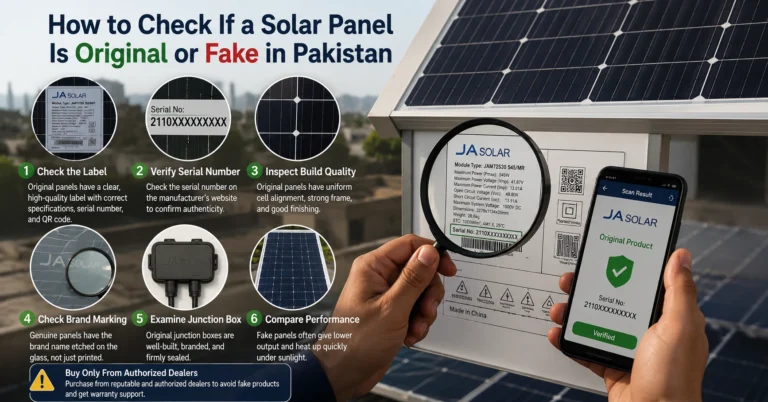
Ask the dealer for the packing list, customs clearance documents, and serial number verification before you pay — this is your main protection against B-Grade panels sold as A-Grade.
Be wary of deals that seem too cheap
As of May 2026, genuine N-Type Tier-1 panels priced below Rs. 35/watt are almost certainly B-Grade, mislabeled, or otherwise not what they’re advertised to be.
Get quotes from at least 3 dealers
Dealer margins vary more than most buyers expect. Three written quotes gives you a real basis for comparison and protects you from overpaying.
Check the inverter warranty on its own
Inverter warranties typically range from 3 to 10 years, separate from the panel warranty. Ask specifically what happens if the inverter fails in year 4 or 5 — this is where many buyers get caught off guard.
Confirm net metering eligibility before committing
Each DISCO (distribution company) runs its own net metering application process, and requirements differ by region. Verify this with your local DISCO before you finalize an on-grid system.
FAQ Section
What is the solar panel price per watt in Pakistan today (May 21, 2026)?
As of today, A-Grade Tier-1 solar panels are priced between Rs. 40 and Rs. 43 per watt, depending on the brand. Longi and JA Solar are at Rs. 40–41.50/watt, while Jinko and Canadian Solar are at Rs. 42–43/watt. B-Grade panels are available from Rs. 22–28/watt.
Which is the best solar panel brand in Pakistan in 2026?
The top three Tier-1 brands in Pakistan are Longi Solar, Jinko Solar, and JA Solar. For premium buyers, Canadian Solar and Trina Solar are also excellent. Longi Hi-Mo X10 is currently the most popular model due to its HPBC technology and anti-shading performance.
What is the price of a 5kW solar system in Pakistan in 2026?
A complete 5kW hybrid solar system (no battery) costs between Rs. 620,000 and Rs. 750,000, including panels, inverter, mounting structure, wiring, and installation. An on-grid-only 5kW system is cheaper at Rs. 450,000–550,000.
What is the difference between A-Grade and B-Grade solar panels?
A-Grade panels are factory-certified with full warranty and documentation. B-Grade panels have minor cosmetic defects and may carry partial or no warranty. Always choose A-Grade documented panels for long-term performance and warranty claims.
Are N-Type solar panels worth the extra cost in Pakistan?
Yes. N-Type panels (TOPCon, HJT, HPBC) have a degradation rate below 0.25% per year versus 0.45–0.55% for older P-Type PERC panels. Over a 25-year lifespan, an N-Type panel produces significantly more cumulative energy, making the higher upfront cost worthwhile.
CTA
Ready to go solar? Get 3 quotes today. Share your monthly electricity bill and location with at least 3 verified solar dealers in your area. Ask specifically for A-Grade documented N-Type panels, confirm the inverter brand and warranty, and request a written quote with a net metering assistance option. The best deal isn’t always the cheapest, it’s the one that gives you the best output and backup for the next 25 years.