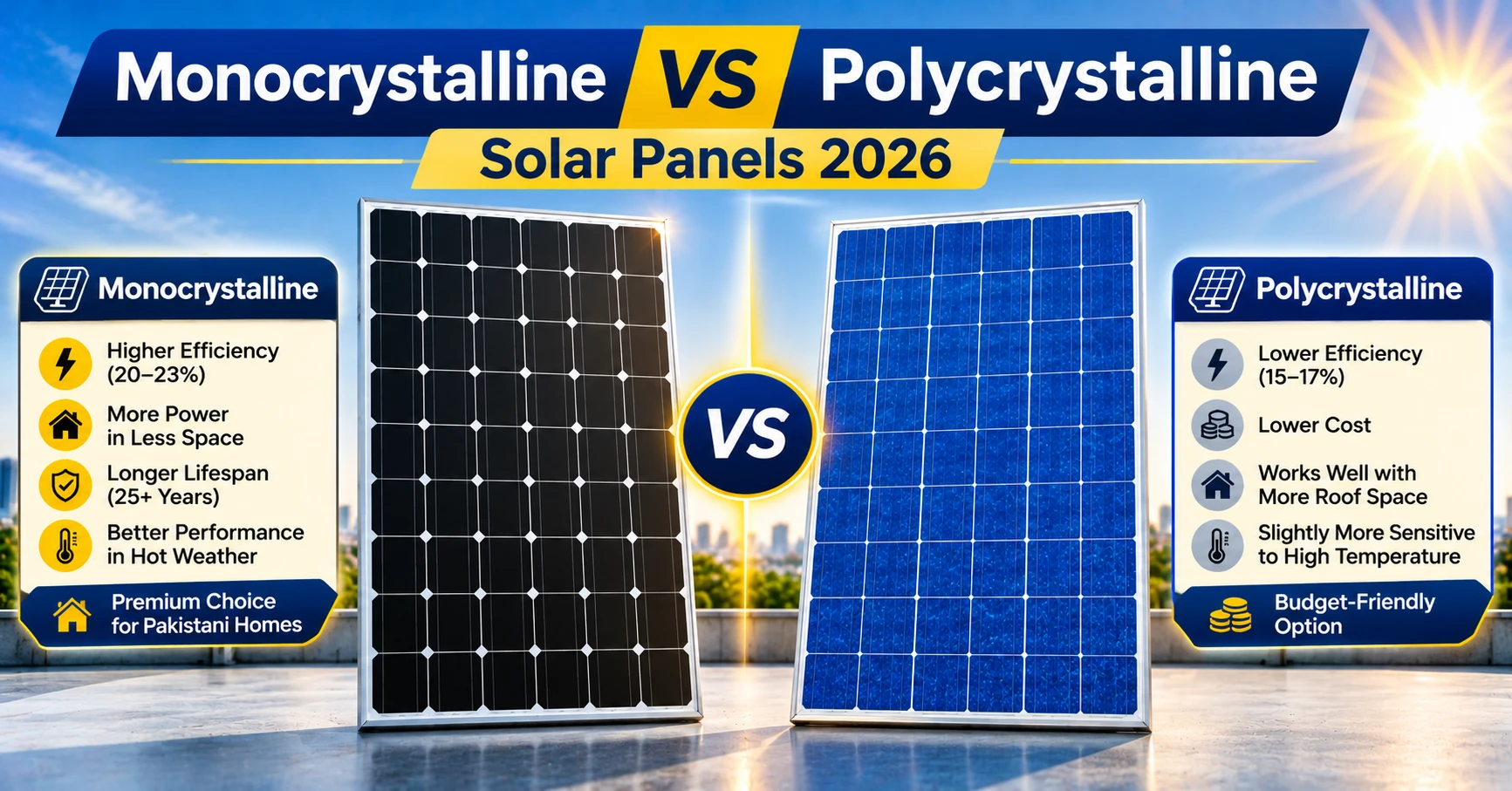
Monocrystalline vs Polycrystalline Solar Panels in Pakistan (2026)
In Pakistan’s market in 2026, monocrystalline solar panels cost ~10–20% more per watt than polycrystalline. Still, they offer better efficiency, less degradation, and improved heat performance, and that is why monocrystalline now represents the vast majority of new residential installs across the country. Polycrystalline is still around, but the price gap has narrowed enough that it’s a tougher sell, unless there are some specific circumstances.
This guide compares monocrystalline vs polycrystalline on efficiency, price, lifespan, and real-world performance in Pakistan’s climate. It tells you plainly which one to buy for your roof.
Monocrystalline vs Polycrystalline: The Core Difference
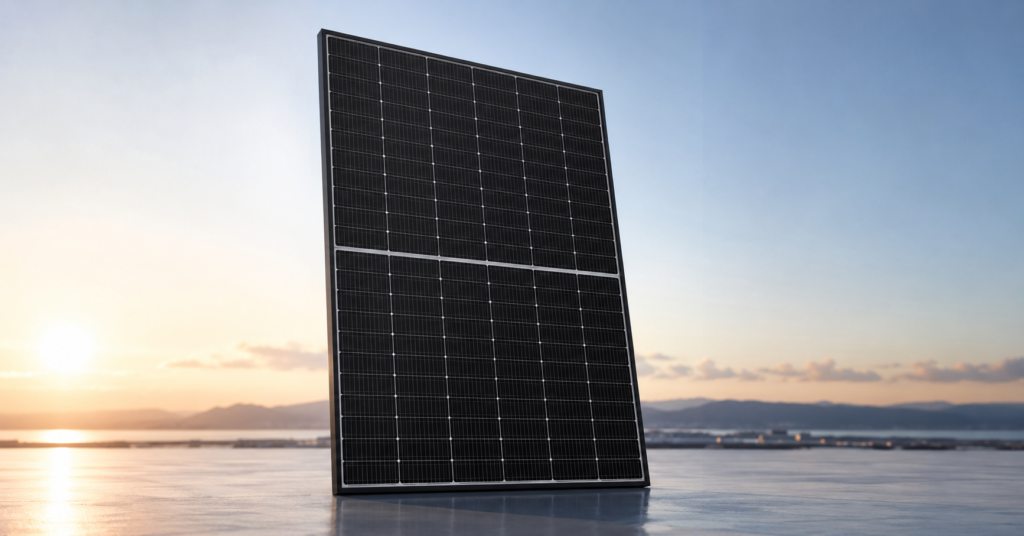
Monocrystalline solar panels and polycrystalline solar panels differ in the construction of their silicon. Monocrystalline cells are cut from a single, continuously grown crystal of silicon, which allows electrons to move through the material with less resistance. Polycrystalline cells are cast from several pieces of silicon melted together in a mould, creating more grain boundaries and more resistance to electron flow.
That structural difference is why the two are different in every other way – efficiency, looks, cost, and heat tolerance all flow from it.
| Factor | Monocrystalline | Polycrystalline |
|---|---|---|
| Silicon structure | Single continuous crystal | Multiple silicon fragments melted together |
| Efficiency | ~17–22%+ | ~15–20% |
| Appearance | Black/dark grey, uniform, rounded-corner cells | Blue, speckled, square cells |
| Price in Pakistan (2026) | ~PKR 28–40/watt | ~PKR 22–30/watt |
| Annual degradation | ~0.3–0.4% | ~0.5–0.7% |
| Temperature performance | Better in high heat | Loses more output as temperature rises |
| Typical lifespan | 25–30+ years | 25–30 years |
| Space needed for a given output | Less | More |
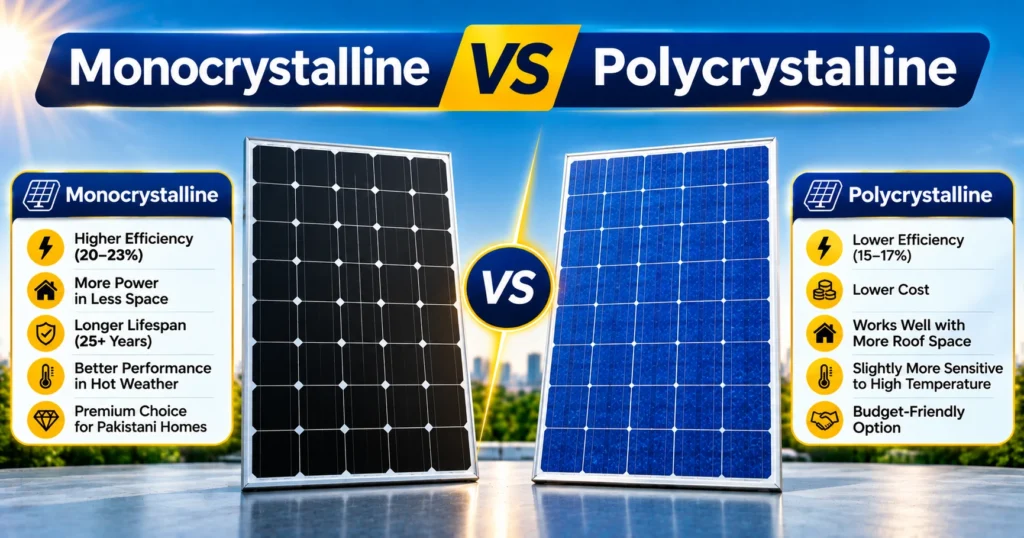
Monocrystalline vs Polycrystalline Efficiency
Monocrystalline usually has a maximum efficiency of 17-22%, although the best N-type cells go beyond this range, and polycrystalline generally ranges from 15% to 20%. In practice, a monocrystalline panel puts out more electricity for every square foot of physical space occupied – a bonus on Pakistan’s frequently cramped urban rooftops where the space for any square foot of usable roof is often restricted by water tanks, satellite dishes and shared boundary walls.
But the efficiency gap alone doesn’t tell the whole story. More important over a system’s working life is how that efficiency stands up from one year to the next – where degradation rate comes into play.
Monocrystalline vs Polycrystalline: Long-Term Output (Degradation)
Degradation rate is how much output a panel loses per year as it ages and compounds meaningfully over a 25-year system life. Monocrystalline panels usually degrade about 0.3-0.4% each year, while polycrystalline panels degrade more quickly, usually 0.5-0.7%.
Do the maths on a real comparison. A 550W monocrystalline panel degrading at 0.35% per year will still be putting out 500W in year 25. A 480W polycrystalline panel that degrades at about 0.6% per year will be about 410W after year 25. Add that slower degradation to monocrystalline’s higher starting efficiency, and a monocrystalline system will usually produce 8-10% more total energy over its 25-year lifespan than an equivalent polycrystalline system — and that’s before even factoring in the space savings.
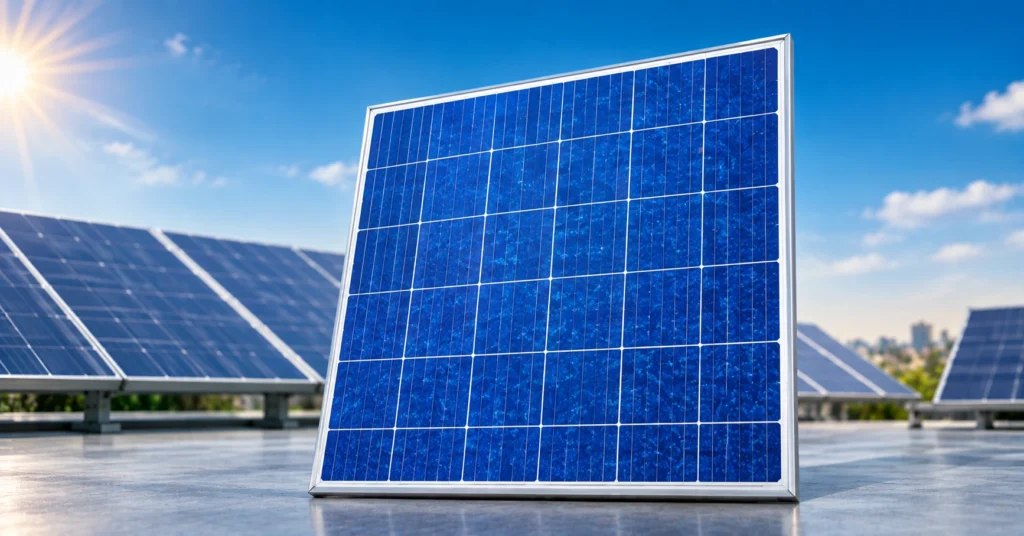
Monocrystalline vs Polycrystalline Price in Pakistan (2026)
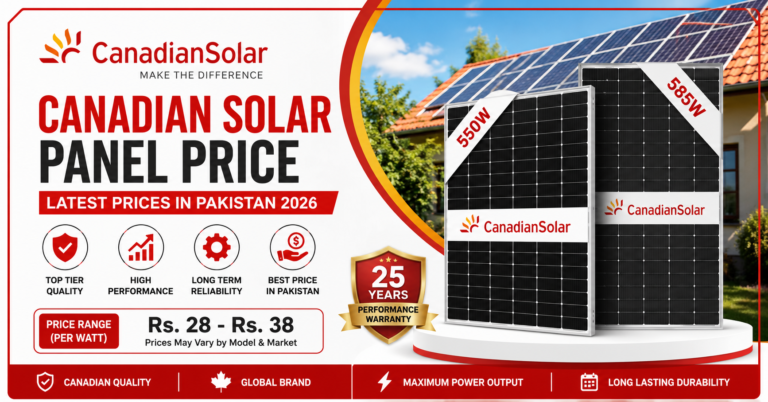
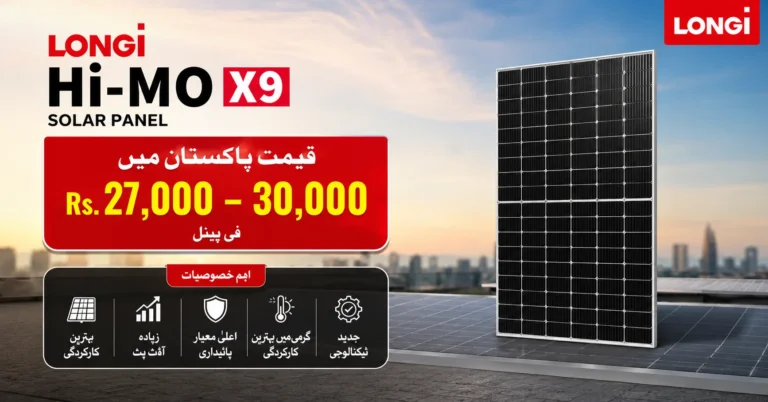
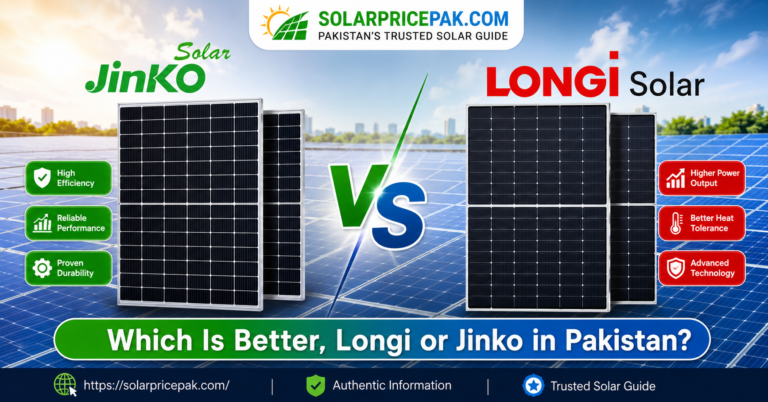
By 2026, monocrystalline panels from established brands – LONGi, Jinko, Canadian Solar, Trina, JA Solar and local players such as Max Power – are priced at about PKR 28-40 per watt depending on cell technology (P-type vs. N-type), efficiency tier and order volume. Polycrystalline panels of comparable build quality cost about PKR 22-30 a watt. So the monocrystalline premium is about 10-20% a watt.
That gap has closed a lot from where it was a few years ago and it changes the maths for most buyers. The extra rupees spent on monocrystalline for a small residential system are usually recouped by the combination of higher output and slower degradation well within the panel’s warranty period—which is a big part of why monocrystalline has taken over the bulk of the residential market in Pakistan.
Where polycrystalline still wins on total project cost is large-footprint installs: agricultural pumps, warehouse roofs, and rural properties where land or roof area isn’t the limiting factor, and a bigger array of cheaper panels can match a smaller array of pricier ones.
Monocrystalline vs Polycrystalline: Heat Performance in Pakistan’s Climate
All silicon solar panels lose some efficiency as they heat up, but the rate of that loss, the temperature coefficient, differs between the two technologies. Polycrystalline panels degrade more in high heat than monocrystalline, losing a higher percentage of output per degree Celsius above standard test conditions.
In milder climates, this is less of a problem than in Pakistan. In Punjab and Sindh, rooftop panel surface temperatures frequently exceed 60-70°C during the height of summer, far above the 25°C standard test condition that each panel is rated at. That heat penalty builds up over a full summer and is yet another reason monocrystalline tends to out-produce polycrystalline in practice, not just on the spec sheet.
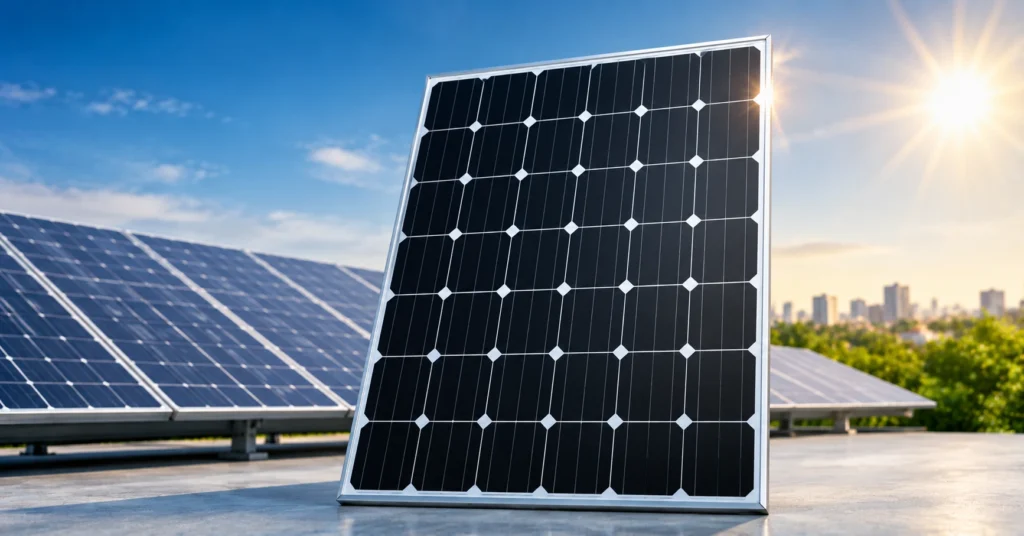
Monocrystalline vs Polycrystalline vs Thin-Film: Where Thin-Film Fits In
Thin-film panels are a third, separate category built by depositing a thin layer of photovoltaic material (commonly amorphous silicon, CdTe, or CIGS) onto a substrate, rather than using crystalline silicon wafers at all. They’re the least efficient of the three — typically 7–13% — but they’re lightweight and, in some cases, flexible.
| Monocrystalline | Polycrystalline | Thin-Film | |
|---|---|---|---|
| Efficiency | Highest (~17–22%+) | Mid (~15–20%) | Lowest (~7–13%) |
| Cost per panel | Highest | Mid | Lowest, but more panels needed |
| Best use case in Pakistan | Urban rooftops, limited space | Large roofs, agricultural sites | Off-grid kits, portable chargers, curved surfaces |
Thin-film isn’t a realistic competitor for a standard home or commercial rooftop in Pakistan — it shows up mainly in portable solar kits, off-grid backup chargers, and speciality building-integrated applications where flexibility matters more than efficiency.
Which Should You Choose: Monocrystalline or Polycrystalline?
Choose monocrystalline if:
- Your roof space is limited, as is typical on urban plots in Lahore, Karachi, Islamabad, or Faisalabad
- You want the lowest long-term degradation and the best output in Pakistan’s peak summer heat
- You’re building a grid-tied or hybrid system where maximising self-consumption per square foot of roof matters (more important than ever since NEPRA’s 2026 shift from net metering to lower-value net billing)
- You can afford the roughly 10–20% per-watt premium and want the strongest 25-year return
Choose polycrystalline if:
- You have ample, unconstrained roof or ground space — a large flat commercial roof, a warehouse, or a rural plot
- The upfront budget is the primary constraint, and you can compensate for lower efficiency with a bigger array
- The installation is a lower-stakes, secondary system (a tube well, a small workshop) where every rupee of efficiency doesn’t need to be optimised
For most Pakistani homeowners in 2026, the answer leans clearly toward monocrystalline. The price gap has narrowed to the point where polycrystalline’s main advantage — lower cost — is no longer large enough to offset the efficiency, degradation, and heat-performance gap for a typical rooftop-constrained residential install.
Does Panel Type Affect Net Metering or Net Billing Eligibility?
No. Net metering and net billing eligibility in Pakistan depend on your inverter certification and DISCO approval process, not on whether you install monocrystalline or polycrystalline panels. That said, since NEPRA’s 2026 Prosumer Regulations reduced the buyback rate for exported units, getting more usable output from your available roof space — which monocrystalline is generally better at — has become more valuable than it used to be, because self-consumption now saves more than export credits.
FAQs
Which is better, monocrystalline or polycrystalline solar panels?
Monocrystalline is generally better for most Pakistani homeowners because it offers higher efficiency, slower degradation, and better heat performance, which usually outweighs its 10–20% price premium over polycrystalline within the panel’s 25-year lifespan.
What is the price difference between monocrystalline and polycrystalline solar panels in Pakistan?
Monocrystalline panels typically cost PKR 28–40 per watt in Pakistan in 2026, while polycrystalline panels cost roughly PKR 22–30 per watt, a gap of around 10–20% per watt.
What is the efficiency difference between monocrystalline and polycrystalline solar panels?
Monocrystalline panels typically reach 17–22%+ efficiency, while polycrystalline panels range from about 15% to 20%. The gap means monocrystalline produces more power from the same roof area.
Is monocrystalline vs polycrystalline the same as monocrystalline vs thin-film?
No. Thin-film is a separate, third category made without crystalline silicon wafers at all. It’s less efficient than both monocrystalline and polycrystalline, and it’s used mainly for off-grid, portable, or flexible-surface applications rather than standard rooftops.
Is polycrystalline still worth buying in Pakistan in 2026?
Yes, in specific cases, mainly large-footprint installs like agricultural or rural sites with ample space, where a bigger array of cheaper polycrystalline panels can match a smaller, pricier monocrystalline array. For space-constrained urban rooftops, monocrystalline is usually the better value.
Do monocrystalline panels really last longer than polycrystalline?
Both types are typically rated for 25–30 years, but monocrystalline panels degrade more slowly each year (around 0.3–0.4% vs. 0.5–0.7% for polycrystalline), so they retain more of their original output by the end of that period.
Does choosing monocrystalline over polycrystalline affect net metering approval?
No. Net metering and net billing approval in Pakistan depend on inverter certification and DISCO paperwork, not panel type. However, monocrystalline’s higher output per square foot has become more valuable since 2026’s shift to lower net billing export rates.
Still Deciding Between Mono and Poly?
The right answer depends on your exact roof size, budget, and how much of your usage happens during the day versus at night. Get a site-specific quote from a licensed local installer who can size a system mono, poly, or a mix—around your actual electricity bill and roof layout.
One Comment