
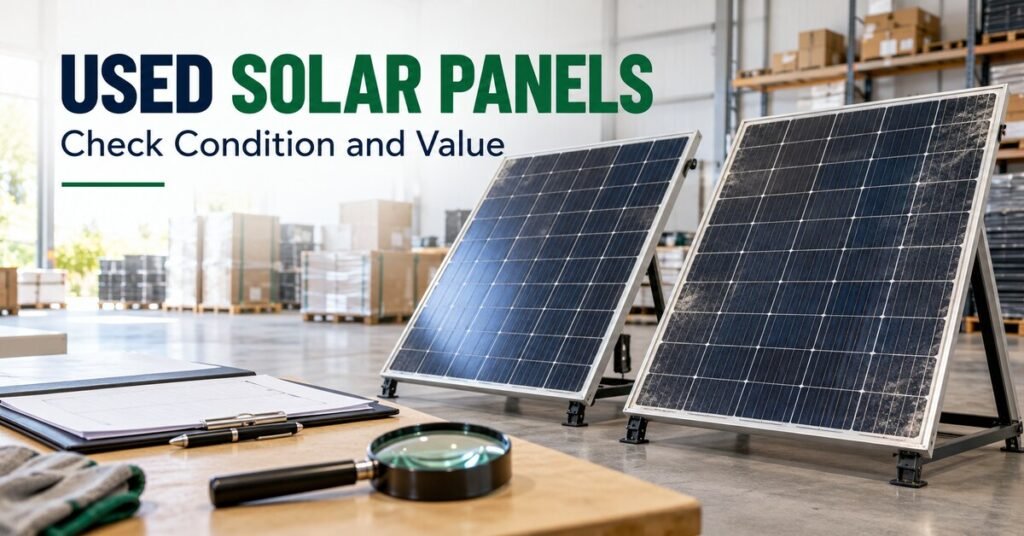
Buying used solar panels in Pakistan is a condition and compatibility decision as well as a price comparison. A low purchase price can lose its advantage if modules have undocumented history, reduced performance, unsupported warranty claims or electrical characteristics that complicate the installation. Inspect the actual stock and compare the complete project cost.
Establish identity and ownership records
Ask for the manufacturer, exact model, serial numbers, original documentation and evidence of legitimate supply. Identify whether modules were previously installed, removed from another project, held as surplus or repaired. Those situations should not be described as equivalent without supporting records.
Our panel authenticity guide helps organise identity checks. Authenticity does not establish present condition, and a genuine label does not prove transferable warranty coverage. Keep both questions visible when reviewing a used-equipment offer.
Ask why the modules were removed
Record the previous installation’s approximate age, environment and reason for removal where known. A planned upgrade is different from removal following a fault or damaging event. Missing history creates uncertainty that should affect the comparison rather than be replaced with optimistic assumptions.
Request available service and testing records. Check whether the seller can trace each module to those records. A general statement that all the panels are working should not replace an assessment of the specific units proposed for purchase.

Inspect visible condition professionally
Qualified personnel should review the modules using appropriate manufacturer procedures. Relevant concerns can include glass damage, frame distortion, backsheet problems, compromised junction boxes and damaged connectors. Avoid pressure tests, improvised live connections or unsafe handling to demonstrate condition.
Photograph serial-linked findings and agree on rejection criteria before payment. Cosmetic differences and electrical faults require different interpretations, but both should be described honestly. Do not accept an unidentified replacement module if the tested item is later swapped during delivery.
Recognise what visual inspection cannot prove
Internal defects may not be visible in a normal surface check. Where appropriate, request specialist testing with documented methods and interpretation. The test report should identify modules, conditions, findings and any limits on what was assessed.
A simple open-circuit reading or brief production demonstration cannot establish every aspect of performance and safety. Compare evidence consistently across the stock. If testing is unavailable, treat the uncertainty as part of the purchase decision rather than describing the modules as certified.
Verify electrical and physical compatibility
Check module dimensions, mounting requirements, connector details, voltage and current characteristics. Mixed batches can create design complications even when the advertised wattages look similar. The installer should assess the actual proposed string arrangement and inverter inputs.
Our panel types guide helps explain product categories, but matching a technology label is insufficient. Confirm exact models and documented characteristics. Installation savings can disappear if the stock requires unsuitable workarounds or additional design changes.
Compare usable value instead of headline watts
The price-per-watt guide offers a starting point for cost comparison. For used modules, state the power basis and its evidence. Original nameplate power and measured current condition should not be confused or presented as interchangeable without qualification.
Suppose a hypothetical used module costs PKR 12,000 and a new alternative costs PKR 18,000. The PKR 6,000 difference is only one input. Testing, transport, mounting, expected service life, support and replacement risk can change the complete installed value. These numbers illustrate comparison, not current market prices.
Before you negotiate, check which models hold their value in the Pakistani market — see the best solar panels in Pakistan by price and performance for current retail benchmarks.

Read warranty and return terms
Check whether any manufacturer warranty remains valid for the buyer and installation. Transferability, proof of purchase, handling and claim requirements depend on the applicable terms. A seller’s verbal promise should not be presented as manufacturer coverage.
Our warranty guide distinguishes product and performance obligations. Obtain the seller’s return policy, inspection period and responsibility for transport costs in writing. A short return window may be difficult to use if installation and testing are delayed.
Include the installer in the decision
Confirm that the installer is willing to use the specific stock and can support the resulting design. Ask who handles a later module fault and whether suitable replacement stock is likely to be available. Keep responsibilities clear across equipment supply and installation.
If used modules are proposed for an existing array, request a compatibility assessment. Matching only the old panel’s wattage can miss dimensions, mounting and electrical differences. The assessment should describe the finished arrangement rather than simply approving a bargain purchase.
Before-you-buy checklist
- Traceable models, serial numbers and supply records.
- Previous use, removal reason and available service history.
- Serial-linked inspection and relevant test evidence.
- Supported mounting, strings and inverter compatibility.
- Complete installed cost with testing and transport included.
- Written return, warranty and fault-resolution terms.
Keep records even if the price is low. Used equipment can be considered rationally when condition and responsibilities are clear. The goal is to purchase a documented working asset suitable for the project, not merely the cheapest collection of nominal watts.
Frequently asked questions
Are all used panels unsuitable?
No blanket conclusion is justified. Evaluate the actual condition, records and supported design. A low price alone does not establish either a good deal or a poor one.
Does a serial number prove remaining warranty?
It helps identify the product, but warranty validity and transfer conditions must be checked separately. Obtain the applicable written terms and supporting documents.
Can I mix different used models in one array?
Have the qualified designer assess the proposed arrangement. Similar labels do not establish matching electrical behaviour or mounting requirements. Resolve compatibility before purchasing the stock.
Used panels can be a genuine bargain, but only when their condition and history check out. Inspect every module, verify the serial numbers and paperwork, and walk away from any deal that cannot document what it is selling.