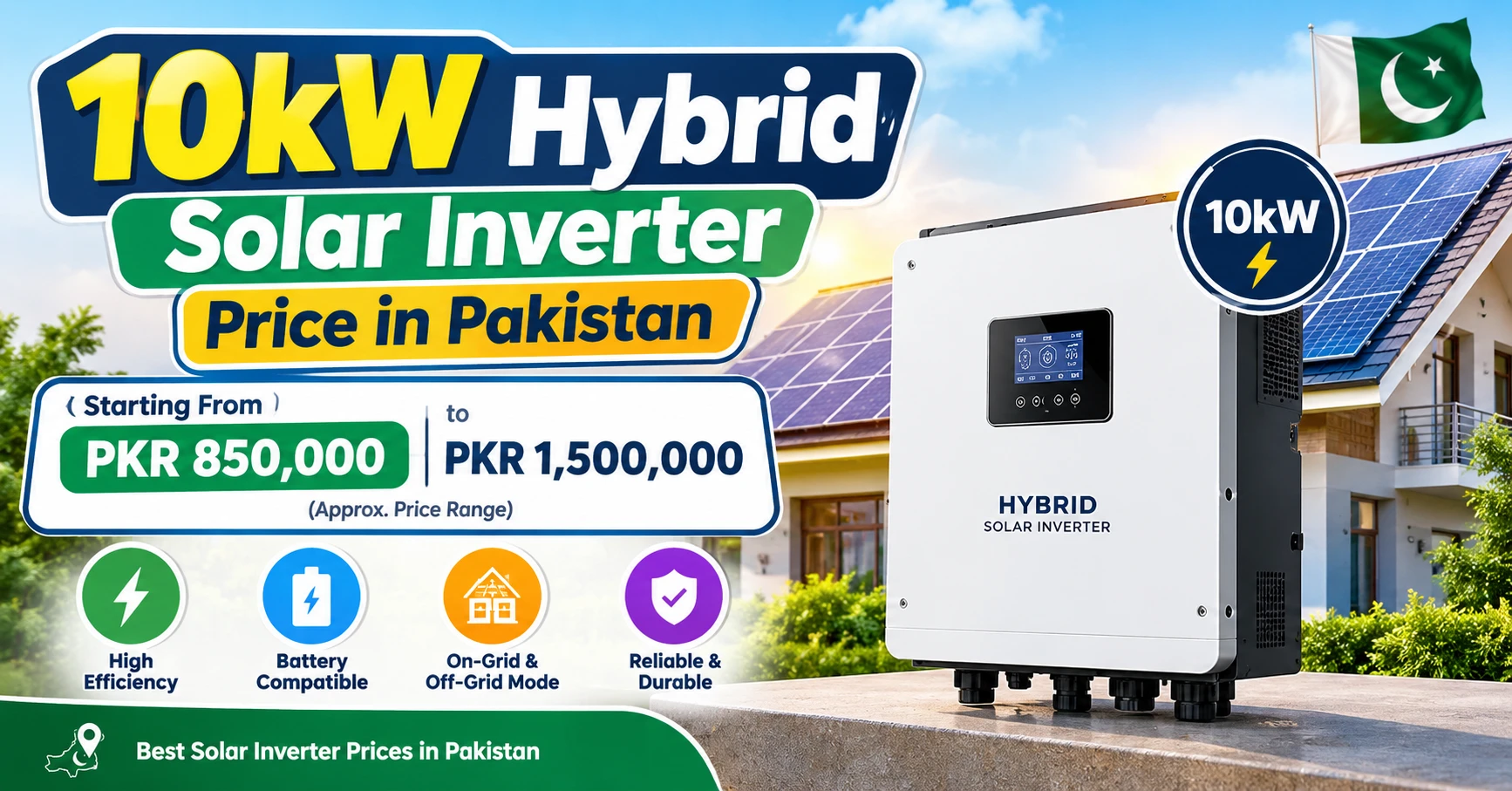
10kW Hybrid Solar Inverter Price in Pakistan (2026)
A 10 kW hybrid solar inverter price in Pakistan ranges from Rs. 270,000 to Rs. 600,000, with the most reliable single-phase residential units falling between Rs. 350,000 and Rs. 465,000. The spread at this capacity is wider than at 6kW because 10kW sits at a fork in the road: some buyers need a simple single-phase home unit, others need three-phase for commercial or heavy-load properties, and the two categories are priced very differently.
This guide breaks down brand-wise 2026 prices, explains single-phase versus three-phase (the decision that most affects your final cost), and covers how NEPRA’s 2026 net billing rules change the payback math for a system this size.
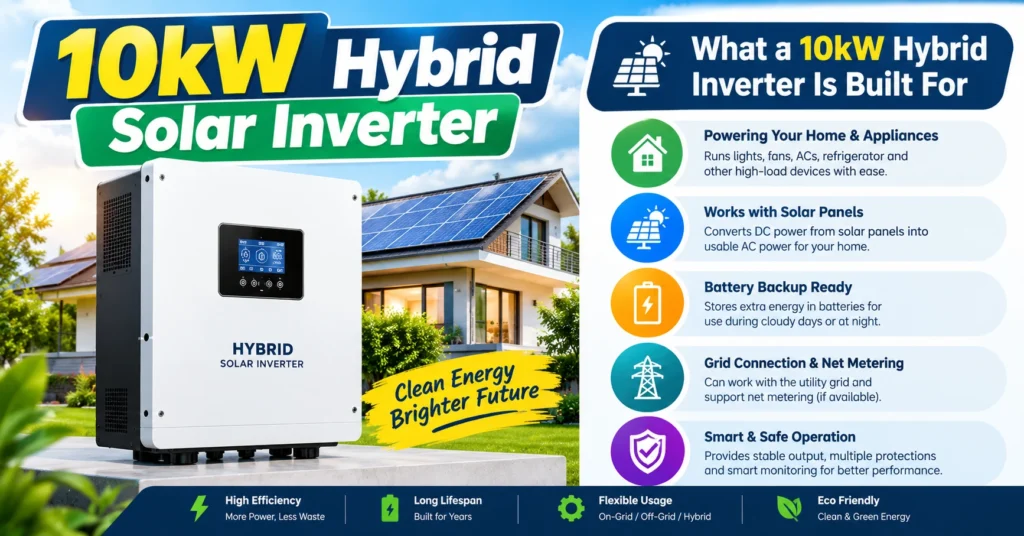
What a 10kW Hybrid Inverter Is Built For
A 10kW hybrid inverter sits above the standard 6kW residential range and is typically chosen for large homes, farmhouses, small offices, or properties running 3-4 split ACs alongside standard household load. It manages the same three-way switching as smaller hybrid units – solar, battery, and grid – but with a higher continuous output rating and, in many models, support for larger lithium battery banks.
10kW Hybrid Solar Inverter Price in Pakistan, 2026 Brand Comparison
| Brand & Model | Approx. Price (PKR) | Notable Feature |
|---|---|---|
| Knox Krypton 10kW (PV13002) | 270,000 to 295,000 | Grid-tied and battery backup, budget-friendly |
| Solis 10kW LV Single Phase (S6-EH1P10K-L-PLUS) | 390,000 to 415,000 | IP66, high-performance energy management |
| Voltas 10K-H4 | ~375,000 | Versatile single-phase, efficient energy management |
| Inverex Nitrox 10kW | ~465,000 | 5 to 10-year warranty range, strong local support |
| GoodWe GW12K-ES-C10 (12kW class) | ~430,000 | Single-phase low-voltage, residential and light commercial |
| Growatt 10kW Three-Phase SPH | ~500,000 to 550,000 | Industrial and commercial applications |
Typical single-phase 10 kW range: Rs. 270,000 to Rs. 465,000
Typical three-phase 10 kW range: Rs. 500,000 and above
Single-Phase vs Three-Phase: The Decision That Actually Sets Your Price
This is the single biggest reason 10kW inverter quotes vary so much, and it’s the detail most price lists skip.
- Single-phase units are standard for most homes and are cheaper to buy and install. They suit properties with a single-phase WAPDA connection, which covers the large majority of residential Pakistani households even at higher load levels.
- Three-phase units are required for properties with a three-phase grid connection, typically larger homes, farmhouses, commercial buildings, and industrial setups with heavier, more balanced load demands. Three-phase hybrid inverters cost significantly more and often need a licensed electrician to confirm your existing connection type before you order.
Before buying a 10 kW inverter, check your electricity bill or meter connection type first. Ordering the wrong phase configuration is the most expensive mistake buyers make at this capacity.
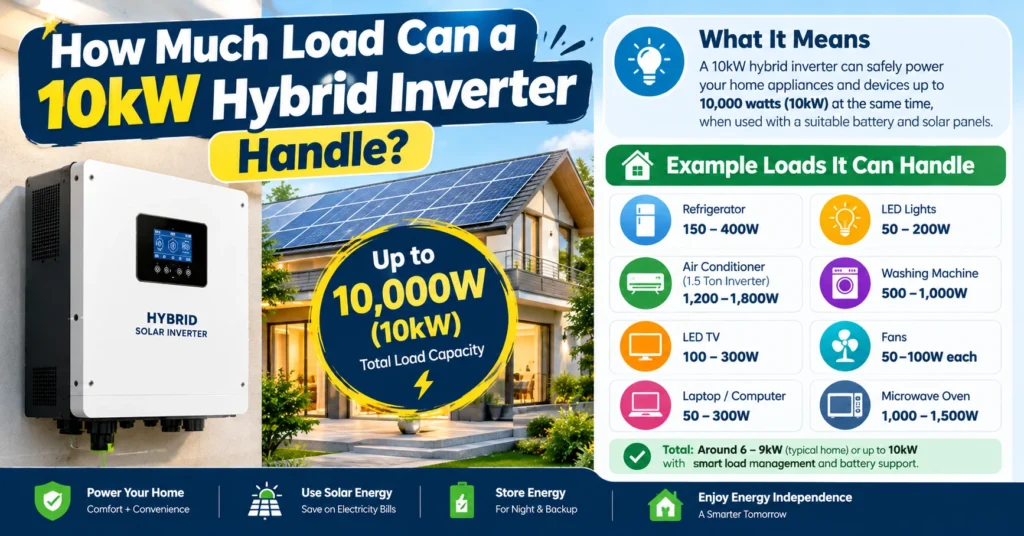
How Much Load Can a 10kW Hybrid Inverter Handle?
A 10kW hybrid inverter is generally sufficient to power an entire medium to large-sized home, comfortably running 3-4 split ACs, a fridge, washing machine, water pump, and full household lighting simultaneously, provided the panel array and battery bank are sized to match.
How to Apply for Solar Net Metering in Pakistan (2026 Guide) →Panels and Battery Sizing for a 10kW System
A 10kW hybrid inverter typically pairs with 20 to 24 solar panels (at 450W to 550W each), giving roughly 10kW to 13kW of DC panel capacity to account for cloudy days and long-term panel degradation. For backup during load-shedding, most 10kW households install 10kWh to 15kWh of lithium battery storage, enough for several hours of essential to near-full home backup depending on usage.
NEPRA’s 2026 Net Billing Shift: What It Means at 10kW
The NEPRA (Prosumer) Regulations 2026, notified February 9, 2026 under SRO 251(I)/2026, replaced the older net metering framework with a net billing system. Instead of the previous one-to-one offset, where exported solar units were credited at the same rate as grid electricity, DISCOs now buy surplus power at the national average energy purchase price (around Rs. 10 to 11 per unit) while continuing to sell grid electricity at standard tariffs of roughly Rs. 37 to 55 per unit. New connections also carry a shorter five-year contract term instead of the earlier seven years. Applications submitted before February 8, 2026, are still processed under the older, more generous rules.
At 10 kW, this matters more than at smaller capacities because larger systems generate more surplus during peak sun hours, exactly the power that now sells back at the lower net billing rate. A well-sized battery bank that stores that surplus for evening use, rather than exporting it, has become a bigger part of the ROI calculation than it was under the old net metering regime. This is also why NEPRA has capped solar capacity at the sanctioned load of the consumer and restricts new connections once a transformer nears its rated capacity, a detail worth confirming with your DISCO before finalising a 10kW system.
N-Type Solar Panel Price in Pakistan (2026) — Full Buyer’s Guide →What Drives Price Differences at 10 kW
- Battery chemistry and capacity — lithium battery banks large enough for a 10kW system add significantly more to total cost than the inverter itself
- IP rating — IP65/IP66 rated units cost more but survive outdoor rooftop conditions far longer
- Phase configuration — three-phase units carry a substantial premium over single-phase
- Warranty and local service — 5- to 10-year warranties backed by a local service network justify a higher upfront price
- Installation and structure — elevated mounting structures, cabling, earthing, and commissioning can add Rs. 100,000 or more to the total system cost beyond the inverter price alone

Where to Buy and What to Verify
- Confirm your connection type (single-phase or three-phase) with your electricity bill before requesting quotes.
- Buy from an authorized dealer to protect warranty claims.
- Ask for a line-by-line bill of materials — a low quote may exclude the battery, elevated structure, or installation.
- Check sanctioned load and net billing eligibility with your DISCO before finalizing system size.
- Size the battery to your actual backup goals, not just the inverter’s maximum rating.
For official regulatory details, refer to NEPRA’s official notifications and the Alternative Energy Development Board (AEDB).
Bifacial Solar Panels Price in Pakistan (2026 Guide) →FAQ Section
1. What is the average 10 kW hybrid solar inverter price in Pakistan in 2026?
Single-phase 10 kW hybrid inverters typically cost Rs. 270,000 to Rs. 465,000, while three-phase models for commercial or heavy-load properties start around Rs. 500,000.
2. Do I need a three-phase inverter for a 10 kW system?
Only if your property already has a three-phase WAPDA connection. Most residential homes, even large ones, use single-phase connections, so check your electricity bill before ordering.
3. How much does a complete 10 kW solar system cost, not just the inverter?
A full 10 kW system, including panels, battery, structure, and installation, typically costs Rs. 850,000 to Rs. 1.4 million on-grid, or Rs. 1.3 million to Rs. 2.8 million for a hybrid system with lithium battery storage.
4. How many batteries does a 10 kW hybrid inverter need?
Most 10kW systems pair with 10 kWh to 15 kWh of lithium battery storage for several hours of meaningful backup during outages.
5. Can a 10 kW hybrid inverter run a whole large house?
Yes, a 10 kW hybrid inverter can generally power an entire medium- to large-sized home, including 3-4 split ACs, a fridge, a water pump, and full lighting, when properly matched with adequate panels and battery capacity.
6. Does the 2026 NEPRA net billing change affect a 10kW system more than a 6kW system?
Yes, larger systems typically generate more exportable surplus, which now sells back at the lower net billing rate rather than the old one-to-one offset, making battery storage for self-consumption more valuable at 10 kW.
7. Which brand offers the best warranty for a 10 kW hybrid inverter in Pakistan?
Inverex typically offers 5- to 10-year warranty ranges depending on the model, though exact terms should always be confirmed directly with the authorised distributor at the time of purchase.
2 Comments