N-Type Solar Panel Price in Pakistan (2026) – Full Buyer’s Guide
N-type solar panel technology has become the default for new solar installations in Pakistan by 2026. The price difference with older panel types has shrunk enough that most buyers now find it an easy decision. This guide covers up-to-date per-watt pricing by brand, explains what makes an N-type panel different from the P-type panels they’re replacing, and answers the practical questions Pakistani buyers ask before they order, from bifacial options to small 200W units for backup and off-grid use.
What Is an N-Type Solar Panel?
An N-type solar panel is made on a silicon wafer doped with phosphorus. This dopant gives the base material an excess of free electrons, hence the ” N ” for negative. This is the reverse doping process to the older P-type cell, which uses boron and produces positively charged “holes” instead of additional electrons. That single manufacturing difference accounts for just about every practical advantage of N-type panels: higher electron mobility, better heat tolerance, and complete immunity from light-induced degradation (LID), the small permanent efficiency loss that P-type panels suffer in their first few weeks of sunlight.
In practical terms, this means an N-type panel converts more sunlight into usable electricity, retains that output longer, and loses less performance as Pakistan’s summer rooftop temperatures rise past 60°C.
N-Type Solar Panel Price in Pakistan – Current Rates by Brand
Prices move with the USD/PKR exchange rate, so treat the figures below as a current market snapshot rather than a fixed number, but they give an accurate picture of where each Tier-1 brand sits relative to the others.
| Brand | Model | Price per Watt (PKR) |
|---|---|---|
| Trina Solar | Vertex S+ 585W Bifacial | Rs. 40 |
| JA Solar | 585W / 610W Bifacial | Rs. 42 |
| Longi Solar | Hi-Mo 7 585W Bifacial | Rs. 42.5 |
| Longi Solar | Hi-Mo X10 645W Double Tech | Rs. 44 |
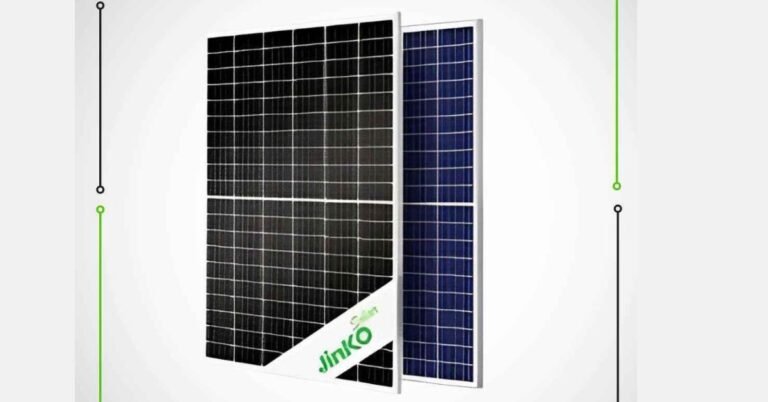
| Jinko Solar | Tiger Neo 585W Monofacial | Rs. 43.5 |
| Jinko Solar | Tiger Neo 585W Bifacial | Rs. 44.5 |
| Canadian Solar | HiKu7 TOPCon 585W | Rs. 44.5 |
| Canadian Solar | TOPCon 710W Double Glass | Rs. 45 |
These are pallet rates ex-Lahore. Buying loose panels rather than a full pallet typically adds around 25 paisa per watt, and bifacial versions run roughly Rs. 0.50–1 more per watt than the equivalent monofacial model, a premium that’s usually recovered through the extra 5–25% output bifacial panels generate from their rear surface.
Across the market, genuine Tier-1 N-type panels currently sit in the Rs. 38–45 per watt range, compared to roughly Rs. 28–38 per watt for P-type panels of similar wattage.
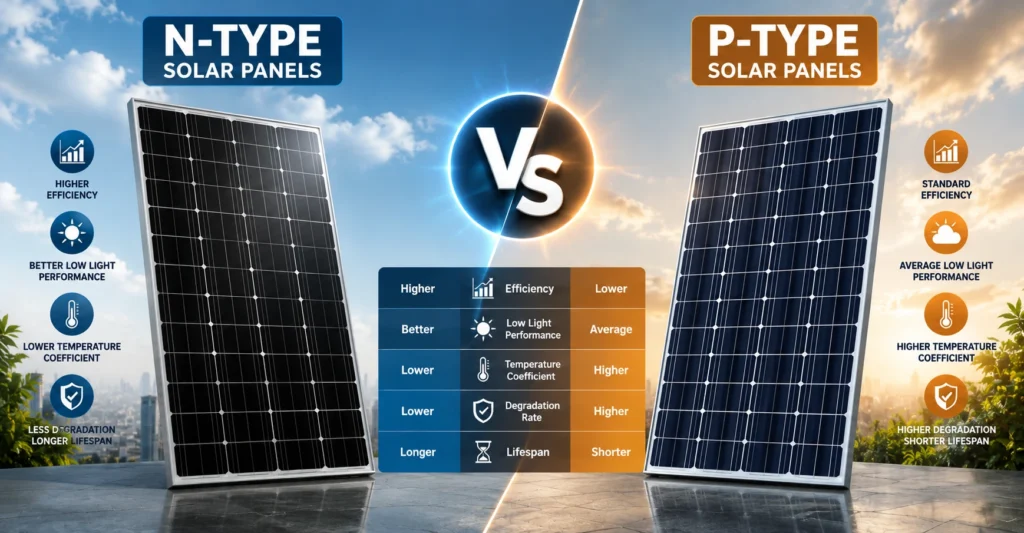
N-Type vs P-Type Solar Panels: What’s the Real Difference?
This is the comparison every buyer eventually needs to make, since it directly affects both upfront cost and 25-year return.
| Feature | P-Type (PERC) | N-Type (TOPCon) |
|---|---|---|
| Efficiency | 20.1% – 21.2% | 21.5% – 22.65% |
| Annual Degradation | 0.45% – 0.55% | 0.30% – 0.40% |
| Temperature Coefficient | -0.38%/°C | -0.28%/°C |
| Light-Induced Degradation | Present (2–3% loss) | None |
| Price per Watt (2026) | Rs. 28–38 | Rs. 38–45 |
| Heat Performance (45°C+) | Moderate | Strong |
| Best Suited For | Budget systems, farms, off-grid | Homes, net metering, commercial roofs |
The heat-performance line matters more in Pakistan than almost anywhere else. On a 65°C rooftop, a P-type panel can lose over 15% of its rated output to heat alone, while an N-type panel under the same conditions loses closer to 11%. That roughly 4-point gap repeats every hot day for 25 years, which is where most of the long-term financial advantage comes from — not the sticker price.
25-Year Savings: Does the Extra Cost Pay Off?
For a typical 5kW residential system, the higher N-type price is recovered early and keeps compounding afterward:
| Year | P-Type Cumulative Savings | N-Type Cumulative Savings | N-Type Advantage |
|---|---|---|---|
| 5 | Rs. 19.2 lakh | Rs. 19.8 lakh | +Rs. 60,000 |
| 10 | Rs. 37.8 lakh | Rs. 39.5 lakh | +Rs. 1.7 lakh |
| 15 | Rs. 55.7 lakh | Rs. 59.0 lakh | +Rs. 3.3 lakh |
| 20 | Rs. 72.9 lakh | Rs. 78.2 lakh | +Rs. 5.3 lakh |
| 25 | Rs. 89.4 lakh | Rs. 97.0 lakh | +Rs. 7.6 lakh |
The extra Rs. 30,000–40,000 an average homeowner pays upfront for N-type panels on a 5kW system is typically offset within the first two to three years through lower degradation and better heat performance, after which every additional year is pure gain.
N-Type Solar Panels vs Monocrystalline: Clearing Up a Common Mix-Up
This is one of the most searched comparisons, and it’s based on a slight misunderstanding worth clearing up: N-type panels are monocrystalline panels; they’re not a separate, competing category. “Monocrystalline” describes how the silicon crystal is grown (as a single, continuous crystal structure, as opposed to polycrystalline), while “N-type” and “P-type” describe how that monocrystalline wafer is chemically doped.
So the real comparison isn’t N-type vs. monocrystalline; it’s N-type monocrystalline vs. P-type monocrystalline, which is exactly the comparison covered in the table above. Every N-type panel sold in Pakistan today is monocrystalline; the difference buyers actually experience comes down to the doping process and the resulting efficiency, heat tolerance, and degradation figures.
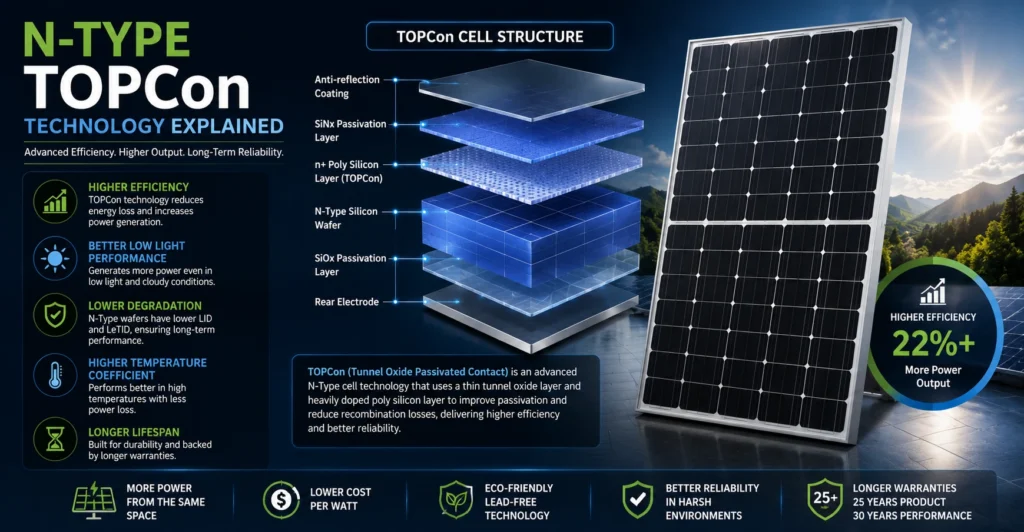
N-Type TOPCon Technology Explained
TOPCon (Tunnel Oxide Passivated Contact) is the cell architecture behind most N-type panels sold in Pakistan today. It works by adding an ultra-thin oxide layer to the rear of the N-type silicon wafer, which passivates the surface and sharply cuts down on electron recombination. In this process, captured electrons are lost before they can be turned into usable current. Fewer electrons lost means more electrons collected, which is where TOPCon’s efficiency edge over older PERC (P-type) cells comes from.
Two other architectures show up occasionally in the Pakistani market:
- HJT (Heterojunction Technology)—layers of thin-film silicon over a crystalline core for even higher efficiency, though it remains a smaller, pricier segment locally.
- HPBC / Back-Contact designs—move all electrical contacts to the rear of the cell, improving both efficiency and aesthetics, seen in premium models like Longi’s Hi-Mo X10.
For most Pakistani residential and commercial buyers, TOPCon currently offers the best balance of price, availability, and long-term performance.
N-Type Bifacial Solar Panels
Bifacial N-type panels generate electricity from both the front and rear surfaces, capturing reflected light from a white rooftop, gravel, or a light-colored surface below on the back side of the cell. This can add anywhere from 5% to 25% additional output depending on mounting height, tilt angle, and how reflective the surface underneath the array is.
In Pakistan, bifacial N-type panels typically cost Rs. 0.50 to Rs. 1 more per watt than the monofacial version of the same model. They make the most financial sense on elevated mounting structures, ground-mount systems over light gravel or reflective roofing, and commercial installations where the extra rear-side gain can be maximized—they add less value on a standard flush rooftop with minimal ground clearance.
N-Type Solar Panels 200W – Options for Small and Off-Grid Use
Not every buyer needs a full rooftop system. Smaller 200W-class N-type panels are increasingly available for:
- Off-grid cabins and small setups where space and load requirements are limited
- RV, van, and camping setups needing a compact, lightweight panel
- Backup and emergency power kits paired with a small inverter and battery
- Portable or foldable panel kits for field or agricultural use
200W N-type units carry a higher price per watt than large-format 585–710W panels used in rooftop systems, since manufacturing and shipping smaller units loses the economies of scale that bring down the per-watt cost of pallet-quantity, high-wattage panels. Buyers in this segment should still confirm the cell is genuinely N-type TOPCon rather than a rebranded P-type panel, since smaller-format labeling in this category is less standardized than in the mainstream 500W+ segment.
N-Type Solar Panel Efficiency
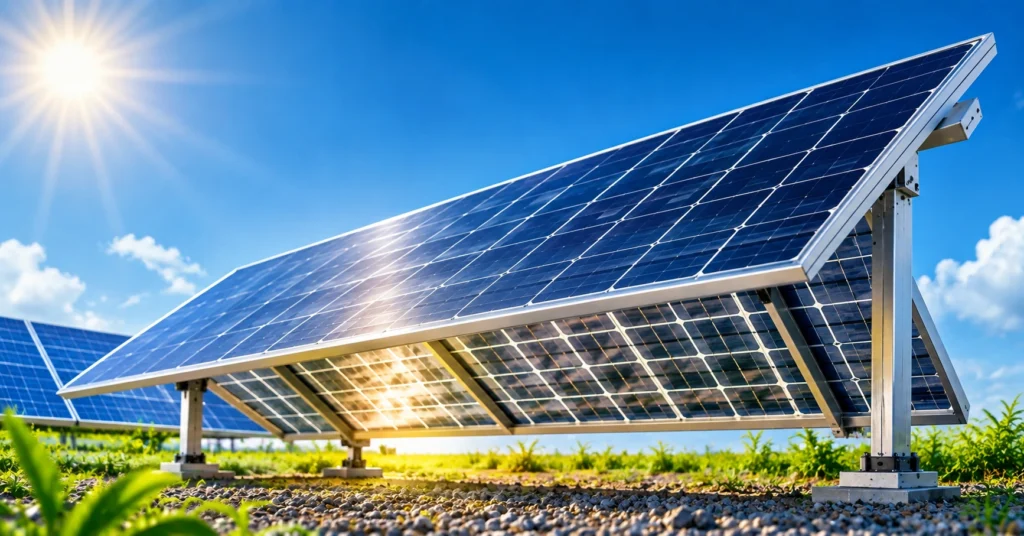
Efficiency is the metric that ultimately drives every other advantage on this list. Current N-type TOPCon panels available in Pakistan reach up to 22.65% module efficiency, with some premium back-contact models pushing higher still, compared to a 20.1–21.2% range for standard P-type PERC panels. TOPCon’s theoretical ceiling sits above 28%, well ahead of PERC’s roughly 24% limit, which is why manufacturers continue to push R&D spending toward N-type architecture rather than further refining P-type designs.
For a homeowner, the practical effect of this efficiency gap is fewer panels needed to hit a given system size—useful on roofs where space, not budget, is the limiting factor.
How Many N-Type Panels Do You Need?
Using a standard 645W N-type panel as the baseline:
| System Size | Panels Needed | Approx. Panel Area | Recommended Roof Space |
|---|---|---|---|
| 3kW | 5 panels | ~10.5 m² | 12+ m² |
| 5kW | 8 panels | ~16.8 m² | 20+ m² |
| 8kW | 12 panels | ~25.2 m² | 30+ m² |
| 10kW | 16 panels | ~33.6 m² | 40+ m² |
What Actually Moves N-Type Solar Panel Price in Pakistan
Four factors explain almost all day-to-day price movement:
- USD/PKR exchange rate — since every panel is imported and priced in dollars, a five-rupee move in the exchange rate can shift per-watt pricing by Rs. 1–2 overnight.
- Import duties and GST — a 17% GST applies to imported panels, though partial duty exemptions introduced in 2025–26 to encourage renewable adoption have helped keep prices more stable than in previous years.
- Pallet vs. loose purchase—buying a full pallet rather than individual units saves roughly 25 paisa per watt.
- Bifacial vs. monofacial—bifacial models run Rs. 0.50–1 higher per watt, offset by additional rear-side generation over the panel’s life.
Warranty Comparison by Brand
Warranty length is a useful proxy for how confident a manufacturer is in its own product, and it varies more between N-type brands than price does.
| Brand | Product Warranty | Performance Warranty | Annual Degradation |
|---|---|---|---|
| Longi Hi-Mo X10 | 15 years | 30 years | 0.35% |
| Jinko Tiger Neo | 12 years | 30 years | 0.40% |
| Canadian TOPCon | 12 years | 30 years | 0.40% |
| JA Deep Blue | 12 years | 30 years | 0.40% |
| Trina Vertex N | 12 years | 25 years | 0.40% |
Is the Extra Cost of N-Type Solar Panels Worth It in Pakistan?
For any installation intended to last more than a few years — which covers essentially every residential and commercial rooftop system — the answer is yes. The 5–10% upfront premium over P-type is small relative to the 25-year gap in cumulative savings, and Pakistan’s heat and long sunshine hours make the N-type advantage larger here than in milder climates. The only scenario where P-type still makes sense is a genuinely budget-constrained, short-horizon, or off-grid agricultural setup where upfront cost outweighs long-term generation.
FAQs:
What is the N-type solar panel price in Pakistan per watt right now?
Genuine Tier-1 N-type TOPCon panels currently range from about Rs. 38 to Rs. 45 per watt, depending on brand, wattage, and whether the panel is monofacial or bifacial. Rates are pallet prices ex-Lahore and shift with the dollar rate, so it’s worth checking a live price page before finalizing an order.
Is the N-type solar panel price in Pakistan worth the extra cost over P-type?
Yes, for any permanent installation. The 5–10% higher upfront cost is typically recovered within two to three years through lower degradation and better heat performance, and the gap in total savings keeps widening every year after that, reaching several lakh rupees of advantage over 25 years on a typical residential system.
Which N-type solar panel brand offers the best price in Pakistan?
Trina Solar’s Vertex S+ currently offers the lowest genuine Tier-1 N-type rate at around Rs. 40 per watt, while JA Solar sits close behind as the best budget option with a 30-year performance warranty. Jinko and Canadian Solar sit at the premium end with slightly higher efficiency and the longest warranty coverage.
What’s the difference between N-type TOPCon and N-type bifacial panels?
“TOPCon” describes the cell architecture — the oxide passivation layer that boosts efficiency, while “bifacial” describes the panel’s physical design, which allows it to capture light on both the front and rear surfaces. Most bifacial panels sold in Pakistan today use TOPCon cells, so the two terms usually describe the same panel from different angles rather than competing options.
Are N-type solar panels approved for net metering in Pakistan?
Yes. N-type TOPCon and bifacial panels from certified Tier-1 manufacturers are approved for NEPRA net metering the same way P-type panels are, provided the installer submits standard documentation and the system meets the relevant technical requirements.
How many N-type 585W panels do I need for a 5kW system?
A 5kW system typically needs around 8 to 9 panels of 585W each, depending on the inverter’s DC-to-AC oversizing ratio and expected shading losses on the roof.
Are 200W N-type solar panels worth buying compared to larger panels?
Only for specific use cases like off-grid cabins, RVs, or backup kits where space and portability matter more than cost efficiency. For a standard rooftop system, larger-format 585W+ panels deliver a meaningfully lower per-watt price and fewer panels to install.
2 Comments