
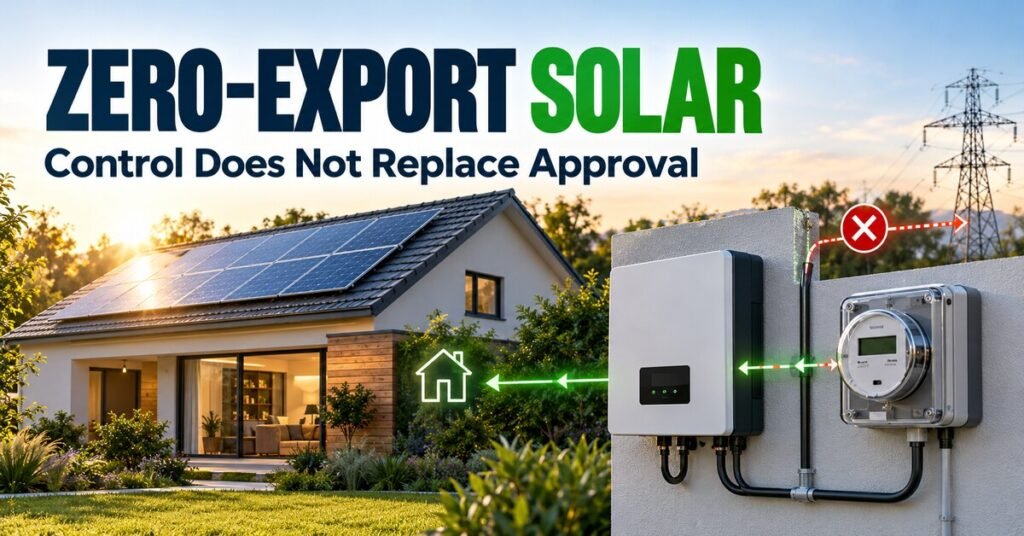
Zero-export solar uses a supported control arrangement intended to limit electricity flowing from the installation into the grid. It is an operating function within a system design, not a substitute for the approvals or connection conditions that apply to the property. Understand the equipment, measurement boundary and limitations before accepting a zero-export proposal.
Define the function clearly
A zero-export arrangement measures or otherwise responds to conditions at the relevant connection point and regulates supported generation. The exact implementation depends on the equipment. A seller should identify the inverter, controller, meter and configuration used rather than describe the feature as a simple universal switch.
Some manufacturer guidance notes that control timing can still permit small residual flows. Do not interpret the phrase zero export as an unconditional guarantee that no energy ever crosses the connection point under every transient or fault condition. Request the exact documented behaviour and acceptance criteria.
Keep connection approval separate
Check the applicable requirements with the relevant distribution company or authorised process for the actual connection. A software limit does not independently establish permission to connect generation. Requirements and eligible arrangements need current verification for the property.
Our net-metering application guide provides context for documentation questions. Do not infer that an export-limiting installation qualifies for a particular billing or approval arrangement simply because it uses similar hardware. Ask for written confirmation of the intended connection scope.

Verify the complete compatible equipment set
Confirm exact models, supported firmware and the required metering or controller accessories. The system should follow manufacturer instructions for the proposed configuration. An inverter with a zero-export marketing claim may require components absent from a basic quotation.
Use our inverter comparison guide to identify product details. Ask which equipment regulates output and how it receives the required measurement. A compatible physical connector or a meter displayed in an app does not by itself prove correct export control.
Check meter location and phase coverage
The measurement boundary should match the intended property connection. Incorrect placement, direction or phase coverage can undermine the control. A qualified installer should verify the actual arrangement and document it in the system diagram.
For multi-phase premises, clarify whether the design regulates aggregate power or applies another supported approach. The relevant connection requirements and product configuration must be considered together. Do not assume a single headline setting answers every phase-specific question.
Understand what happens to surplus generation
If consumption is low and exports are restricted, supported generation may be reduced unless another permitted load or storage path uses it. Installed panel capacity is therefore not a promise that all potential production will become useful household energy.
The energy-management guide helps identify flexible demand. Suppose a hypothetical array could produce 4 kW while the property uses 1 kW and no other supported energy path is available. The control arrangement may need to reduce generation to serve its objective. Actual behaviour depends on the system’s documented design.
Policy around net billing could reshape the value of exported units — see what the latest PIDE study says net billing means for solar households: what the PIDE net billing study means for solar households
Assess battery operation separately
Storage can sometimes absorb energy or supply loads later within its supported limits, but it is not an unlimited sink. Charge power, usable capacity, reserve policy and state of charge affect operation. A full battery does not remove the need for appropriate generation control.
Our hybrid inverter guide helps compare storage functions. Confirm how the proposed battery and controller interact and what occurs when charging is restricted. Keep backup requirements separate from the export-control function when evaluating equipment and cost.
Review communication and fault behaviour
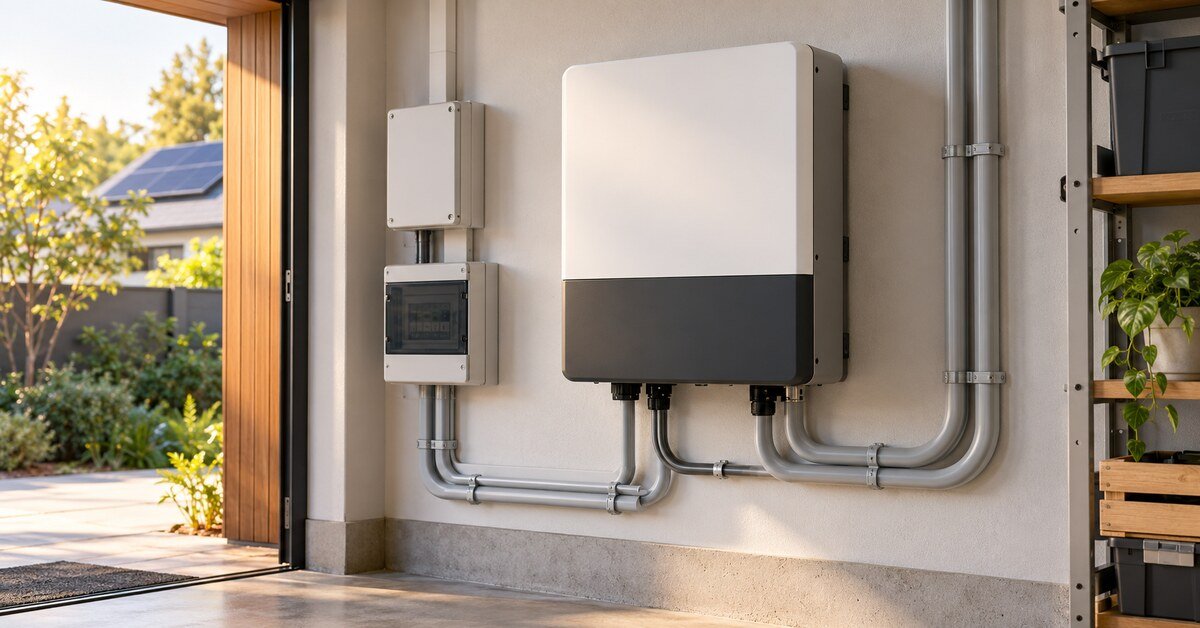
Ask what the system does if meter communication, the controller or another required component fails. The response should follow the supported design and relevant connection conditions. Record alarms and the service process rather than assuming all failures produce the same outcome.
Monitoring should make the control status and relevant power flows understandable. A cloud dashboard can be delayed or incomplete, so establish what local measurements and commissioning evidence verify the function. Do not rely on a single app screenshot as proof of every operating condition.
Request a documented commissioning check
The qualified installer should verify the supported configuration across relevant load conditions using the appropriate procedure. Record equipment, settings, measurement boundary and results. If the connection has specific acceptance requirements, include evidence that addresses them.
Obtain the final diagram and owner instructions. Keep any limitations, unresolved issues and support contacts with the handover documents. Later equipment or firmware changes should be reviewed for their effect on the export-control arrangement before they are applied.
Quotation checklist
- Exact inverter, meter and controller models.
- Manufacturer-supported configuration and required accessories.
- Connection approval and billing scope confirmed separately.
- Meter location, direction and relevant phase coverage.
- Surplus-generation and battery operating behaviour.
- Communication-loss response and commissioning evidence.
- Monitoring ownership and post-installation support.
Compare complete scope, including controller and metering costs. An apparently cheaper proposal may omit the components or documentation needed to establish the promised function.
Frequently asked questions
Does zero export mean off-grid?
No. Export limitation and standalone operation are different functions. Confirm whether and how the installation remains connected to the grid and what backup mode is supported.
Can it replace connection approval?
Do not assume that. Obtain the relevant current requirements for the property. Equipment settings and permission to connect are separate matters.
Will all panel production still be used?
Only within available loads, storage and supported control limits. Surplus may be curtailed. Assess expected useful energy rather than equating nameplate capacity with uninterrupted usable generation.
Choosing zero-export means trading potential feed-in income for a simpler approval path, so make sure that trade actually suits your property. Confirm the export-control settings with your installer and the distribution company before you commit, and keep the written acceptance criteria with your handover documents.