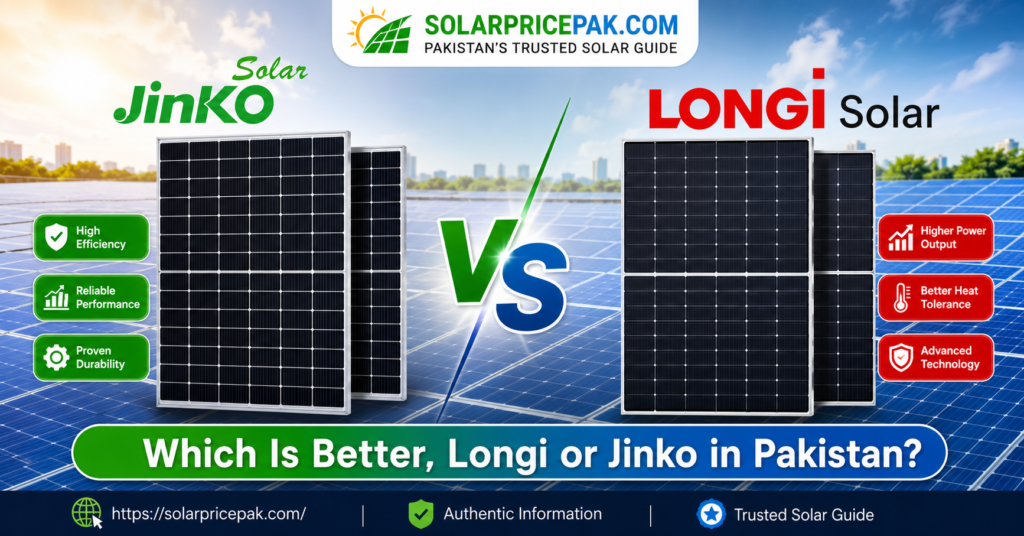
Walk into any solar market in Lahore, Karachi or Multan and ask “LONGi or Jinko?” and you will get a confident answer in seconds. The problem is that the next shopkeeper will give you the opposite answer with equal confidence. Both LONGi and Jinko are large, established manufacturers — but neither sells a single panel called “LONGi” or “Jinko”. Each offers several product families, in many power bins, with different cell technologies. Comparing the brands as wholes is like comparing “Toyota vs Honda” without saying whether you mean a Corolla or a Land Cruiser. This guide shows you how to compare the two exact models on your quotations, so you buy the better panel for your roof — not the better slogan.
Why brand-level comparisons mislead
LONGi’s catalogue includes Hi-MO X6, Hi-MO X10 and other ranges; Jinko’s includes Tiger Neo and other families. Within one brand you will find different efficiencies, temperature coefficients, dimensions, warranty terms and prices. A claim such as “LONGi is more efficient” is meaningless until you ask which LONGi and which Jinko, at which power bin. Two offers you might actually receive — say a Jinko Tiger Neo 585W and a LONGi Hi-MO X10 645W — differ in wattage, physical size and cell architecture. They are not interchangeable, and the “winner” depends on your roof space, your inverter’s input limits and the delivered price per watt.
The practical rule: never compare a specific model from one brand against a brochure claim from the other. Collect the full manufacturer code for both offers first, then compare those two documents side by side.
The five numbers that decide the comparison
Open both datasheets and line up these five figures:
1. Module efficiency. Watts divided by panel area. On a space-constrained roof, a more efficient panel fits more kilowatts in the same area — that is the number that matters, not the brand badge.
2. Power temperature coefficient. Expressed as %/°C (for example −0.29%/°C), this tells you how much output the panel loses as cells heat up. In much of Pakistan, cell temperatures cross 60°C on summer afternoons, so a better coefficient compounds into noticeably more energy over a year. Compare the exact datasheet values, not marketing adjectives.
3. Warranty split. Every serious panel carries two warranties: a product warranty against defects (often 12–15 years) and a performance warranty guaranteeing a percentage of output over 25–30 years. Check both, plus who handles claims in Pakistan — a warranty is only as good as its local claim route.
4. Dimensions and weight. A 645W panel is physically larger than a 585W one. On some roofs the “smaller” panel actually yields a bigger total array because more of them fit around tanks, parapets and shade.
5. Delivered price per watt. Divide the delivered panel-only total (including tax and transport) by total rated watts. Our price-per-watt guide walks through the method. Compare pallet rates with pallet rates and single-panel retail with retail — never mix the two.
Decoding the technology labels
Quotations love alphabet soup: TOPCon, HPBC, N-type, bifacial. These describe different things and they overlap. N-type describes the silicon doping; TOPCon and HPBC (back-contact) describe how the cell is built; bifacial describes whether the module collects light from the rear too. A single panel can be N-type and TOPCon and bifacial at once — they are not competing options in one list. Jinko’s Tiger Neo family is TOPCon-based; LONGi’s Hi-MO X10 uses HPBC back-contact cells (see our Hi-MO X10 buying guide). Neither label alone guarantees more energy on your roof; what matters is the model-specific efficiency, temperature behaviour and price you actually pay.
Comparing a Hi-MO X10 offer?
Check the exact variant, 645W pricing logic and verification steps.
When each offer tends to win
There is no universal winner, but patterns emerge once you compare properly. The LONGi offer tends to be the better buy when its higher wattage per panel reduces your panel count on a small or awkward roof, or when its datasheet shows a meaningfully better temperature coefficient for a hot, unshaded site. The Jinko offer tends to win when its delivered price per watt is clearly lower for equivalent efficiency, or when its dimensions tile your roof more neatly — an extra panel that fits can outweigh a few watts per panel that don’t.
Either way, record your reasons: the exact model codes, the per-watt rates, the roof layout sketch and the warranty claim contact. A decision documented this way survives the installer’s “sir, ye model short hai, ye le lein” phone call. If the model changes at the last minute, the comparison must be redone — a substitute panel is a new decision, not a minor swap. Our authenticity checklist shows what paperwork to demand so the panels on your roof match the ones on your quotation.
Normalise every quote first
Learn the delivered price-per-watt method before you compare any two offers.
Frequently asked questions
Is the LONGi vs Jinko question decided by watts alone?
No. Compare module area, electrical limits, roof layout, temperature performance and purchase terms together. A larger-wattage module may simply occupy more space without delivering more energy from your roof.
Can I mix LONGi and Jinko panels in one string?
Only if the system designer verifies electrical matching — voltage and current characteristics, connector compatibility and manufacturer requirements. Matching the wattage label alone is not enough, and mixed strings can underperform or create warranty issues.
Which handles Pakistani summers better?
Whichever exact model has the better (less negative) power temperature coefficient on its datasheet. Compare the two documents for your specific models rather than relying on brand reputation.
What should I keep after purchasing?
The dated invoice, panel serial numbers, matching datasheets, warranty terms and the installed equipment schedule. Photograph the labels before the panels go on the roof — you cannot read them afterwards.