550 Watt Solar Panel Price in Pakistan 2026 – Real Rates, Best Brands & What Nobody Tells You
Electricity bills in Pakistan have gotten genuinely painful, and load shedding shows no sign of easing up. If solar has been on the mind for a while, this is the moment to stop weighing it and start reading: the 550-watt panel is where the market has settled, and the math behind it actually holds up.
A couple of years back, most conversations still revolved around 300W and 400W panels. That conversation is essentially over now. The 550W size took over because it squeezes more power out of the same roof space, and pricing has dropped enough that a full system now pays for itself faster than most people expect.
This guide covers what a 550W panel costs right now, which brands are genuinely worth buying, how much electricity to expect from one, and what a complete system runs. No filler, just the numbers that matter.
Ready to go solar? Get a free, no-obligation quote today.
Compare All Battery Brands → Get Free Battery QuoteSo What Is a 550 Watt Solar Panel, Really?
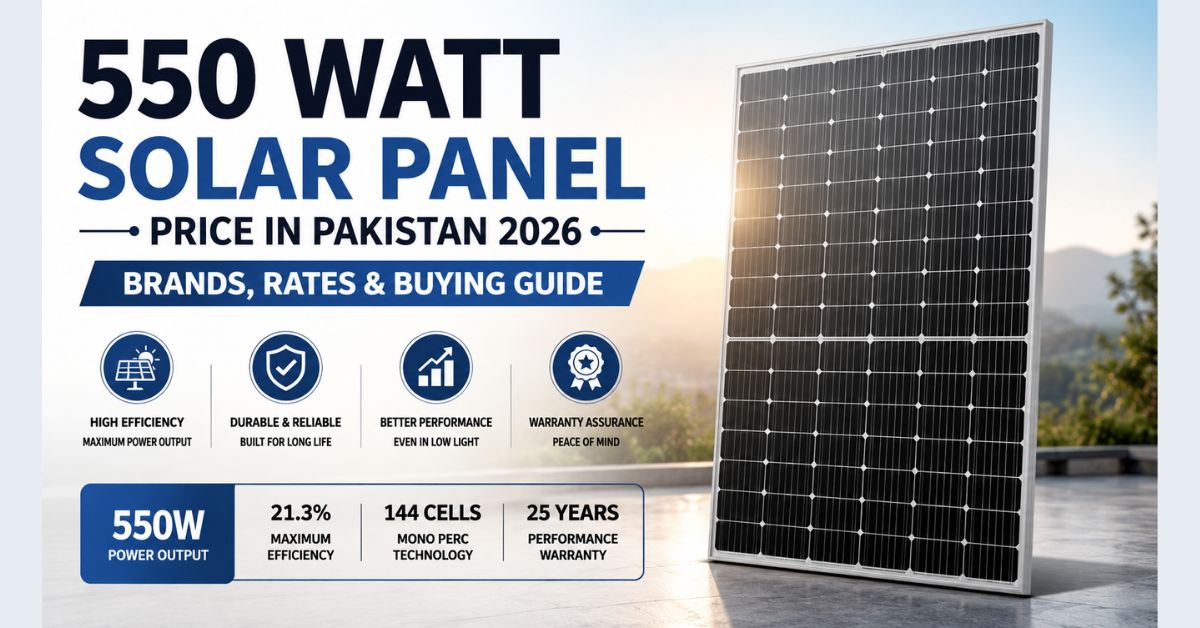
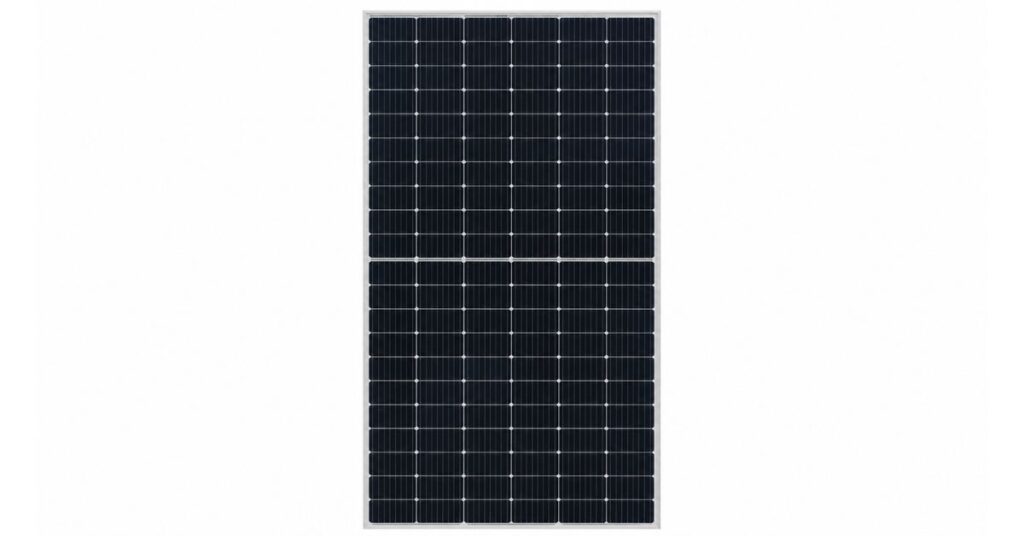
A 550-watt solar panel is a large monocrystalline module, roughly door-sized, that converts sunlight into electricity. It’s currently the standard panel size across Pakistani rooftops, shops, and small businesses alike.
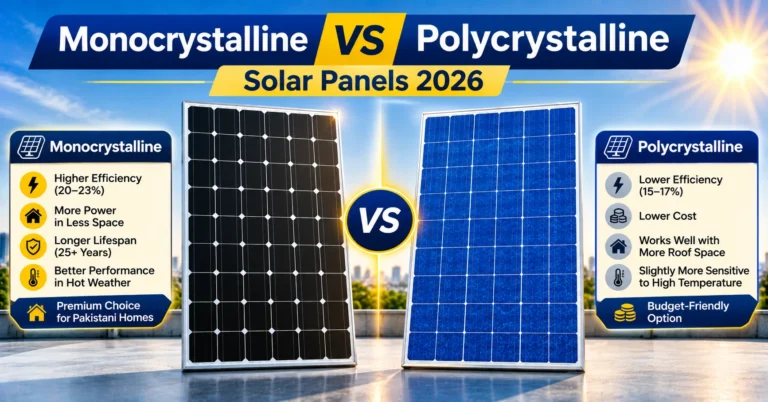
Most panels sold today use either Mono PERC or the newer N-Type TOPCon cell technology, both landing in the 20.5% to 22% efficiency range a meaningful step up from what panels offered just a few years ago.
View More: Smart Energy Management Solar: Why Pakistan Needs More Than Just Panels
Technical Specs Quick Reference
| Specification | Typical Value |
|---|---|
| Peak Power Output | 550 Watts |
| Cell Technology | Mono PERC / N-Type TOPCon |
| Module Efficiency | 20.5% – 22% |
| Open Circuit Voltage (Voc) | 49 – 52V |
| Max Power Voltage (Vmp) | 41 – 44V |
| Short Circuit Current (Isc) | 13 – 14.5A |
| Panel Dimensions | approx. 2279 x 1134 x 35 mm |
| Weight | 27 – 30 kg |
| Product Warranty | 10 – 12 years |
| Performance Warranty | 25 years (80% output guaranteed) |
| Operating Temperature | -40°C to +85°C |
550 Watt Solar Panel Price in Pakistan – May 2026
Pricing depends on brand, grade, single-glass versus bifacial construction, and wherever the dollar happens to be sitting that week. Here’s roughly where the market stands heading into late July 2026:
| Brand | Panel Type | Per Watt (PKR) | Total Price (PKR) | Grade |
|---|---|---|---|---|
| JA Solar 550W | Single Glass Mono | Rs. 26 | Rs. 14,300 | A-Grade |
| Canadian Solar 550W | Single Glass A-Grade | Rs. 27 – 28 | Rs. 14,850 – 15,400 | A-Grade |
| Jinko Solar 550W | Single Glass P-Type | Rs. 29 – 39 | Rs. 15,950 – 21,450 | A-Grade |
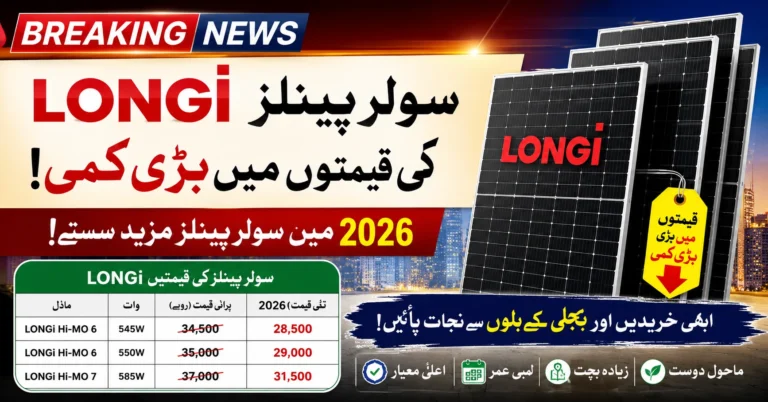
| LONGi Solar 550W | Single Glass Mono | Rs. 30 – 36 | Rs. 16,500 – 19,800 | A-Grade |
| Trina Solar 550W | Mono Half-Cut | Rs. 53 | Rs. 29,150 | A-Grade |
| JA Solar 550W Bifacial | Double Glass Tier-1 | Rs. 54 | Rs. 29,700 | Tier-1 |
Rates move with the exchange rate, import duties, and seasonal demand — treat this as a planning reference and confirm the same-day figure before ordering.
View More: Osaka Battery Price in Pakistan 2026 – Updated Price List for All Models
How Much Electricity Does One 550W Panel Actually Produce?
This is worth checking before even glancing at price, since output is what actually determines savings — not the number on the tag. Pakistan gets roughly 5 to 6 peak sun hours a day across most regions, and based on that, a single 550W panel produces:
| Period | Estimated Output |
|---|---|
| Per Day | 2.5 – 3.3 units (kWh) |
| Per Month | 75 – 99 units |
| Per Year | 900 – 1,200 units |
At Rs. 50 to Rs. 60 per unit — close to what most households currently pay — one panel saves somewhere around Rs. 125 to Rs. 165 a day. Spread that across ten panels and the daily savings climb to Rs. 1,250 to Rs. 1,650. Run that over a full year and the investment case becomes fairly obvious.
A handful of real-world factors shape this output. Roof direction matters a lot: south-facing placement at a 25-to-30-degree tilt gives the strongest production. Dust buildup quietly erodes performance too; most people underestimate this until they actually clean their panels and see the difference.
Even a small shadow from a water tank or a nearby tree can drag down an entire string’s output, not just the shaded panel itself. tank or nearby tree can drag down an entire string’s output, not just the one shaded panel.
Ready to go solar? Get a free, no-obligation quote today.
See All Solar Panel Brands → Get Free Solar QuoteWhy Per-Watt Price Matters More Than Total Price
Most buyers make the mistake of comparing total panel price rather than the per-watt rate, which gets misleading fast once different wattages or technologies enter the comparison. To find the honest number, divide total price by 550 — that’s the figure worth comparing across brands.
| Brand | Total Price | Per Watt | Verdict |
|---|---|---|---|
| JA Solar 550W | Rs. 14,300 | Rs. 26/W | Cheapest Certified A-Grade |
| Canadian Solar 550W | Rs. 14,850 | Rs. 27/W | Excellent Value |
| Jinko Solar 550W | Rs. 15,950 | Rs. 29/W | Good Value + Brand Trust |
| LONGi Solar 550W | Rs. 16,500 | Rs. 30/W | Best Overall Balance |
| Trina Solar 550W | Rs. 29,150 | Rs. 53/W | Premium |
| JA Bifacial 550W | Rs. 29,700 | Rs. 54/W | Premium Bifacial |
JA Solar and Canadian Solar currently offer the lowest per-watt cost among properly certified A-Grade panels, while LONGi sits in a comfortable middle ground, with fair pricing, a strong warranty, and a long track record in Pakistan’s climate.
View More: Longi HiMo X10 Price in Pakistan 2026 — Complete Buyer’s Guide
Brand Reviews: Which 550W Panel Is Actually Worth Buying?
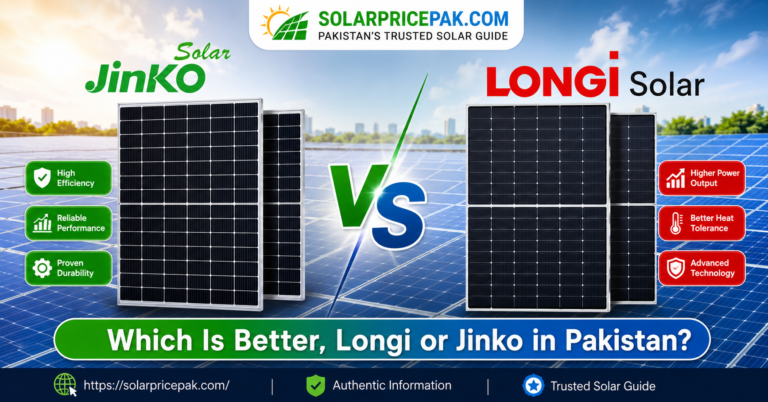
LONGi Solar 550W — The Default Pick at Almost Any Solar Shop
There’s a reason LONGi outsells nearly everything else in the country. The Hi-MO series has been installed on Pakistani rooftops for years and holds up well through brutal summers, backed by a 12-year product warranty and a 25-year performance guarantee that’s practically enforceable rather than just printed on paper. Priced around Rs. 30–36/watt, LONGi panels are widely stocked at Hall Road (Lahore), College Road (Rawalpindi), and Saddar (Karachi). Anyone who values long-term reliability and real after-sales support over shaving a few rupees off the per-watt price will find LONGi the sensible choice.
Jinko Solar 550W — A Global Tier-1 Name With the Numbers to Match
Jinko is one of the largest solar manufacturers worldwide, and its footprint in Pakistan reflects that scale. The 550W P-Type model reaches roughly 21.33% module efficiency and uses Multi Busbar technology, which specifically helps performance in partially shaded or overcast conditions — more relevant during monsoon season than most buyers realize. Priced at Rs. 29–39/watt, it’s a solid pick for anyone planning to apply for net metering, provided the documented A-Grade version is what actually gets purchased — undocumented Jinko stock regularly gets flagged during DISCO application review.
JA Solar 550W — Hard to Beat on Price for a Certified Panel
At Rs. 26 per watt, JA Solar offers the lowest certified A-Grade rate currently available from a reputable brand — a strong fit for anyone chasing net metering eligibility on a tighter budget. The bifacial version is worth a look for white-cement roof surfaces or open ground-mount setups, since it draws power from both sides of the panel and can add 10 to 20% extra output under the right conditions.
Canadian Solar 550W — Backed by Two Decades of Manufacturing
Canadian Solar has been in the game for over 20 years, and its 550W A-Grade panel, priced around Rs. 27/watt, performs particularly well in high-temperature environments, which describes Pakistani rooftops in summer almost without exception. Once roof surface temperatures hit 55°C, a panel’s temperature coefficient stops being a spec-sheet footnote and starts genuinely affecting output.
Ready to go solar? Get a free, no-obligation quote today.
Get Free Battery Quote →Trina Solar 550W — For Buyers Playing the Long Game
Trina’s 550W panel uses Half-Cut cell technology, which lowers internal resistance, improves shaded-condition performance, and reduces hotspot risk over time. At Rs. 53/watt, it’s a premium buy best suited to commercial properties or anyone planning to stay in the same building for the next two decades.
A-Grade vs B-Grade: Where Many Buyers Quietly Lose Money
Thousands of buyers in Pakistan end up with B-Grade panels every year without realizing it. Here’s what that distinction actually involves:
| Feature | A-Grade | B-Grade |
|---|---|---|
| Quality Standard | Fully tested, no defects | Minor micro-cracks, color inconsistencies |
| Price Range (550W) | Rs. 14,300 – 21,450 | Rs. 11,000 – 13,500 |
| Performance Warranty | 25 years | Usually none |
| Net Metering Eligible | Yes | Usually rejected |
| Expected Lifespan | 25 – 30 years | 10 – 15 years |
| Documentation | Provided | Rarely available |
Saving Rs. 2,500 per panel across a 10-panel system feels like Rs. 25,000 saved upfront. But once a net metering application gets rejected, or a panel starts underperforming in year seven with no warranty to fall back on, that saving evaporates fast. Factor in early replacement and lost net metering income, and choosing B-Grade on a 10-panel system can easily cost more than Rs. 200,000 over time.
The bottom line: documented A-Grade only, from a known dealer, for any on-grid or net metering setup.Documented A-Grade only, from a known dealer, for any on-grid or net metering setup.
Mono PERC vs N-Type TOPCon vs Bifacial: Which Technology Fits Your Roof?
Mono PERC remains the most widely available and affordable option, priced around Rs. 26–39/watt. It handles Pakistan’s full climate range- coastal Karachi, dry Lahore, extreme Multan heat without trouble, making it the practical default for a standard home installation.
N-Type TOPCon is newer, pushing efficiency to 21.5–22.5% and degrading more slowly, around 0.4% a year versus 0.55% for PERC, meaning more retained output meaningfully over 25 years. Priced around Rs. 33–45/watt, it’s worth the premium for anyone optimizing specifically for long-term return.
Bifacial Double Glass draws power from both panel surfaces and performs best mounted above a reflective surface. Priced roughly Rs. 38–54/watt, it suits commercial rooftops or ground-mounted systems more than a typical home setup.
For the average Pakistani home, A-Grade Mono PERC from any of the major brands remains the smart, reliable default.
How Many 550W Panels Do You Need?
Check the average monthly units across the last three electricity bills, then match against the table below:
| Monthly Units | System Size | 550W Panels Needed |
|---|---|---|
| 150 – 250 units | 1.5 – 2 kW | 3 – 4 panels |
| 300 – 400 units | 3 kW | 5 – 6 panels |
| 500 – 600 units | 5 kW | 9 – 10 panels |
| 700 – 900 units | 7 kW | 12 – 13 panels |
| 1,000+ units | 10 kW | 18 – 20 panels |
Getting sizing wrong is one of the most common and most expensive mistakes buyers make, so it’s worth confirming this figure with an installer rather than guessing.
Full Solar System Cost in Pakistan 2026: Complete Breakdown
Panels are only part of the total bill. Here’s a realistic cost breakdown for a 5kW hybrid system built with 550W panels:
| Component | Estimated Cost (PKR) |
|---|---|
| 9–10 x 550W A-Grade Panels | Rs. 130,000 – 215,000 |
| 5kW Hybrid Inverter | Rs. 80,000 – 150,000 |
| Solar Batteries, 200Ah x 2 (optional) | Rs. 80,000 – 150,000 |
| Mounting Frame & Structure | Rs. 25,000 – 40,000 |
| DC/AC Wiring | Rs. 15,000 – 25,000 |
| Installation & Labour | Rs. 20,000 – 50,000 |
| Net Metering Application | Rs. 10,000 – 20,000 |
| Total — Without Battery | Rs. 270,000 – 480,000 |
| Total — With Battery | Rs. 350,000 – 630,000 |
These ranges stay wide because inverter brand, battery chemistry, and installer fees vary significantly by city, and getting quotes from at least three installers before committing is worth the extra day it takes.
On-Grid, Off-Grid, or Hybrid: Which One Actually Fits Your Home?
On-grid connects directly to the WAPDA/DISCO grid with no batteries needed, making it the lowest-cost installation. It works well where load shedding stays under 4 hours a day, and net metering sends surplus power back for bill credits.
Off-grid runs entirely independent of the grid, meaning enough battery capacity has to be in place to cover nights and cloudy days without help. This suits rural areas or spots seeing 8 to 12 hours of daily load shedding — higher upfront cost, full independence in return.
Hybrid is what most urban Pakistani households are choosing in 2026: the grid connection stays active, battery backup covers load shedding, solar handles daytime load, and any excess feeds back through net metering. For anyone dealing with 4 to 8 hours of daily load shedding, hybrid tends to make the most financial sense over the long run.
Inverter and Battery: Don’t Underestimate These Components
Panels produce DC electricity, but homes run on 220V AC — the inverter bridges that gap. A 5kW system built from nine or ten 550W panels needs a 5kW hybrid inverter with an MPPT voltage range of roughly 120V to 450V DC.
Trusted brands currently active in Pakistan include Growatt, Solis, Deye, Inverex Nitrox, and SolaX Power. This isn’t the place to default to the cheapest option — the inverter functions as the system’s brain, and replacing a failed one mid-system is both costly and disruptive.
For storage, the choice comes down to two paths. Gel tubular batteries cost less upfront but typically need replacing every 4 to 6 years. Lithium LiFePO4 batteries last 8 to 10 years and charge and discharge more efficiently, and although they cost two to three times more upfront, they often work out cheaper across the system’s full lifespan.
Net Metering: Send Surplus Power Back, Cut Your Bill to Near Zero
Net metering works simply: any solar electricity a home doesn’t use gets sent back to the local DISCO and credited against the next bill. With a properly sized system, many households see their monthly bill drop to almost nothing, and some end up with a credit balance in their favor.
Qualifying requires an AEDB-licensed installer, documented A-Grade panels, a grid-compatible inverter, and a formal application submitted to the relevant DISCO (LESCO, MEPCO, IESCO, FESCO, and so on). There’s paperwork and follow-up involved, but the long-term financial upside makes it worth the effort.
Payback Period: How Fast Does the Investment Return?
At current electricity rates of Rs. 50 to Rs. 60 per unit:
| System Size | Monthly Savings | Annual Savings | Payback Period |
|---|---|---|---|
| 1 x 550W Panel | Rs. 3,750 – 5,000 | Rs. 45,000 – 60,000 | 4 – 5 months |
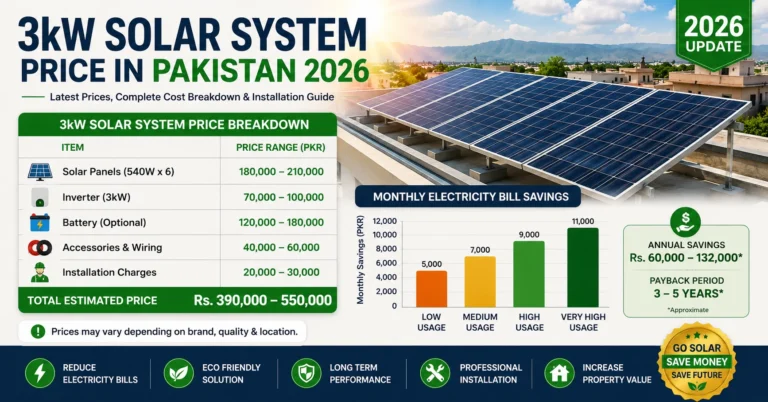
| 3kW System (6 panels) | Rs. 22,500 – 30,000 | Rs. 270,000 – 360,000 | 10 – 14 months |
| 5kW System (10 panels) | Rs. 37,500 – 50,000 | Rs. 450,000 – 600,000 | 8 – 12 months |
Under 12 months to break even, followed by essentially free electricity for 20-plus years afterward; few investments in Pakistan currently offer this kind of return, especially with electricity rates still moving in one direction.
Available in Pakistan right now offer this kind of return, and electricity rates continue to move in only one direction.
5 Things You Must Do Before Buying
- Accept only documented A-Grade panels.
No documentation means no net metering eligibility, no enforceable warranty, and no resale value this isn’t negotiable for any on-grid or hybrid installation. - Calculate price per watt, not total price.
Divide total panel price by 550 and compare that figure across brands, not the sticker price on the box. - Verify the serial number before paying.
Every major Tier-1 brand runs a free verification portal: LONGi through longi.com/modules-authenticity, Jinko through cs.jinkosolar.com, JA Solar through product.jasolar.com, Canadian Solar through snquerycn.csisolar.com, and Trina through customerservice.trinasolar.com. - Use an AEDB-licensed installer only.
Poor installation work can cut real-world output by 15 to 25% and void panel warranties outright. Ask for an installation certificate and at least a one-year workmanship guarantee. - Check roof direction first.
South-facing at a 25-to-30-degree tilt delivers maximum annual output; east- or west-facing roofs lose 15 to 20%. A north-facing roof is worth a professional consultation before spending anything.
Output. If your rooftop faces north, talk to a solar professional before spending a single rupee.
Mistakes People Regret After Installation
Buying B-Grade to save a couple thousand rupees per panel.
Net metering applications get rejected, warranties become unenforceable, and panels degrade faster than expected. A small upfront saving on a 10-panel system can cost Rs. 200,000 or more down the line.
Choosing the wrong inverter size.
A 3kW inverter running ten 550W panels won’t operate efficiently and causes long-term system damage; inverter capacity needs to match total panel output.
Skipping paperwork and receipts.
Without documentation, there’s no way to file a warranty claim if a panel underperforms or fails a couple of years in.
Skipping a roof structural check.
Ten 550W panels plus mounting frames weigh 270 to 300 kilograms; older or weaker roof structures need a proper assessment first.
Undersizing the system just to cut upfront cost, which usually means paying more per unit saved over the system’s lifetime than a correctly sized setup would have cost.
FAQs
What is the 550 watt solar panel price in Pakistan right now?
JA Solar A-grade starts around Rs. 14,300, while JA Bifacial Tier-1 tops out near Rs. 29,700. Most in-demand A-grade options from top brands fall between Rs. 14,300 and Rs. 21,450.
How many units does a 550W solar panel produce per day in Pakistan?
Under normal conditions, 2.5 to 3.3 units per day, working out to 75–99 units monthly and 900–1,200 units annually.
Which 550W solar panel brand is best in Pakistan?
LONGi for reliability and warranty strength, JA Solar for the lowest price per watt, Jinko for efficiency and wide availability, and Canadian Solar for hot-climate performance.
Is Mono PERC or N-Type TOPCon better for Pakistan?
Mono PERC is more affordable and works reliably across Pakistan’s climates. N-Type TOPCon degrades more slowly and delivers more cumulative power over the panel’s life, making it the better pick when long-term ROI is the priority.
Can net metering work with 550W solar panels?
Yes, with documented A-grade panels, a compatible inverter, and an AEDB-licensed installer. Approval timing also depends on the local DISCO’s processing schedule.
What does a full 5kW solar system cost in Pakistan?
Without battery storage: Rs. 270,000 to Rs. 480,000. With battery backup: Rs. 350,000 to Rs. 630,000, with exact cost depending on inverter brand, battery type, and local installer rates.
Will 550W solar panel prices fall further in 2026?
Pricing depends on international supply, PKR-USD movement, and import policy. The broader trend over the past two years has been downward, but large sudden drops aren’t guaranteed if the numbers already work today; waiting often doesn’t save as much as it seems like it should