
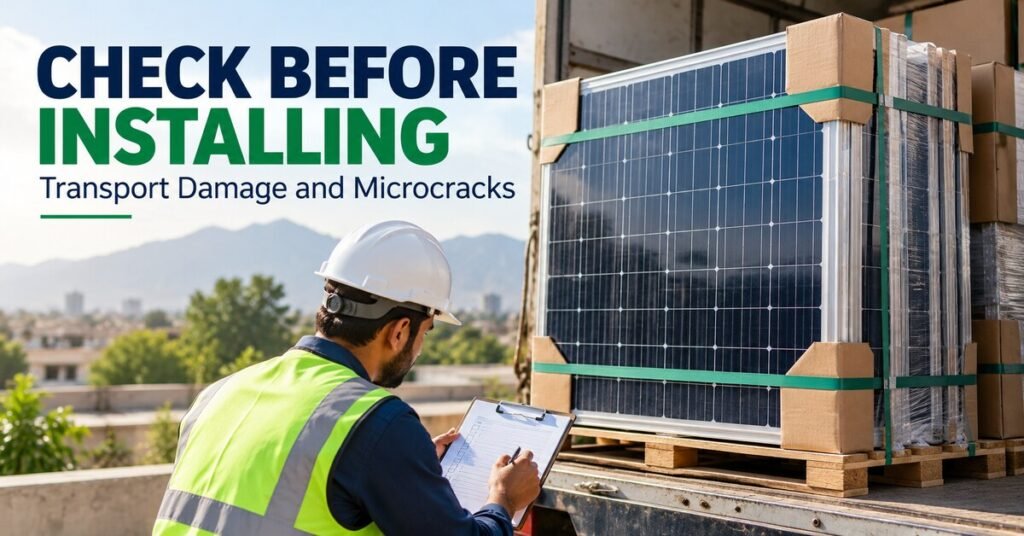
Most solar panel failures blamed on “bad quality” actually began on a truck. Modules travel hundreds of kilometres from port or warehouse to your roof, and rough handling can crack solar cells inside the glass — damage you cannot see with your eyes but that quietly eats generation for years. A careful delivery inspection costs you thirty minutes; skipping it can cost you a dead string you discover two summers later.
What microcracks are — and why looks deceive
A microcrack is a hairline fracture in a silicon cell, usually caused by impact, bending or pressure during transport, unloading or storage. The glass stays intact and the panel looks perfect, but the crack raises the cell’s electrical resistance. Cracked cells run hotter than their neighbours, and hotspots accelerate degradation — a panel can lose a meaningful share of its output over a few years while looking brand new. Because microcracks are invisible without electroluminescence (EL) testing equipment, your defence is prevention and documentation, not eyesight.
Before delivery: agree the rules in writing
Do not leave handling to chance. Before the shipment arrives, get the supplier to confirm in writing: how the modules are packed (original factory pallets, edge protectors, strapping), how they will be unloaded (by hand, not thrown off a truck bed), and where they will be stored if installation is not immediate (dry, shaded, flat — never leaning against a wall in the sun). Agree who inspects the delivery and what happens if damage is found: the acceptance procedure, the time limit for reporting (often 24–72 hours), and whether replacement or credit applies. Keep your order’s model numbers and quantities at hand so you can spot a product substitution on the spot.
Delivery checks also guard against counterfeits — here is how to spot fake solar panels in Pakistan and avoid scams before you pay: how to spot fake solar panels
Delivery-day inspection checklist
When the truck arrives, work through this list before you sign anything:
- Photograph everything first: the loaded truck, each pallet, and all labels before unpacking. Photos are your evidence.
- Check the packaging: crushed corners, broken pallets, torn wrapping, water damage or missing straps all signal rough handling — note them on the delivery receipt.
- Count and identify: confirm the number of panels matches the order, and that the model code on the boxes matches your quotation exactly.
- Inspect each panel: look for cracked glass, chipped frames, bent corners, scratches on the backsheet and loose junction boxes.
- Record serial numbers: photograph the label of every panel. Serials tie each module to its flash-test data and warranty — and prove what you received if a dispute arises later.
If the packaging is damaged, open those boxes first and inspect the panels inside before the driver leaves. Never sign a clean receipt for a visibly damaged shipment “to sort out later” — once signed, your leverage is gone.
Make sure the panels themselves are genuine
Damage checks mean nothing on a counterfeit module — verify first.
Storage and handling until installation day
Panels often wait days or weeks before mounting. Store them flat or upright at a slight angle on their long edge, on a level surface, strapped so they cannot topple — never stacked flat in a tall pile where the bottom panels bear the weight. Keep them out of standing water and direct midday sun if possible; heat cycling on an unmounted panel is harmless, but a toppled stack is not. Carry panels vertically by the frame with two people, never by the junction box or cables, and never walk on a panel or place tools on the glass. Most microcracks happen in these casual moments, not on the highway.
If you find damage, act fast and in writing
Stop, photograph, and notify the supplier the same day — email or WhatsApp with photos, referencing your order number and the agreed reporting window. Do not install a damaged panel “to see if it works”; installing it can void the damage claim and the warranty. Ask for replacement, not repair: cracked glass or a dented frame cannot be fixed in the field. Keep the damaged panel and its packaging until the claim is resolved. A supplier who argues about a clearly documented delivery defect is telling you something important about their after-sales service — believe them, and buy your next batch elsewhere.
Second-hand panels need extra care, so read the buying used solar panels guide for Pakistan before accepting delivery.
Protect the system after it is installed
A maintenance routine catches the problems delivery checks cannot.
Frequently asked questions
Can I test for microcracks myself?
Not reliably. Microcracks need electroluminescence imaging, which most buyers do not have. Your practical protection is careful handling, delivery documentation, and buying from reputable brands whose warranty process you can actually use.
The glass looks fine — is the panel safe?
Probably, if handling was careful. But intact glass does not rule out internal cell cracks from a hard impact, which is why packaging condition and handling records matter more than a visual once-over.
Should I reject a panel with a scratched backsheet?
Yes, reject or get it replaced. Backsheet damage can let moisture in over time and is a valid warranty and delivery-claim issue. Do not accept a discount to keep it.
How long do I have to report transport damage?
It depends on your supplier’s terms — commonly 24 to 72 hours. Agree the window before delivery and report the same day to be safe.