
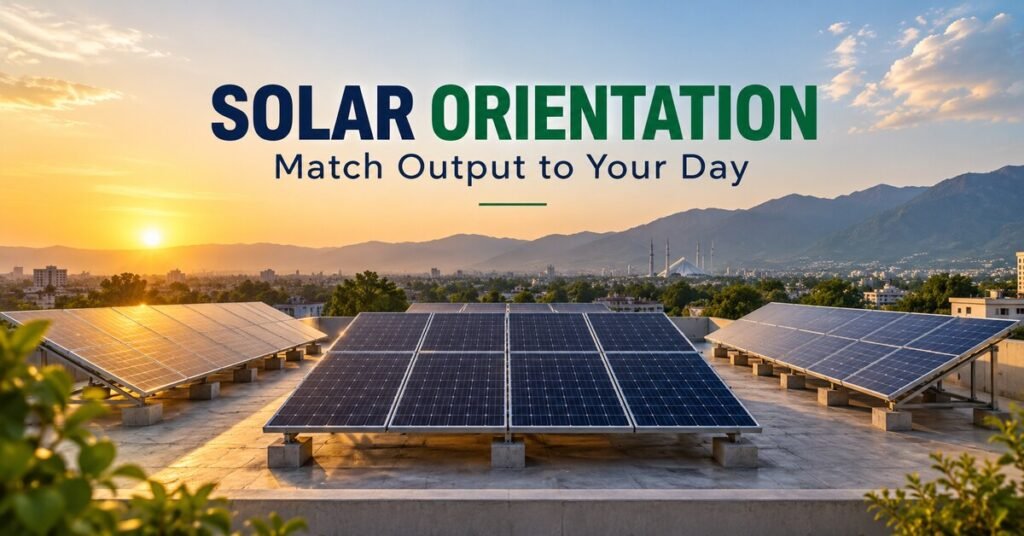
“Panels must face south” is the first thing every installer tells you — and it is usually right, but not always, and rarely the whole story. In Pakistan, the best orientation is the one that fits your roof’s shape, your shading, and when your household actually uses electricity. Here is how to think about it properly instead of arguing about compass directions.
Why south-facing is the textbook answer
Pakistan sits between roughly 24°N and 31°N latitude, so the sun spends most of the year in the southern sky. A south-facing array tilted at 10–15° catches the strongest midday sun and produces the highest total annual energy per panel — typically 5–10% more than the same panels facing east or west. If your goal is maximum yearly units (kWh) — for example to maximise net-metering credits — south-facing remains the default choice. But “maximum annual energy” is only one possible goal, and roofs have opinions of their own.
When east-west wins in practice
East-west layouts split the array: half the panels face east, half face west, usually at a shallow 10° tilt. Each half produces less than a south-facing panel, but the pair generates earlier in the morning and later in the afternoon — a wider, flatter generation curve instead of a sharp midday peak. This suits households whose heavy loads run mornings and evenings (a family that cooks, irons and pumps water early and late) far better than a midday spike they cannot use. East-west also fits more panels on flat commercial roofs: the shallow tilt means rows can sit closer without shading each other, so total system capacity — and total energy — can end up higher despite the per-panel penalty. If your roof is wide but shallow, or your demand curve has two humps, east-west deserves a proper simulation, not a dismissal.
Tilt matters as much as direction
A south-facing array laid flat loses a surprising amount of energy; tilted at 25° it may catch more winter sun but shade its own rows and catch more wind. For most Pakistani homes, 10–15° on a south-facing structure is the practical sweet spot — good year-round production, self-cleaning in rain, and structurally sane. East-west pairs typically sit at about 10°. Whatever the direction, every row needs enough spacing that winter-morning shadows from the row in front do not fall on the row behind — a detail installers rush and owners pay for. Ask your installer to show the layout with shadow spacing marked; a drawing without it is a guess.
Size the system around your actual demand
Orientation is one input — load timing is the other half of the design.
Shading beats orientation every time
Here is the uncomfortable truth: an unshaded east-facing array will outperform a south-facing array that spends two hours a day behind a neighbour’s water tank. Before debating direction, map your shade — the overhead tank, the parapet wall, the growing neem tree, the under-construction plaza next door. Walk the roof at 9am, noon and 3pm and photograph the shadows. A good installer does a shade analysis; a bad one points south and quotes. If part of the roof is shaded, consider placing panels only on the clean section, or using an inverter with multiple MPPTs (or optimisers) so the shaded panels do not drag down the rest. Direction is optimisation; shade avoidance is survival. Shading can undo the gains of any orientation, so get familiar with the causes, calculation and solutions for shading losses before you finalise your layout.
A decision framework for your roof
Work through these questions in order: (1) Where is the roof shade-free for most of the day? Put panels there first, whatever the direction. (2) When do you use the most electricity — midday, or mornings and evenings? Match the generation curve to it. (3) How many panels can each layout physically fit, including maintenance walkways? More panels at 90% beats fewer panels at 100%. (4) What does the simulation say? Ask for both layouts modelled with your location and roof dimensions — a serious installer produces this in an hour. And when you are comparing hardware for the chosen layout, our panel quantity guide and panel technology overview will help you choose modules that suit it.
How many panels does your roof actually need?
Roof space, load and layout — the full calculation.
Frequently asked questions
My roof faces east — is solar still worth it?
Yes. An east-facing (or west-facing) array in Pakistan still produces roughly 85–90% of a south-facing array’s annual energy. Shading-free and well-installed beats ideally-oriented but shaded, every time.
What tilt is best in Lahore or Karachi?
For south-facing home systems, 10–15° is the practical standard — a balance of annual yield, rain cleaning and wind safety. Steeper tilts help winter production slightly but complicate the structure.
Can I mix orientations on one inverter?
Yes, if the inverter has two or more independent MPPTs — put each orientation on its own MPPT. Never parallel east and west strings into a single MPPT; the mismatch will cost you generation all day.
Does orientation affect net metering earnings?
Only through total energy produced. Net metering credits units, not directions — so the layout with the highest usable annual yield for your roof earns the most, whether that is south or east-west.