
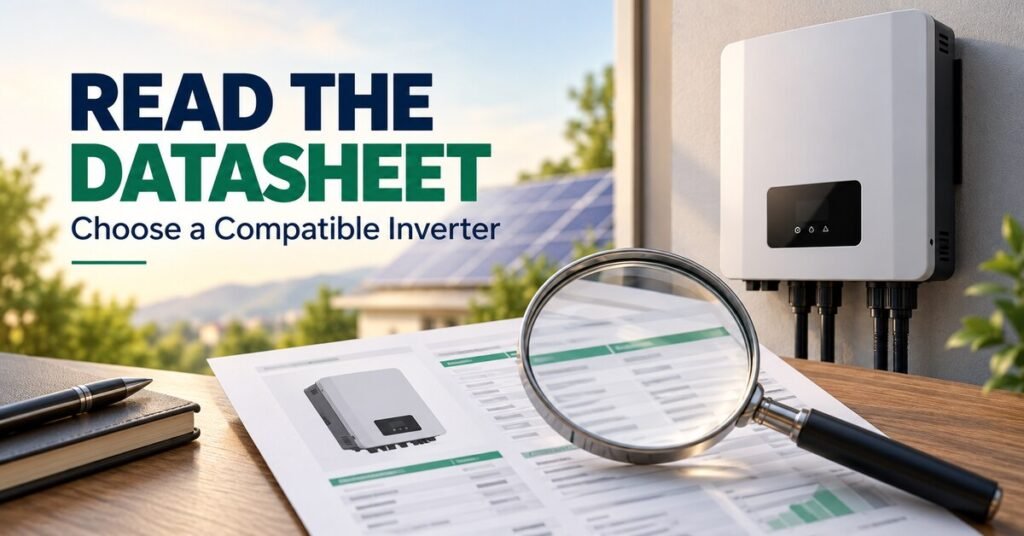
The biggest number on an inverter brochure is rarely the number that matters. A “6kW” inverter might deliver 6kW of AC output — or it might accept 6kW of panels while delivering less, back up only 3kW during outages, or overheat into derating on a Lahore rooftop in June. The datasheet tells you which. Here is how to read one before you pay, line by line, in the order that prevents expensive mistakes.
Step 1: match the exact model and document revision
Start at the top, not the specs table. Confirm the complete model code on the datasheet matches your quotation and the label on the box — series names routinely span single-phase and three-phase versions, on-grid and hybrid variants, and different battery platforms under nearly identical names. Note the document revision and date; a 2022 datasheet for a “new” 2026 model is a red flag that the seller is quoting old stock or the wrong variant. Ask which regional version will be delivered — firmware, grid-code settings and warranty terms can differ between regions for the same hardware. Keep a copy of the applicable revision with your invoice; it is your evidence if the delivered unit behaves differently.
Step 2: separate the power ratings
An inverter datasheet lists several “power” figures that are not interchangeable:
- Rated / continuous AC output: what it can deliver indefinitely — this is the real size of the inverter (e.g. 5kW).
- Backup / EPS output: what it supplies during grid outages, often lower than the AC rating. A 6kW hybrid might back up only 4kW — critical if you sized backup loads to 6.
- Surge / overload capacity: e.g. 200% for 10 seconds — enough for motor starts, not for sustained overload.
- Max PV array power: a DC-side design limit (e.g. 8kWp of panels on a 5kW inverter). It is not a promise of 8kW AC output; the inverter still converts at its AC rating.
Read the conditions attached to each figure — ambient temperature, duration, power factor. A rating valid only at 25°C ambient is not valid in a Pakistani summer store-room; check the derating curve.
Step 3: read the PV input section like an installer
Three lines determine whether your panels and inverter are electrically compatible: the number of MPPTs (two independent trackers let you split strings across roof faces), the MPPT voltage range (your string’s operating voltage must sit inside it in both winter cold and summer heat), and the maximum input current per MPPT (modern high-current panels can exceed older inverters’ limits — the panels fit, the inverter clips). Also check maximum system voltage (typically 500V or 1000V DC) against your longest planned string. A wattage match between panels and inverter means nothing if the voltage or current windows do not overlap; this is where “compatible” quotations most often quietly fail.
When panels outsize the inverter like that, solar inverter clipping explained shows what happens to the extra power.
Understand the inverter types first
On-grid, off-grid or hybrid — know which datasheet you are reading.
Step 4: check the battery section (hybrid inverters)
For hybrid models, find the battery voltage range (e.g. 40–60V for 48V systems), the maximum charge and discharge current, and the supported battery types or communication protocols. Cross-check these against your planned battery’s BMS limits — a 100A-charge inverter paired with a 50A-max battery is a mismatch the datasheet will not warn you about; you must do the comparison yourself. If the datasheet lists specific compatible battery models, treat anything off-list as unproven until the seller documents otherwise. Our hybrid inverter buying guide covers the features worth paying for.
Step 5: efficiency, protection and the fine print
Finish with the lines buyers skip: maximum and European efficiency (97%+ is standard for good string inverters; every percent is energy you keep), ingress protection (IP65 for outdoor mounting in dust and rain; IP20 belongs indoors), operating temperature range and the derating curve above it, noise level (a fan-cooled unit next to a bedroom is a regret), and certifications relevant to grid connection. Then the warranty: years, what it covers, and — crucially — who honours it in Pakistan. A 10-year warranty serviced only through an overseas RMA process is worth less than a 5-year warranty with a local service centre. Confirm the claims contact in writing before paying, and verify the unit’s authenticity on delivery like you would the panels.
After installation, see solar inverter error codes in Pakistan for what each fault code means.
See the features that matter in practice
Hybrid inverter features, explained without the brochure talk.
Frequently asked questions
The brochure says 6kW but the datasheet says 5kW AC output — which is right?
The datasheet. Brochures often headline the maximum PV array size or a model-series name. Continuous AC output is the figure that determines what the inverter can actually run.
What does “dual MPPT” give me in practice?
Two independent string inputs — so east- and west-facing panels, or shaded and unshaded sections, can each operate at their own optimum instead of dragging each other down. On complex Pakistani roofs it is close to essential.
Is 97% efficiency meaningfully better than 95%?
Over a year, yes — two percentage points on a 10kWp array is hundreds of extra units annually. But do not pay a large premium for 0.3%; put that money into more panels or better mounting.
Can I trust a datasheet from the seller’s WhatsApp?
Verify it: match the model code and revision against the manufacturer’s official website. Sellers occasionally circulate datasheets of similar-but-different models. The five minutes of checking is worth it.