
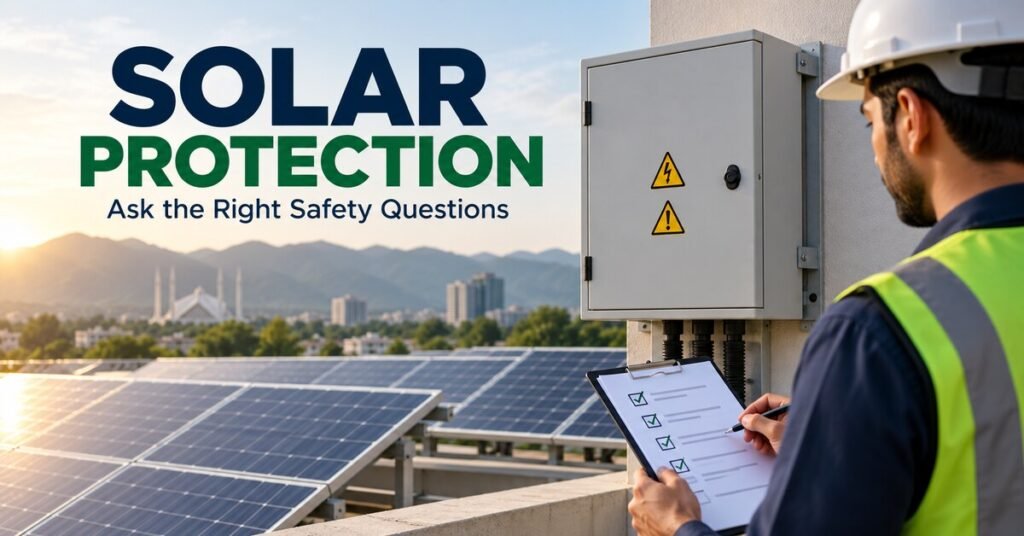
Small boxes, serious job
Ask a new solar owner to name their system’s components and you will hear “panels” and “inverter”. Almost nobody mentions the grey boxes mounted beside them — the DC isolators, breakers and surge devices. Yet these unglamorous components are what let a technician safely service your array, what disconnect a fault before it becomes a fire, and what stand between a lightning surge and your expensive inverter. This checklist helps you, the homeowner, verify that the protection side of your installation was actually designed — not just assumed.
First: isolation is not the same as protection
People use “protection” loosely. In a solar installation, several different devices do several different jobs:
- DC isolator (disconnect switch): a manual switch that lets someone safely isolate the panel array from the inverter for maintenance. It does not trip on faults by itself.
- DC circuit breaker or fuse: interrupts overcurrent faults automatically.
- Surge protection device (SPD): diverts lightning-induced surges away from equipment. Particularly relevant in Pakistan’s monsoon season.
- Earthing/grounding: gives fault currents and surges a safe path to earth.
One device cannot do all of this. If your quotation has a single vague line reading “accessories” or “protection”, that is not a design — it is a hope. Ask the installer to name each device, its rating and its location on a system diagram.
The homeowner’s protection checklist
Work through these with your installer before installation day:
- Array isolation: Is there a DC isolator rated for the array’s actual voltage and current (not an AC switch repurposed)? Can it be locked in the off position?
- String fusing: Where multiple strings run in parallel, are fuses or breakers provided per string as the design requires?
- AC-side protection: Are properly rated AC breakers installed between inverter and distribution board?
- Surge protection: Are SPDs fitted on the DC side (and AC side where appropriate), with a documented earthing arrangement to carry surges away?
- Earthing: Are panel frames, mounting structure and equipment enclosures bonded to an earth electrode? What earth resistance was measured and recorded?
- Enclosures: Are the devices housed in weather-appropriate enclosures (IP-rated) with proper cable glands — not open boxes or twisted-tape joints?
- Labelling: Is every isolator and breaker clearly labelled so anyone can identify what it disconnects in an emergency?
- Documentation: Do you receive a single-line diagram, a component schedule and test results on handover? For the full handover documents and tests to request, see our solar system commissioning and handover checklist.
Red flags that should stop the job
AC-rated isolators used on DC circuits (DC arcs do not self-extinguish like AC arcs — this is a genuine fire risk); no SPD in a lightning-prone area; earth wire “connected” to a water pipe or simply not present; enclosures mounted where monsoon rain runs straight into them; and any installer who dismisses these questions as unnecessary. A professional welcomes them — each answer is documented proof of a proper job.
Keep the system safe year after year
Protection devices need periodic checks — put them on your maintenance routine.
What this costs (indicatively)
Proper DC protection — isolators, breakers, SPDs, earthing and enclosures — is a small fraction of total system cost, typically a low single-digit percentage as an indicative range. Any quotation that omits it to shave the headline price is selling you a system with no safety net. When comparing installers, a quote that itemises protection properly is worth more than a cheaper quote that hides it inside “accessories”. Equipment selection interacts with all of this — see our hybrid inverter guide for which protective functions modern inverters integrate and which still need external devices.
Understand your inverter’s built-in protection
Know what the inverter covers — and what still needs external devices.
Frequently asked questions
Can I just use a normal MCB as a DC isolator?
No. AC and DC switching duties differ fundamentally — a DC arc is harder to extinguish, so DC-rated devices are built differently. Using AC devices on DC solar circuits is a recognised fire hazard.
Do I really need surge protection?
In most of Pakistan, yes. Monsoon lightning is a real threat to inverters, and SPDs are inexpensive relative to the equipment they protect. At minimum, ask your installer to justify the decision either way in writing.
How often should protection devices be checked?
Include them in annual maintenance: check isolator operation, enclosure seals, cable glands and SPD status indicators. Our maintenance checklist covers the full routine.
Who is responsible if protection was never installed?
The installer who designed and commissioned the system. This is why you want the component schedule and diagram at handover — without documentation, accountability evaporates.