
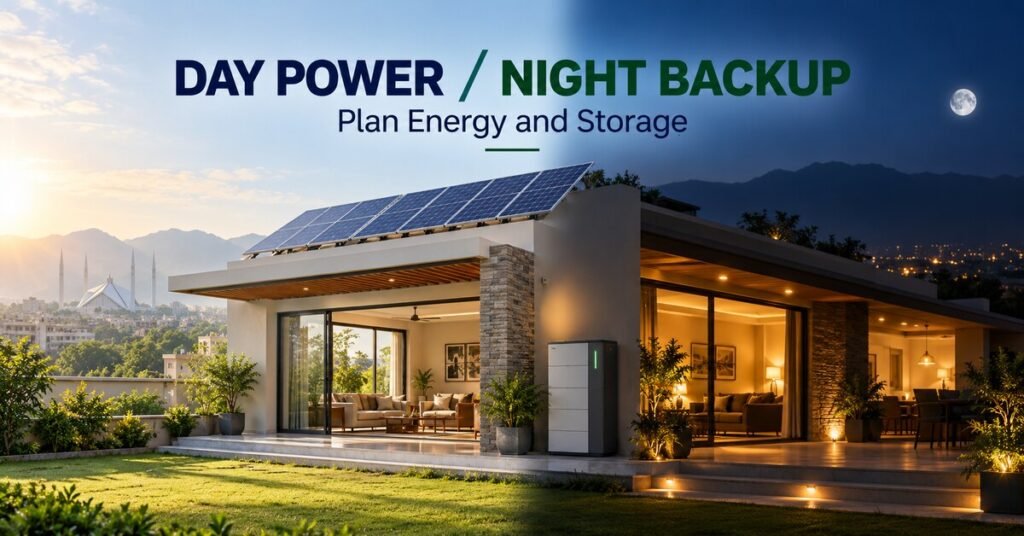
The single most expensive misunderstanding in home solar is treating “daytime savings” and “nighttime backup” as one plan. They are two different engineering jobs: one is about using sunshine while it shines, the other is about storing energy for when it does not. Size them together and you will either overpay for batteries you never cycle or — more commonly — discover your “5kW system” cannot run two fans through the night.
Plan 1: daytime — use the sun while it shines
Daytime planning is about matching consumption to generation hour by hour. List what runs between roughly 9am and 4pm: water pump, washing machine, iron, air conditioner, office equipment. These are your golden loads — every unit they consume directly from the panels is a unit you do not buy from the grid and do not need to store. The practical move is load shifting: run the washing machine at 11am instead of 8pm, pump water at midday, pre-cool rooms before evening. A family that shifts just its pump, washer and iron to solar hours can cut grid imports dramatically without adding a single battery. When you size your system, the daytime plan sets the array size: enough panels to cover simultaneous midday loads with headroom for cloudy spells.
Plan 2: nighttime — pick circuits, then size storage
Nighttime planning starts from the opposite end: which circuits must survive load shedding, and for how long? Be ruthless — whole-house backup through the night needs an enormous, expensive battery bank. Most households do well protecting 4–6 circuits: bedroom fans and lights, the Wi-Fi router, phone charging, and perhaps the refrigerator. Write down each backup load’s watts and the hours it must run, then convert to energy: four 75W fans for 6 hours is 1.8kWh; add lights, router and charging and you are near 2.5–3kWh of usable storage needed. Our battery backup-time calculator walks through this math. Size the battery for the backup plan, not for the daytime array — they are separate numbers.
Do the backup math before you buy batteries
Check whether the proposed storage actually covers your nights.
The battery mistake almost everyone makes
Batteries are sold in amp-hours (Ah), but your loads consume kilowatt-hours (kWh) — and only part of a battery’s capacity is usable. A 12V 100Ah battery stores 1.2kWh in theory; a lead-acid one should only be discharged to about 50% if you want it to last, giving ~0.6kWh usable. Four such batteries (a common 48V bank) give roughly 2.4kWh usable — enough for fans and lights for an evening, nowhere near enough for an air conditioner. Lithium batteries allow deeper discharge (80–90% usable) but cost more upfront. Read our solar battery buying guide before choosing chemistry, and never let a seller size your storage from the panel wattage — storage is sized from your nighttime load table, full stop.
Where net metering fits in
With net metering, daytime surplus is exported to the grid for credit instead of being wasted — which changes the daytime plan (oversizing the array slightly can pay) but does not change the nighttime plan at all. The grid does not send your exported units back during load shedding; only a battery does that. Many buyers hear “net metering” and assume backup is included. It is not. Decide separately: net metering for bill reduction, batteries for backup, and a hybrid inverter if you want both managed intelligently. Our system type comparison explains which architecture fits which goal.
Not sure which system type you need?
On-grid, off-grid or hybrid — match the architecture to your two plans.
Frequently asked questions
Can I add batteries later to a daytime-only system?
Yes — if the inverter is hybrid or battery-ready. A plain on-grid inverter cannot use batteries at all, so confirm the upgrade path before buying. Retrofitting batteries to the wrong inverter means replacing the inverter too.
How many fans can a 200Ah battery run?
It depends on voltage and chemistry, not Ah alone. A 12V 200Ah lead-acid battery holds ~2.4kWh, roughly 1.2kWh usable — about four 75W fans for 4 hours. Always convert to kWh before comparing.
Will solar run my AC at night?
Only with a very large battery bank — a 1.5-ton AC can consume 8–12kWh overnight, which needs several times the storage of a fan-and-lights setup. Most households run the AC on solar in daytime and accept grid or limited backup at night.
Is load shedding protection automatic?
Only if the system was designed for it: a hybrid inverter, a charged battery, and your essential loads wired to the backup output. A grid-tied system without batteries shuts down during outages for safety.