
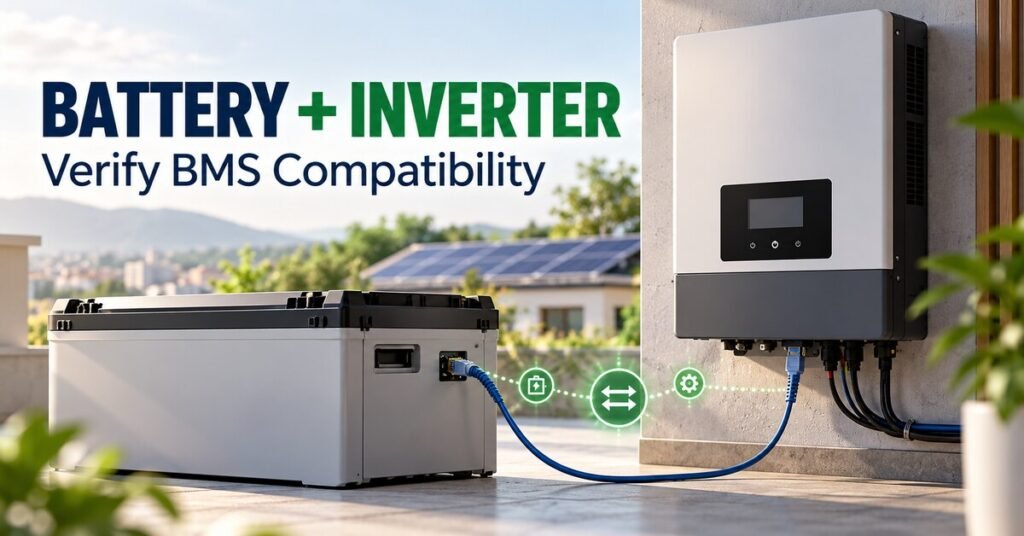
“48V hai, lag jayegi” — this single sentence has caused more dead lithium installations in Pakistan than any other. A lithium battery and an inverter can share the same nominal voltage and still refuse to work together, because the battery’s management system (BMS) and the inverter must agree on much more: charge voltages, current limits, communication language and what happens when the battery says stop. Get this wrong and you get nuisance tripping, a battery that never fully charges, or a warranty neither company will honour.
What the BMS actually controls
The Battery Management System is the battery’s brain and bodyguard. It continuously watches every cell’s voltage and temperature, balances charge between cells, and disconnects the battery — instantly — if anything goes outside safe limits: over-voltage, under-voltage, over-current, over-temperature. This protection is non-negotiable and automatic. The inverter must therefore treat the battery as a partner with strict rules, not as a dumb tank of energy. When the BMS cuts off discharge to protect the cells, the inverter must handle the sudden loss gracefully instead of faulting out. That choreography only works if the two devices were designed — or at least documented — to work together.
Voltage match is just the entry ticket
Both devices saying “48V” is necessary but far from sufficient. A “48V” lithium battery is typically 51.2V nominal (16 LiFePO₄ cells), charges to about 56–58V and must never be pushed beyond its documented maximum. Your inverter’s charger must be programmable to stay inside that window — many default lead-acid profiles charge too high or equalise, which lithium must never receive. Equally important are current limits: a 100Ah battery with a 100A BMS cannot be charged or discharged at 150A just because the inverter can deliver it. Check the battery’s maximum continuous charge and discharge current against what the inverter will actually demand at your loads. Mismatched current is the quiet killer — everything works until one hot afternoon the BMS trips and the house goes dark.
Closed-loop vs open-loop: do they actually talk?
The gold standard is closed-loop communication: the battery’s BMS talks to the inverter over CAN bus or RS-485, reporting state of charge, temperature and limits in real time, and the inverter adjusts charging accordingly. This needs a specific protocol both sides support — “supports lithium” on a brochure is meaningless; you need your exact battery model on the inverter’s compatibility list, or vice versa. Without that, systems run open-loop (voltage-based): the inverter guesses state of charge from voltage, which is notoriously inaccurate for lithium’s flat discharge curve. Open-loop can work acceptably with conservative settings, but expect less accurate battery gauges and more manual tuning. Ask the seller directly: “Is this pair on a written compatibility list, and will you configure closed-loop communication at commissioning?” A shrug is your answer.
Choose the battery with the full picture
Chemistry, capacity and compatibility — the complete battery guide.
The pre-purchase compatibility checklist
Before paying, confirm these six points in writing:
- Exact models on both sides — battery model and inverter model, including hardware/firmware revisions.
- A compatibility document — one manufacturer’s list naming the other, or a written statement from the seller accepting responsibility.
- Voltage windows overlap — the inverter’s battery voltage range must contain the battery’s full charge-to-cutoff range.
- Current limits respected — inverter max charge/discharge current at or below the BMS limits.
- Communication defined — which protocol, which cable, who configures it, and what the fallback settings are.
- Firmware plan — who updates what if a mismatch appears after installation, and at whose cost.
Also verify the warranty fine print: several battery brands void coverage if the battery is used with an unapproved inverter. That clause is where finger-pointing lives when things fail.
What failure looks like
Incompatible pairs rarely explode — they just misbehave in maddening ways. Typical symptoms: the system shuts down at 30% displayed charge (BMS hit its real limit while the inverter was guessing), the battery never reaches 100% (charge voltage set too low), random fault codes after a firmware update on one side, or the battery gauge stuck at full for hours. If you already own a mismatched pair, a competent installer can often stabilise it with conservative open-loop settings — but “often” is not “always”, and you should budget for the possibility that one component needs replacing. Prevention, as always, is cheaper: pair from a compatibility list, or buy battery and inverter from the same seller as a tested combination.
Match it with the right inverter
Hybrid inverters and the battery features that matter.
Frequently asked questions
Can I use a lithium battery with my old UPS/inverter?
Only if its charger can be set to lithium-safe voltages with no equalisation, and the currents suit the BMS. Most old UPS units cannot — check the manual or assume no.
Does the BMS make the battery maintenance-free?
Electrically self-protecting, yes; fit-and-forget, no. Terminals, ventilation, firmware and mounting still need attention per the manual. And “maintenance-free” never means “compatible with anything”.
What is the safest lithium chemistry for home solar?
LiFePO₄ (lithium iron phosphate) is the standard for home storage: thermally stable, long-lived and well supported by hybrid inverters in Pakistan. Check any unfamiliar chemistry against your inverter’s list.
How do I check my backup time with a new lithium bank?
Convert the bank to usable kWh (nominal voltage × Ah × usable depth of discharge), then divide by your backup load in kW. Our backup-time calculator does the arithmetic for you.