The invisible tax on your solar system
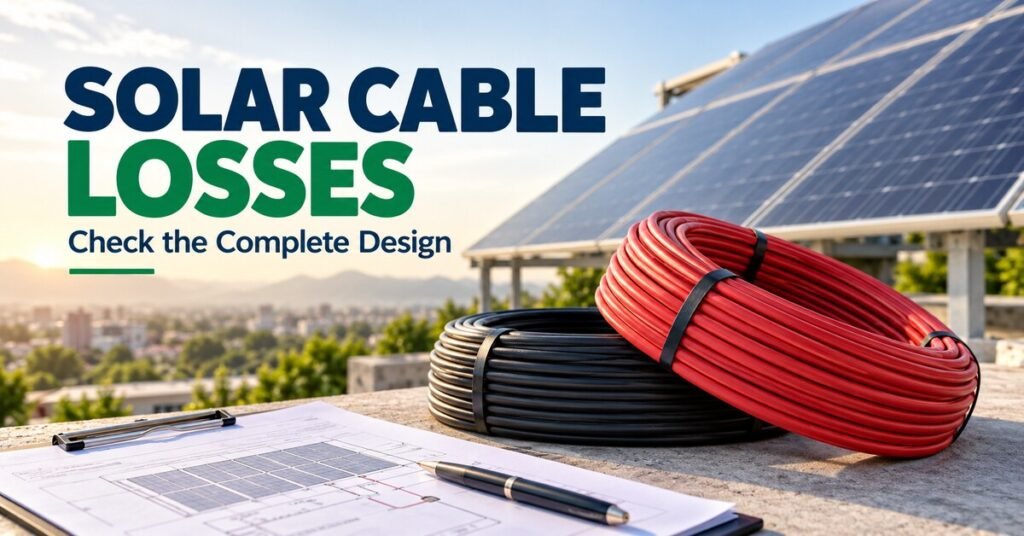
Every metre of cable between your panels and your inverter quietly takes a cut of your electricity. That cut is called voltage drop: as current flows through a wire’s natural resistance, a small part of the voltage is lost along the way and turns into heat. On a well-designed system the loss is tiny — 1 to 2 percent. On a system where the installer saved money with thin cables or long, wandering routes, it can reach 5 percent or more. That is 5 percent of your expensive panels’ output vanishing into warm wires, every sunny day, for 25 years.
You do not need an electrical engineering degree to protect yourself. You need to know which questions to ask before the cables go up — because once they are clipped to the roof and buried in conduit, nobody is coming back to upgrade them.
Where voltage drop bites hardest
Not all cables in your system are equal. Three rules decide where losses hurt most:
- Low voltage + high current = big losses. A 48V battery bank delivering 3kW carries roughly 60+ amps — the same power at 220V AC carries under 14 amps. Battery cables are therefore the most sensitive to undersizing, even over short distances.
- Long DC runs from roof to inverter. If your inverter sits in the basement and your panels are three floors up, the DC cable run can easily exceed 25–30 metres. Every extra metre adds resistance.
- Thin conductors. Cable cross-section (measured in mm²) is the main lever: double the cross-section and you roughly halve the resistance. This is exactly where cheap installers cut corners, because thicker copper costs more.
Questions to ask your installer — before signing
Put these to every installer who quotes you, and compare the answers:
- “What cable size (mm²) are you using for the DC run, the AC connection and the battery bank?” Vague answers like “heavy-duty” or “good quality” are not answers. You want numbers.
- “How long is the actual cable route?” Ask them to walk the route — around parapets, down risers, to the inverter position — not measure a straight line on Google Maps. Bends and obstacles add metres.
- “What is the calculated voltage drop on each run?” A competent designer has done this calculation. As a rule of thumb, DC runs should stay under about 2–3% drop and AC runs under about 2%.
- “Are the cables solar-rated (UV-resistant) for the outdoor sections?” Ordinary PVC cable degrades in Pakistani sunlight within a few years; proper solar DC cable is built for it.
- “What connectors are you using, and are they matched pairs?” MC4-style connectors from different manufacturers may physically fit together but are not certified as a pair — mismatched pairs are a known cause of overheating and even fires.
Red flags in a quotation
Watch for these warning signs: a single line item saying “wiring and accessories” with no cable sizes, lengths or types; DC and AC cable treated as one vague entry; no mention of UV-rated cable for the roof; or a price dramatically lower than competing quotes — the saving often came straight out of the copper. Our system-type guide helps you understand which circuits your chosen setup actually needs, so you can check nothing was omitted.
Check your full quotation line by line
Cabling is one of several places installers hide savings — review the whole quote.
Why you should not “fix” this yourself later
Voltage drop tempts DIY thinking — thicker cable looks like a simple swap. It is not. DC circuits on a solar array operate at hundreds of volts and remain live whenever light hits the panels, even with the inverter switched off. Re-terminating connectors incorrectly creates arc faults. Leave cable work to qualified personnel, and never open live enclosures or disconnect PV wiring to investigate losses yourself. Your job is to ask the right questions upfront; the installer’s job is to answer them with numbers.
Getting the electrical design right also interacts with equipment choice — see our hybrid inverter guide for how inverter placement and input limits affect the whole layout.
Planning your system size?
Correct sizing keeps currents — and cable losses — within sensible limits.
Frequently asked questions
What is an acceptable voltage drop for solar cables?
As a widely used design target, keep DC array runs under roughly 2–3% and AC runs under roughly 2%. These are design guidelines, not guarantees — the exact requirement depends on equipment manuals and applicable electrical rules.
Can thin cables damage my inverter or panels?
Thin cables mainly waste energy as heat, but severely undersized cables can overheat, melt insulation and, in the worst case, start fires — particularly at poor connections. This is a safety issue, not just an efficiency one.
Does cable length really matter that much?
Yes. Resistance grows with every metre, and losses grow with the square of the current. A long, thin run on a high-current battery circuit is the worst combination — short, thick runs are always preferable.
Should the DC cable be different from normal electrical wire?
Yes. Outdoor DC solar cable needs UV-resistant insulation, a higher voltage rating (often 1,500V DC systems), and proper temperature ratings for rooftop heat. Standard indoor PVC wire is not a substitute.